Sunday, 14 November 2010

Gyotaku

Gyotaku

or

The Art and Technique of the Japanese Fish Print

(and now my print loving friends: something quite different)

When I bought this little print on Ebay for a few dollars I had no idea what it was. And I had no idea what a mysterious and unknown world would be revealed to me. Printing from Nature is as old as mankind. Artistic examples are known from 13th century China.
Everybody who has dried flowers and leafs pressed between (news) papers at some moment will have seen lucky impressions staying behind.
Googling one can find hundreds of examples of prints made by amateurs. But after a while everyone is perfecting his/her skills to be a specialist in this art form. Like the ones above by artists Lori Hatch and Jack Schwartz. These are definitely no lucky impressions.


All literature on the subject of Gyotaku started with this little book. Like Frank Morley Fletcher wrote his standard book on woodblock printing (see recent postings by “Modern Printmakers” and “Art and the Aesthete”, the links are on the opening page of this Blog), Yoshio Hiyama wrote his on Gyotaku. In 1964. Professor of Fisheries Biology at the University of Tokyo he was the founder of Gyotaku-no-kai (Association of Fish printing). Printing tools and materials very similar to a woodblock printing workshop. Except for the wood carving knifes. Kitchen knives are used after printing is done in this art form


Gyotaku or fish rubbing is a relatively new art form. It supposedly originated from Japanese fishermen who, making an impression with ink on paper of the fishes each caught, could later divide the catch or profits of the sale. A simple way of direct book keeping.

The wonderful little book is easily found (www.bookfinder.com) when interested. It is a simple and complete manual for beginners, 65 pages and many wonderful prints. Once you see the beauty of it the possibilities seem endless. Plants, stones (stone rubbing a popular Chinese variation), beach findings, shells, crabs, shrimp etc..

The Printers Catch, an Artist’s Guide to Pacific Coast Edible Marine Animals (1985), by Christopher M. de Wees, Marine biologist and American Gyotaku pioneer. The title suggesting eating your studio models afterwards is a great way to create art, have fun and have a nice meal in the end. Print it and eat it. Many wonderful prints and there is a manual inside to get started as well.

Gyotaku Fish Impressions (above) by Doug Olander (1994), who’s colorful impressions brought fish printing to another, higher level.
Antarctic Fishes, illustrated by Boshu Nagase (2006), the nestor of the Gyotaku printers, and text by Marine biologists Professors Mitsuo Fukuchi and Harvey J. Marchant. Using the Gyotaku fish printing method to illustrate this scientific publication. 130 pages of wonderful and strange fish printed in full color by the Master of fish print Boshu Nagase. A huge, scholarly and massive coffee table book (still) for sale at Amazon. Available "used" for an unbelievable 12 US bucks !


To close off, these two great compositions by wonderfull artist Jean Kigel showing this art form is still evolving from a simple method of keeping book into great art. Please take in mind that only one fish is needed for making compositions on a grand scale. Visit ! You will be amazed by some of here Chinese watercolors too.

And now my friends, Onwards, armed with ink, printing paper and recipe books, on to the market place !

I hope all wonderful artists will not have any objections of their work displayed in this Blog. Here are their www connections:

Jean Kigel: www.jeankigel.com

Lori Hatch:
www.lorihatch.com/

Jack Schwartz:
www.jaxsfishprints.com

Barry Singer:
www.gyotakuartist.com


This long planned posting on Gyotaku took me the best part of a rainy sunday to create. Leaving your comment after reading would be very much appriciated.

Gerrit Willem Dijsselhof: Artis Aquarium


Gerrit Willem Dijsselhof
(1866 – 1924)

Dutch painter, decorative artist, designer.


Gerrit Dijsselhof was one of the most important artists in the Duth Arts and Crafts period and is considered the founder of the Nieuwe Kunst (New Art) in the Netherlands.

Sea Anemones

He was trained in the Academy of Figurative Art in the Haque 1882-1884 and later attended the Amsterdam Arts and Crafts school 1884-1886. He was educated to become an all round artist in painting, batik, textiles and furniture design, glasswork and book illustrations.

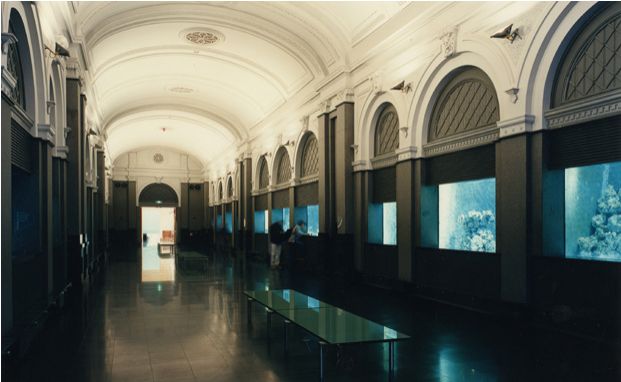
Dijsselhof started his career as a painter of landscapes but in particular of fishes and sea creatures in the Amsterdam Artis Zoo aquarium. Making his sketches in pencil and watercolor in the corridors only dimly lit by the filtered lights from the aquariums he must have met Jan Voerman Jr. and Adriaan van’t Hoff, artist appearing in the two preceding postings . They also found inspiration in the Zoo Aquarium and the mysterious underwater world displayed there. Artis Zoo Aquarium opened in 1882 (see recent previous postings).


All his life Dijsselhof stayed dedicated transforming his aquarium sketches into these wonderful dreamy oil paintings. I have found some 40 examples in museum and auction cataloques. Their has never been a book or exposition on his work. I show you 10 of my most favorite here.

These timeless and dreamy painting have always been very in demand. The way he was able to imitate the silent world with soft light in this impressionistic style makes him quite unique among contemporary artist and fellow painters


Later Dijsselhof developed into a Dutch equivalent of Scottish Charles Rennie MacKintosh ( 1868 – 1928). Without the professional architectural background, but designing furniture, lamps and even complete interiors.
His work is represented in many Dutch museums and in the Hague a complete room designed by him saved, restored and rebuild in 1935 in the local communal museum.


This posting concludes three postings on 3 contemporary artists that were inspired by the Artis Zoo Aquarium and played all three an important role in Dutch art (Art Nouveau, Art Deco, Arts and Crafts) Nieuwe Kunst) in the first quarter of the twentieth century.

Friday, 29 October 2010

Adriaan Johannes van't Hoff


Adriaan Johannes van’t Hoff
(1893-1939)

Painter, watercolor, grafic and poster artist.


Well known Dutch Arts and Crafts artist. Famous and loved for his travel Posters and drawings and etchings of animals, particularly birds.

Van't Hoff studied in the Academy of Figurative Art in the Hague (Netherlands) and became one of the best loved and famed artists in the beginning of the 20th century. His work strongly influenced by Art Deco and Jugendstil motifs.

The reason I show him here is was a regular visitor, like Jac. Koeman and Gerrit Dijsselhof of the Amsterdam Aquarium. It is a part of Artis Zoo one of the oldest in the world (1836).
In the Netherlands poster art never developped like in England in an individual art form. English Train, Travel, Zoo and Underground posters ofcourse worldfamous and very collectable. This 1920's one (by Lindenberg) a nice exeption. Zoo's in the Netherlands in heavy financial weather these days.


The Artis Aquarium was esthablished in 1882. The Verkade pictures album of 1925 was illustrated by Koeman and written by veterinian Anton.F.J. Portielje (1886-1965) who was the appointed "inspector of all living creatures in Artis Zoo".
These are two of Hoff's Aquarium renderings, made in the Artis Aquarium.


and two examples of his posters.

Thursday, 28 October 2010

Jac. J Koeman and the Artis Zoo Aquarium

Jacobus Jan Koeman
(Edam 1889- Bergen 1978)

Landscape and flower painter, watercolor, grafic and ceramic artist, sculptor.


Jac. Koeman attended the Kunstnijverheids (Arts and Craft) school in Amsterdam and worked in Paris and London. He is in the Netherlands most famous because of his wonderful and unforgettable illustrations of many Verkade albums (see posting of September 20th or use the Blogs search options above). Making him a colleague of father and son Jan Voerman.


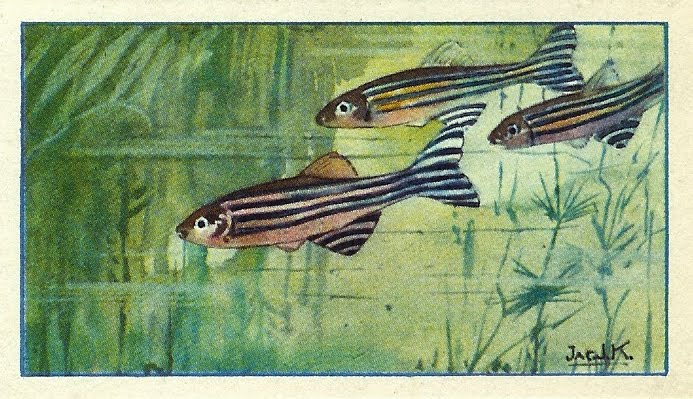
His paintings, lithographs, pastels and watercolors pictures of tropical fish are unequalled but by maybe one artist in the world: Gerrit Dijsselhof (1866-1924). These artistic renderings and compositions far more capable of catching and transferring the atmosphere then (even modern) photography can ever hope to achieve. When I saw Koemans school of fish as a child there was no way stopping me wanting to create such a wonderful and mystic world for myself. And I did.


Dozens of these little jewels litter the pages of the Aquarium Volume of 1925.


Both artists found inspiration in the beginning of the 20th century world famous Artis Aquarium (Amsterdam Zoo). It is still a wonderful place to be. When ever I visit a city I just have to pay a visit the local Zoo Aquarium.


1930's pastel by P. Zwart, an unknown artist.


Moonfish, 1930's pastel by Alb. Schram an also very obscured artist but with lots of talent.


I cannot resist these terribly out of fashion pastels, I love them every day I see them even more.

Jac J. Koeman will return in postings to come since I plan showing more examples of the wonderful Verkade Album Art (1905-1940), hardly known outside the Netherlands.

Postings on Gerard Dijsselhof (1866-1924) are in preparation and will follow soon.

Please let me know what you think of this and other postings by leaving a comment.

Frans Willem Hartsuijker


Frans Willem (Fred) Hartsuijker

(Amsterdam 1896-Utrecht 1991)

Dutch painter

I told you ! I like Nasturtiums, here is a lovely pastel by artist Fred Hartsuijker. A fleemarket find. Not much is known about the man, not many pictures around. I found just this one below. From an auction catalogue and it's quite nice. The soft (pastel) colors giving it a warm, kind of 1950's retro feel. It's a very Dutch view on the Loosdrechtse Plassen (Lake Loosdrecht) near Utrecht were all Dutch learned how to sail.


Alberta Johanna Meijer Smetz


Alberta Johanna Meijer-Smetz
(1893-1953)

Dutch flower and stillife painter, illustrator and etcher.

Alberta entered the Rijksacademie in Amsterdam and took drawing and painting lessons. She later married one of her teachers the painter Johannes Meyer (1875-1970).
She painted mainly flowers, and how well she did. This lovely little Nasturtiums in a ginger jar was my first acquaintance with Alberta Smetz collecting pictures and examples of Nasturtiums in paintings and printings in the Arts and Crafts period. She and her husband became members of the Laren art colony. They lived in Blaricum.
As often, once interested I shortly after found these poppies in a blue vase on a local market and recognized the maker. It's a gouache with a beautiful of the period but damaged frame which I patiently repaired.

Alberta illustrated and designed catalogues for florists (bread and butter) and also made the pictures for this 1930�s album-book to be filled with pictures. This time not collected by eating biscuits, like the famous Verkade albums (see posting of sept. 20th) but drinking coffee and tea. Like the Verkade albums it is stacked with great pictures like this nasturtiums I found inside.

A printed copy of a gouache. I love nasturtiums and these are just great. Good enough to award and honour Alberta Smetz with a small posting.