Friday, 4 November 2016

Florence Lundborg, an American printmaker in Europe.

A recent posting in the Blue Lantern, acting as a teaser, revealed this printmaker to me:


Florence Lundborg

American (1871–1949)


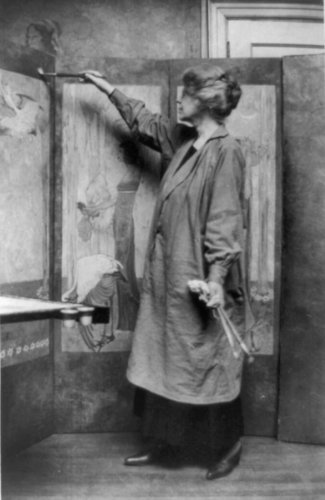
Noted painter, illustrator and muralist Florence Lundborg was born in San Francisco, California in 1871. She studied with Arthur Mathews (1860-1945) at San Francisco School of Design and (like Mathews) went to Paris to study with James Abbot McNeill Whistler (1834-1903). See the before post: Charlotte Popert in Rome, she also was a friend of Whistler. 


Lundborg’s reputation as a muralist was confirmed when she won a bronze medal at the Panama Pacific International Exposition in San Francisco in 1915. Shortly after, she moved to New York where she gained recognition as an illustrator of such books as, “The Rubaiyat”, “Yosemite Legends” and “Odes and Sonnets”.

She produced many posters, influenced by art nouveau and the arts & crafts movement of the early 1900s. Lundborg cut her own woodblocks for her posters and produced seven posters, as such, for “The Lark”, a literary and humor magazine to which she also contributed articles and cover illustrations. She received commissions to paint murals in private homes in Portland, Chicago, New York and San Francisco.


And I suppose its is not unthinkable she was acquainted with the works of (Sir) Lawrence Adema-Tadema (1836-1912) who regularly visited Rome and Pompei. The spectacular use of perspective in Tadema's 1895 "Coign of Vantage" has similarities with Lundburgs illustration for "Yosemite legends" by Bertha Smith (1872-1922).


All pictures borrowed freely from the Internet for friendly, educational and non commercial use only.

Text/Biography copied and borrowed freely from:

Wednesday, 2 November 2016

Marie Hager, unexpected Mecklenburg printmaker 1919

The never ending research into the lives of forgotten and obscured first generation german printmaking women artists today leads to Marie Hager. I found her in a 1919 catalogue.  


Hager, Marie 

(Penzlin in Mecklenburg 20-03-1872 – 25-04-1947 Burg Stargare in Mecklenburg)

Post-Impressionist landscape and architectural painter and printmaker.


Known from 320 paintings but as printmaker by just this one woodblock print represented in the woodblock section of a 1919 Lissner and Wohlgemut Grafik Katalog with an introduction by Berlin art dealer, collector and galerist Fritz Gurlitt (1854-1893). Other printmaking women represented besides Alexander Brendel: Helene Isenbart, Helene Mass, Anna Bähker, Helene Frauendorfer-Muhltaler.

Below Wismar harbour (near Lübeck) Ostsee. 


Daughter of pastor Adolf Hager (1836-1923). She grew up in Dargun Mecklenburg where her father was “Probst” (comparable with archdeacon). She started musical studies as a singer in Hamburg but switched to painting studying 1904 with Berlin Secessionst and professor in Berlin Academy Max Uth (1863-1914) who had been a student of Eugen Bracht (1842-1921) in Berlin and by Bracht himself and also with impressionist Hans Licht (1876-1935) and Ernst Kolbe (1876-1945). Both had been also Bracht students. 

Below: Poel Island near Wismar, Ostsee. 


She exhibited for the first time 1910 in Hannover and in 1911 in Berlin regularly represented in exhibitions in Germany (Munich, Hamburg, Berlin) and in Paris. Through her teachers she became familiar with the village of Stargard where they lead summer painting classes (“Stargarder Malschule”) and where she had a house build in 1921. 


After her death she left the house, paintings, collections etc. to a niece who donated it to the city of Burg Stargard. Known as the “Marie Hager Haus” it is managed by the “Marie Hager Kunstverein Burg Stargard” arranging exhibitions and visits.

Marie Hagens house in Burg Stargard. 


Dresslers KHB 1921 & 1930: Stargard im Mecklenburg. Member VdK 1913-1940, exh. 1928/29, 1934.


All pictures borrowed freely from the Internet for friendly, educational and non commercial use only. 

Sunday, 30 October 2016

More Japan from Rome.

Orlik self portrait
Meeting Charlotte Popert in Rome in last posting I wondered where she could have picked up her interest in Japanese subjects. Emil Orlik wasn't a bad gamble. 

In the 1890 however Max Klinger (1857-1920), who shared with Orlik his early fascination for printmaking the Japanese way owned 1883-1893 a studio in Rome. Orlik etched and sketched his colleague and friend (above). 

Greiner by Klinger 
Otto Greiner (1869-1916) studied in Rome with Klinger and 1898-1915 worked in Klingers former studio. This Odysseus and the Sirens is one of my favorite paintings by Greiner, with the known powerful anatomical study's for this work. I do not know of the whereabouts of this painting today. 


And what about his dancing witches ...............


There obviously was a flourishing German artist community in Rome. When 1915 Italy joined France and England they were forced to leave and were expelled.

----------------------------


And then I discovered this wonderful etching ("Japanerin" created in Rome 1914) to my surprise by Greiners and Klingers friend Erich Wolfsfeld (1884-1956 London). He also lived and worked in Rome 1908-1909. And: from 1916 he taught (with Orlik !) in Berlin Gewerbemuseum School. 


He was a painter, etcher and studied 1904 at Berlin Academy of Arts drawing with Konrad Böse (1852-1938), a follower of Adolph von Menzel (1815-1905), and etching with Hans Meyer (1846-1919). 
Wolfsfeld selfportrait 
He completed his studies with Jules Lefèbvre (1834-1912) at the Académie Julian in Paris in 1906, and between 1908 and 1909 lived and worked in Rome, where he befriended other expatriate German artists such as Otto Greiner (1869-1916) and Max Klinger (1857-1920) producing a number of large etchings of nudes and Roman beggars.


He won a gold medal for an etching entitled The Archers in Berlin 1910 clearly showing what a great drawer he was and the influence of Klinger and Greiner. 


From 1916 he taught in Berlin “Staatlichen Unterrichtsanstalt des Kunstgewerbe museums“ and from 1920 as professor of painting and etching. In 1924 the school fused into “Vereinigten Staatsschulen für Freie und Angewandte Kunst” lead by Bruno Paul (1874-1968). Emil Orlik (1870-1932) was appointed in this school 1905 and worked there until his death !


There's much more to tell about Wolfsfeld, he married beautiful Illa Fackenheim (1914-2010), a dancer 30 years his younger. As Jews the managed to escape Nazi's persecution   and fled to England where he became a well known and respected portrait painter.

All pictures borrowed freely from the internet for friendly, educational and non commercial use only.

Tuesday, 25 October 2016

Charlotte Popert: in Rome

Here's another wonderful forgotten artist that emerged from history along my research into the lives of pioneering printmaking German ladies. Although she was not involved in any woodblock printmaking to my knowledge she exhibited in Munich in 1904 with several well known woman printmakers. 


And although there're hardly any surviving examples of her work accesable I managed to dig up some. Help me by sending more examples of her work or their whereabouts . But most intriguing is the short biography I put together from (translated) scraps, bits and pieces, genealogical research etc.. that I 've included in my index.  


Among the few etchings is this great example of two traditional dressed Japanese women in a hair styling ritual. But in this years, in Germany, who  other then Emil Orlik will have been responsible for the choice or inspiration of her subject. If I only knew how .....


Orlik no doubt was also a source of inspiration for Erich Wolfsfeld (1884-1957) who also taught in the same Institute as Orlik but I will tell you about him later. He never travelled to Japan but rose to great fame later because of his North Africa trips and related paintings and etchings. But now I'm wandering of my track.  

 
Anyway: enjoy the following biography illustrated with some finds. 


Popert, Charlotte 
(Hamburg 01-03-1848 – 01-03-1918 Rome)

Jewish painter and graphic artist. Daughter of prosperous Hamburg leather merchant Joseph Meyer Popert (1797-1868) and Emma Vidal Rothschild (1811-1866). 

While living in Rome she was much appraised by Ludwig Pollack, director of “Museo Barracco di Scultura Antica” in Rome.

This Popert family (originating from the city of Boppard near Koblenz) was living in Hamburg since the early 18th century resulting in building and running a flourishing and well respected trade bank and becoming very, very wealthy. In the early 19th century the sons of banker Meyer Wolf Popert (1763-1812) were all successful in Hamburg trade and commerce while the bank eventually went bankrupt. Joseph’s brother, Charlotte's uncle, Wolf Meyer Popert (1795-1846) was a famous chess-player playing in London against the world’s finest players. Joseph, Charlotte’s father, learned the tanning business probably in Scandinavia.

Charlotte’s niece Anna Brinckmann (1846 – after 1903) married sculptor Joseph (von) Kopf (1827-1903 Rome). Anna Brinckmann’s mother Anna Theresa Popert was  Charlotte’s father sister. Their daughter, Martha Kopf (b. Rome 1870) married sculptor Hugo Berwald (1863-1937). He was the brother of William Henry Berwald (1864-1948) the composer.

Afbeeldingsresultaat voor heinrich heine

Salomon Heine (1767-1844). His mother was Mathilde Martha Eva Popert (1739-1799), dr. of Meyer Samson Popert and Fromet Hekscher). Although also from a banking and trading family he came to Hamburg in 1784 pennyless and learned the banking business inside the Hamburg Popert bank. He grew immensely rich, earning his knickname “Rotschildt of Hamburg” and was a great philanthropist and patron to the arts to the city of Hamburg. He happened to be the uncle of Germany’s foremost poet Heinrich Heine (1797-1856), above, who was promoted by his uncle and by Joseph Meyer Popert, Charlotte’s father, who was also but more distantly related to the  Great Poet.    


Ludwig Pollak (Prague 14 September 1868, Prague – 1943 Auschwitz) was an Austro-Czech classical archaeologist, antiquities dealer, and director of the Museo Barracco di Scultura Antica in Rome. He is perhaps best known for discovering in 1906 the missing right arm of Laocoön in the famous ancient Roman sculpture Laocoön and his sons.


She studied in Weimar “Fürsterliche freien Zeichenschule” with painter etcher Friedrich Preller (the elder) (1804-1878). Then she studied in Düsseldorf, Paris and visiting Rome in 1778 meeting and falling in love with Ligurian painter Nicolò Barabino (1832-1891) with whom she travelled to London. After his death she settled in Rome in the 1890’s where she met and became close friends with John Singer Sargent (1856-1925) of whom she owned several painting and painter Pio Joris (1843-1922). 


Wealthy by birth she had build a tasteful villa at the “Lungotevere Arnolda da Brescia” what became a meeting place for artists. She travelled twice to Sardinia (1899 – 1900) and to the Isle of Capri (1896) staying at the villa of German painter Christian Wilhelm Allers (1857-1915). 


She was a meacenas to the arts and a philantrope to the sick and the poor and visited Queen consort Margaretha of Savoye (1851- 1926) who had been interested in a series (port folio) of etchings made after a trip to Sardinia. She created the etched portraits of both King Umberto-I of Savoye (1844-1900) and his wife. During WW1 she was forced to leave Italy (1915), her house, collections and work were seized and confiscated. 


She wrote an eye-whitness account (privatly published 1915 in Hamburg) of the misery of the war rufugees in East-Prussia. After the war ended she returned to Italy in 1918 staying in the studio of Pio Joris. It is said she died of a broken heart soon after in 1918. Part of her collections were assimilated in the collections of the National Opera in Rome.


Not known by woodblock prints but she is represented with 4 etching (among which are portraits of “Fürst Bismarck”, “Crispi” and “professor Joseph von Kopf” ) + the Sardinia port folio containing 10 etchings and a program with some 60 female and 85 male graphic artists in the important 1904 “Catalog of etchings, engravings and lithographs (chiefly German but including work by Austrian, Swiss, Dutch and English artists)” by Reinhard Piper, Munich 

--------------------------

All pictures borrowed freely from the internet for friendly, educational and non commercial use only.