Showing posts with label Paulus Potter. Show all posts

Tuesday, 5 June 2012

Sijctghen (1627-1650)


Sijctghen (*1627- † 23/10-1650)
(portrait 1647)

From Paulus Potters’ etchings of cows (before posting) to his colleague Albert Cuyp (1620-1722) isn’t a big leap. They were contemporaries, both renowned Dutch landscape and animal painters. Both famous in their lifetime. Doing my best giving at least the impression of a logic and coherent build-up of my Blogging endeavours, here goes.
 Cows etchings and drawings by Albert Cuyp. Compared with similar works by contemporaries like Paulus Potter, Karel Dujardin and Nicolaes Berchem they appear very "modern". 

You’ll find his sketches and prints used and worked into his and others' paintings: National Museum stuff. His Dutch landscape paintings are as famous as the 17th century Dutch landscape are itself.  Carefully arranged cows and other cattle. Bucolic and panoramic river views of cities and arcadisch landscapes stretching endlessly beneath famous and dramatic “Dutch skies”. The Golden Age of Landscape painting.

But the portrait of Sijctghen the Duck is an altogether other story. Its owner probably commissioned the painting for her 20th birthday. Which was already pretty remarkably old for a duck, even a tame one.  He was no doubt one rich and proud farmer. Click here to find a 1Mb picture of the painting. Sijctghen was a production duck. Laying 100 eggs each year in her long life, as she proudly claimes. Her biography is told, by her self, in the form of a poem painted left in the painting in a beautiful handwrighting. She is telling us about her virtuous and productive life, that she never mated, lived her life in chastity, virtue and servitude. The life of a nun. A sanctimonious message ordered by her owner perhaps, the commissoner, her jailer? Had she only be free. Have you ever seen free ducks "at it" in spring ?
She tells us also she survived and healed from broken legs. Probably describing “the treatment” undergone in her youth preventing her ever to fly (away). The fact she never mated is maybe giving another clue because these production ducks were kept in the pen and no sooner they've laid their eggs in the morning they were fed and freed keeping them more or less farm bound. All over Europe, ownership tagged in the bill or flippers. Eggs were sold to bakers, sometimes even as far away as London. These ducks often wandered about and are known to have mated with wild ducks. Today their tame genes are spread in every begging bread-fed duck in the park all over Europe.
No males around meaning she maybe was kept in a closed aviary just with other nuns. Sijctghen asks the poem to be finished after her death. It was. She came into this world the year the population of nearby city of Delft was decimated by the Plaque and she met her maker on the 27th day of October 1650, aged 23. Using chickens for mass egg production came into fashion centuries later after the discovery of the causes of salmonella and paratyphoid spreading.

This sentimental and moving portrait is all the more remarkable if you see what Cuyp was otherwise world famous for. Like this View on Dordrecht, his native city. Abraham van Calreat (1642-1722), probably a pupil of Cuyp, and the 17th century specialist in painting horses, whom’s paintings sometimes were mistaken for Cuyp’s because he used the monogram A.C., is winking at us even after 400 years. He was born and lived in the same city of Dordrecht. He shows Syctghen, the subject of his teachers unique painting, in this horse painting. Maybe it was commissioned by the same no doubt wealthy owner.
But now the good news. Sijctghen is alive! I’ve found her, her family, her genes and even her reincarnation.
Believe it or not she's reappeared and German painter Alexander Koester (1865-1932) is my witness. All he ever did was painting ducks. And more ducks. Probably the same flock of ducks over and over again. He became so good at it he earned a gold medal in America. In St. Louis' World Fair of 1904..... and was nicknamed “Enten Koester” (Duck Koestner). He’s truly the Renoir of duck painting. In the end all he needed was a few brush strokes of paint to create a life duck. A true impressionist magician. And I have one, a genuine Duck Koester. Syctghen probably afterall did lose her virginity. Somewhere between 1647 and 1650 because here, her likeness, her great-great-great-granddaughter is swimming, lower right.  
Found in a recent car boot I ofcourse realize it’s not an oil painting, it’s a very nice 1930’s quality reproduction. But who cares, try finding one. To know what you must be looking for I'll intend showing  you some serious duck painting by Duck Koester in next posting. 

Sunday, 3 June 2012

Pissing at the moon, an update


Today an update on the research and posting on the "pissing cow". I now think I’ve found the original source of the stream. Potters etching of the pissing cow was edited in 1650 in a small collection of 8 small etchings named "het Bullenboekje" (the bull booklet.) Potter wasn't the only Dutch Golden Age painter creating these small pastoral designs and etchings for bread and butter. Affordable art in contrast to his paintings which were Kings and Queens stuff even before the paint was dry. But Potters designs were copied und used the most. By himself in his paintings and by many other artist even during his short lifetime. He died 28 of tuberculosis, a desease often transmitted by .... cows.
With his booklet Potter followed the example of Italian painter Antonio Tempesta (1555-1630) before him. He edited likewise such a design booklet in 1600. It was also used by Rembrandt. Here are Potters original 8 etching of 1650. I couldn't find a site showing these little gems together (They are also in the book, below)


Juts recently I discovered that Potter, in the year before, painted his most elaborate, admired as soon it was ready, and complex work on commission for Princes Amalia van Solms (1602-1675). She was the widow of reigning Prince Frederik Hendrik of Orange (1584-1646) of the Netherlands. In 1649. The painting was supposed to decorate one of the chimney-walls in the same house that her royal descendant (12 generations later), our Queen Beatrix,  today calls her home: the Noordeinde Palace in the Hague. 
The painting is known as “het Boerenerf” (the Farm yard) or "the Pissing Cow" although there are many other animals doing all sorts of other interesting things. Try finding a picture of this painting on the www. Strange.. 


But to keep a long story short. The painting was denied, the order cancelled, because her ladyships’ inspector spoke of “the presence of an object too foul .....”. The painting, a few years later after some haggling over the price, was sold to the royal family of Sweden. It eventually ended up in 1815 in the Hermitage in St. Petersburg, probably bought by the Tsar who couldn't have foreseen  he had so little time left to enjoy it.

It’s not however Potters most well known painting. That, of course, is “The Young Bull” permanently on display in te Mauritshuis Museum in the Haque. It was brought back with great ceremony in 1815, after the French stole it in 1795. Together with Rembrandts' The Nightwatch, probably Hollands most enigmatic paintings.

I think I was the very last generation who learned to read and spell with farmer "Teun", seen both leaning to the tree and on "het Leesplankje" (reading plank) obviously borrowed from Potters famous painting. I learned today.   


"The Farmyard" was back, on loan in the Netherlands in the Mauritshuis Museum 1994-1995 for the great Paulus Potter exhibition. The catalogue, written by Amy Wals, edited by Waanders, “Paulus Potter, schilderijen, tekeningen, etsen”, is still available.  New, 200 pages, with  many wonderful and rare pictures. Search the various pre-owned books sites (Amazon, Abebooks etc.) It's a must have for every lover of great (graphic) Art. The small price making up for being written in Dutch.   

Friday, 4 May 2012

Pissing at the moon


Finding a bunch of old sketchbook drawings in a local car boot by Dutch landscape and cow painter Gerrit Stegeman (1858-1940) unexpectedly lead to a semi-academic exercise in Internet exploring and research.


Preparing and training undergraduate students investigating the origin of statements, “facts” and quotations is the accepted way learning how to write academically reliable papers and theses later. Following the footsteps of history and footnotes of publications the library and, in modern days, the Internet is their excavation field.
In their wake I decided to follow this exercise in the case of Stegemans wonderful sketch of a pissing cow. Stegeman, a schoolmaster’s son, born and raised in the country probably just sketched “a pissing cow”. But unknowingly revived and followed in the footsteps of the Great Masters from two centuries before. Living in rural and dairy country Friesland, pissing cattle are of course an everyday sight but maybe not necessarily so for modern city dwellers. So, let's go out and tour around a bit.
The source of this theme, tracing the first (my investigations not reaching as far back as the Romans who had less of a problem with the calls of nature) may have been Paulus Potter’s (1625-1654) pissing cow. His famous original copied, mirrored and immitated many times by many artists. Most of them engravers/etchers, and their work often wrongly attributed.
Another probable original source could be Nicolaes Pietersz. Berchem (1620-1683) an equally famous painter and etcher of cattle and contemporary of Potter. Most of their work is now in the collections of the Rijksmuseum in Amsterdam.  Including the pissing sheep and goats by Berchem. With Potter and Karel Dujardin (1625-1678) they were the great Italian style Dutch landscape artists of the 17th century. 
Just "mouse-click" and see the often incredible details in these miniature gems.

Just before, in 1619, the iconic statue of Menneken Pis by Hieronymus Duquesnoy was created in commission of the city council of Brussels after an earlier 14th century example. Since a decade or two it has a little sister: Jenneken Pis.


About the same time in Italy Guido Reni (1575-1642) painted his pissing wine drinking cherub with much humor: notice the leaking wine barrel.


Probably the earliest example besides this statue of a Roman farting actor from the 1th century AD I found was the squatting peasant (below) by Jacques Callot (1592-1635).  

Adriaen van Ostade (1610-1685) was an original too, and like Potters bovine equivalent had many later followers and copiers of his burlesque pissing drinker. Like Bernhard Scheuder (1748-1780) and the one attributed to the circle of van Ostade (below)


Rembrandt (1606-1669), always trying something new, showed his fascination for the ordinary and the basic human needs by showing old and young and both sexes in natural poses. He did them probably later in life.
I guess they were both popular and controversial in their days. But maybe they are considered even more controversial in ours. They are hardly seen or discussed.  
Pissing horses: if you've ever seen a horse watering you know were the saying comes from. No wonder artists were drawn showing them. Very powerfull and imaginative stuff. I found a good many, these a selection. Typical: almost if not all shown are male horses in contrast to the female cows, yews and goats. 
Jan van Aken (1614-1661)

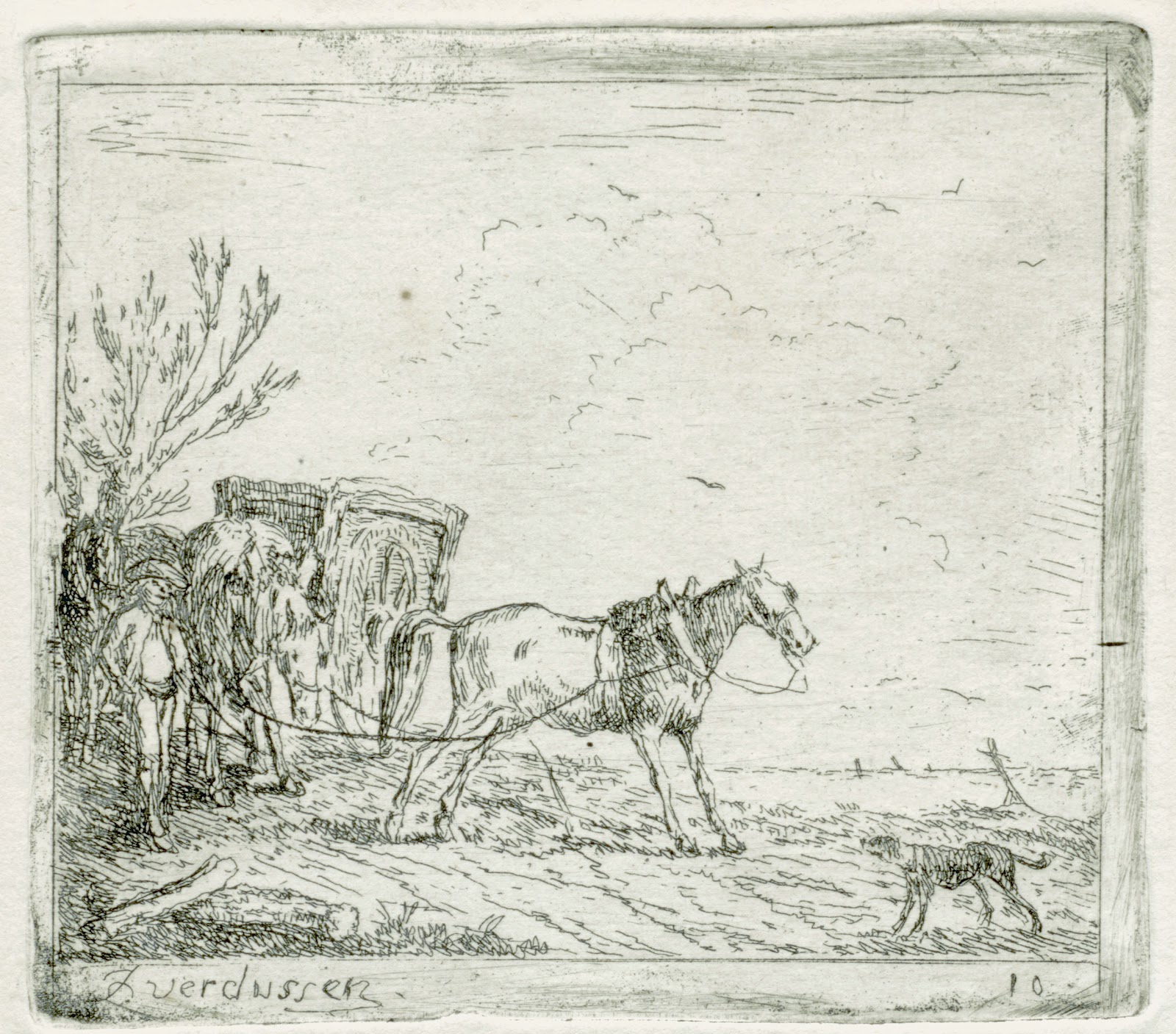
Jan Peeter Verdussen (1700-1763) and Dirk Langendijk (1748-1805)

Pedro Nunez de Villavincenzio (1640-1710) made one of the few(?) oil paintings showing pissing cattle I could find:
Arthur Boris Klein (1893-1985) as a Russian in Paris became world famous for his hilarious, instantly and insanely popular etchings of Paris' pissing dogs in the 1960’s. Still (or again?) affordable and very collectable. They even hang in my old mothers hall way drawing smiles from every visitor even in 2012.


Thomas Bewick’s (1753-1828) example of a pissing dog: nonchalant and sketched to the life. 200 years old and actual and fresh like a 2012 comic cartoon. 

And the youngest example, although "hors concours" I found was so hilarious I couldn’t possibly withhold. All you need is a pencil and two dead flies. Plus a creative mind a dull moment and a somewhat different sense of humor.  
Well, speaking of humor: if I offended you in any way with this posting's pictures (how did you get as far as this I might ask) please keep in mind father and son Brueghel, Pieter the elder (1525-1569)

and Pieter the younger (1564-1636), both saw the humorous side of pissing. Their pissing at the moon making me smile even after 450 years !

See an update of this posting (june 3th)  here *