Wednesday, 17 February 2016

Gustav Bechler and Leo Putz

 Gustav Julius Karl Bechler 
(Munich 01-08-1870 – 14-09-1959 Innsbruck)

Painter and printmaker. 


Son of woodsculptor Julius Bechler and Johanna Conrad. Studied from 1889 in Munich “Kunstakademie” with Heinrich Knirr (1862-1944) and from 1891 with Karl Raupp (1837-1918), and from 1894 with Paul Hoecker (1854-1910) He was a close friend of Leo Putz (1869-1940) with whom he founded artist group “die Scholle” and worked at the literary magazine “Jugend”. Lived and worked 1898-1905 in Steinberg in Tirol later settling in Maurach and Jenbach and also working as a photographer. Travelled to Berlin, Leipzig and Dresden and in 1911 to Rome. 


Appointed professor in Munich Academy in 1927. He painted mainly alpine landscapes especially around the “Achensee”. His known color woodblock prints are also Alpine landscapes and were published in many books and magazines. 


His earliest woodblock prints date 1902 which put him among the earliest of modern printmakers and the other Munich based printmakers: Emil Orlik, Koloman Moser, Walter Klemm and the Neumann brothers. He married Karoline Frankenhauser from Steinberg and they had three children.


Exhibited with “die Scholle” in the “Glaspalast” im Munich 1909, his woodblock “Schneidende Winter” winning a gold medal while “Winterstille” was awarded a bronze medal in Turin “Internationale Ausstellung” 1911. Exhibited in Berlin 1908, Munich 1910, Cologne1914, Leipzig 1920, in the 1930’s in Innsbruck as a member of the Innsbruck Secession and in Innsbruck 1955 and Achenkirchen 1999.

His prints are collected in “Graphische Sammlungen” in Munich, Vienna, Dresden, Berlin and Leipzig. Member of the KVSch. and DKB.
Dressler Kunsthandbuch 1921: living Maurach Achensee/Tirol 

-------------------------
Leo Putz 
(Merano 18-06-1869 – 21-07-1940 Merano)
Tirol painter.


Son of the mayor of Merano Karl Putz. Entered Munich “Kunstakademie” at the age of 16 studying with Gabriel von Hackl (1843-1926) and was sent by his father to the “Academié Julian” in Paris returning after military service to Munich to study with Paul Hoecker (1854-1910) where he will have met his friend Gustav Becker. 


In 1897 he opened his first studio and became a member of the Munich Secession and started working for popular and influential magazine “Jugend”.


His best-known works are two series known as the "Boat Pictures" and the "Bathers", putting him somewhere between Renoir (1841-1919) and  Anders Zorn (1860-1920). 


-------------------

All pictures borrowed freely from the Internet for friendly, educational and non commercial use only.

Tuesday, 9 February 2016

Ernst Kibler: Penguins and Romans

Kibler, Ernst  
(Stuttgart 11-09-1901 – after 1974)

Sculptor, graphic artist  and printmaker. 


Ernst Kibler is known (to me) by this recently surfacing signed color woodblock print showing penguins with text: ”Möge 1975 niemand frieren”:  should nobody be cold in 1975, obviously a, humorous, New-Years wish for his relatives and friends. 


Youngest of three sons of Karl Wilhelm Friedrich Kibler (1871-1937) and Hedwig Zeller (1870-1836). Studied in the “Kunst Akademie” in Stuttgart and in Berlin with sculptor Georg Kolbe (1877-1947)(below). He married Luba Herschensohn (1898-1946) and worked in Stuttgart. His sculptural work was influenced by Ernst Barlach (1870-1938) who also favored wood as sculpting material. 


In Heilbrunn (Bavaria) a statue of the Berlin Bear (“Berliner Bär”) was placed in 1960 (with Willy Brandt (1913-1992) and chancellor 1969-1974). It has been replaced in recent years. 


He also created a port-folio “Ilias” containing 25 etchings. Which I am very curious to see.................


This sketch of a dancer by Ernst Kibler more or less sums up what can be found in the Internet but gives a nice clue to his teachers and his connections with earlier generations of artists.
---------------
His teachers:

Kolbe, Georg
(Waldheim 15-04-1870 – 20-11-1947 Berlin).

Initially trained as a painter he studied in Dresden and Munich and from 1897 at the “Académie Julian” in Paris. Lived in Rome 1898-1901 where he took up sculpting influenced by (probably under the guidance of) Louis Tuaillon(below) (1862-1919) a German sculptor living in Rome 1885-1903. Kolbe has his own Museum in his former house/ studio in Berlin. He became instantly famous when the “Nationalgalerie” in 1912 bought his bronze “Tänzerin” (below). He was am member of the Berlin Secession and the the yearly award of the “Verein der Berliner Künstler”, the “Georg Kolbe Preis” is named after him.


Tuaillon, Louis
(Berlin 07-09-1862 – 21-02-1919 Berlin).

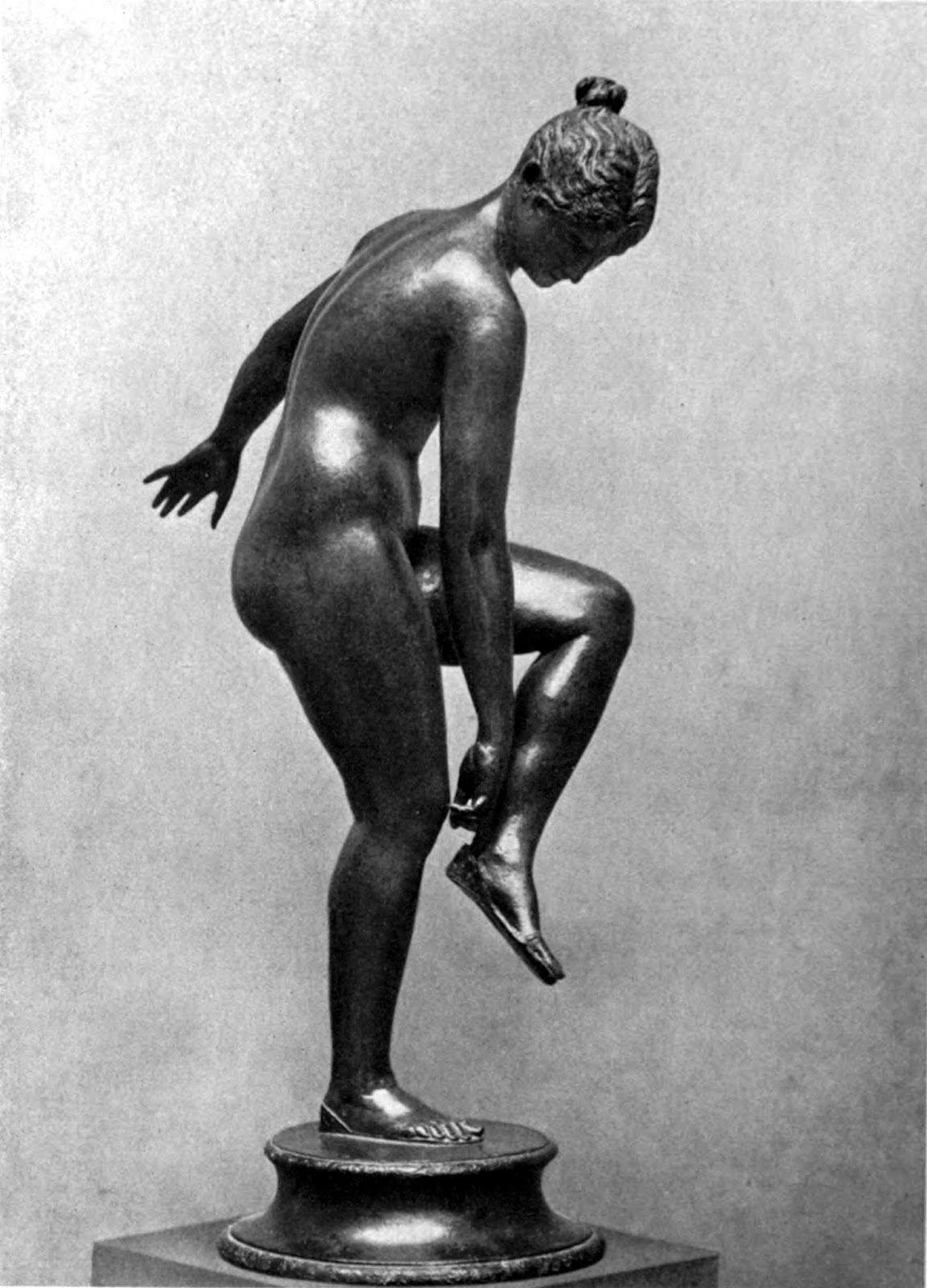
Studied in the "Hochschule für Bildende Künste" in Berlin 1879-1881, with Reinhold Begas (1831-1911) in Berlin and with Rudolf  Weyr (1847-1914) in Vienna. He lived in Rome 1885-1903. Awarded a gold medal in the “Grossen Berliner Kunstausstellung” 1899, member of the Berlin Secession and since 1906 professor in Berlin “Kunst Akademie”. Known for his sculptures of "man and beast". This classic bronze however, "Sandalenbinderin", could have adorned a roman Villa in Claudius time.  


Although there's little evidence of Kiblers creative work in the Internet, from his sketch a red thread, of classical (roman) beauty can be followed connecting the students and his masters. 
--------------

All pictures borrowed freely from the Internet for friendly, educational and non commercial use only. 

Richard Graef: In Campodozza, Italy

Eisack bridge in Atzwang (Campodozza) Italy

1916-2016


Thank you Markus. What great fun solving these puzzles so quickly combining forces. 


The picturesque bridge, part of a bike-trail, is not a popular or tourist landmark and it's location is rather hidden. The river crossing, although renewed, is still there, making use of the great bolder, but the surroundings have changed dramatically since the days Richard Graef was here exactly a century ago. Brenner Highway today towering high over the landscape.  


Campodozza (Italian) or Atzwang (German) a little village in the valley of river Eisack in Italian Trentino or South Tirol province. Near Bosen (Bolzano). Along the Brenner Highway to  Innsbruck via the Brenner mountain pass.  


All pictures borrowed freely from the Internet for friendly, educational and non commercial use only.

Monday, 8 February 2016

Richard Graef: comics and a roofed bridge

Graef, Richard 
(Oberweißenbach, Post Selb, Oberfranken 26-04-1879 -?)
Painter, illustrator and graphic artist. 

Self portrait

This woodblock last week appeared in Ebay: "Pantoffelheld", "slipper hero" but I think Vagabond or Tramp would be a better attempt translating. Searching the Internet I found several of his comic illustrations for Simpliccimus satirical magazine which appeared 1896-1944 and was published in Munich. Including more examples of this bearded character.  


Working in Dachau near Munich he had studied in Munich in the painting school of Anton Azbe (1862-1905) and with Hans von Hayek  (1869-1940) in Dachau and later in Paris. He created a portfolio with woodblocks: “Dachauer Land” Dachau 1916. 
Donau near Regensburg 


Anton Azbe ran his painting school in Munich 1819-1905 (Wassily Kandinsky was among his students) and Hans von Hayek ran a private painting school in Dachau 1900-1915 (Norbertine Bresslern-Roth and Carl Olof Petersen, who also drew for Simpliccismus, were among his students). 

But I saved this, 1916, (very "Japanese") woodblock for last, a wooden bridge across a small river: but where ?  In German it would be called an "überdachte Holzbrücke" or roofed wooden bridge. Readers are invited to help, since I was not able to understand it's title. 


Update:
Once you know it you see it: Atzwang. 
Thank you Markus for solving the location overnight !
For more details see next posting please. 


Printmaker Carl Thiemann (1881-1966) who worked and lived in Dachau wrote in his memoirs about the visiting students in Dachau following summer painting courses in Hayeks painting school. I think it is only reasonable to assume it will have been Thiemann who initiated Graef in the technique of woodblock printmaking.  
---------------------

All pictures borrowed freely from the Internet for friendly. educational and non commercial use only. 

Sunday, 7 February 2016

Arthur Segal: vom Strande

Segal, Arthur Aron 

(Jassey, Romania 13-07-1875 – 23-06-1944 London)

Jewish painter and printmaker. 

I discovered this very nice set of woodblock prints by chance in the Internet  and it made me wishing it was summer. They are executed almost like drawings in an enviable loose and "easy" style. Nice for sharing in midwinter.    


 ....., what if: they would be still available, for "Eine Mark" only ?


Arthur Segal was the son of a Jewish banker from Rumania and settling in Berlin in 1892 studied with Eugen Bracht (1842-1921) and in Munich Academy with Ludwig Schmidt-Reutte (1863-1909) and Friedrich Fehr (1862-1927). He marries his cousin Ernestine in 1904 and the couple became very active in the artist scene was among the founders of the Berlin “Neue Secession” (opposing Max Liebermanns cs. opposing Berlin Secession) traveling to Paris 1910-1911.


After the outbreak of WW1 he fled to Ascona (Swiss Lago Maggiore) and started a painting school which became a meeting point for German exiled artists: Hans (Jan) Arp (1886-1966), Marianne von Werefkin (1860-1938), Alexej Jawlenski (1864-1941) etc…  taking part with these Dadaists in Cabaret Voltaire, an avant-garde cabaret, in Zurich. 


He returned to Berlin in 1920 and in 1919 became a member, and chairman, of the “Novembergruppe” exhibiting 1921-1925 and 1927-31. He ran a painting school in Berlin Charlottenburg 1920-1933 which also became a centre for artists. With Otto Dix (1891-1969), George Grosz (1893-1959) and Kate Kollwitz (1867-1945) he was politically active urging him to flee with his family to London in 1933 founding the Arthur Segal Painting School which was in existence until 1977. He died in London in the Blitz. His son is Arthur Segal (1907-1985) a leading London architect. 


And he visited the Danish island of Bornholm, located at the southern tip of Sweden in the Baltic scratching together all pictures from Google for this Blog article 

All pictures borrowed freely from the Internet for friendly, educational and non commercial use only. 

All pictures embiggen by mouse-click.