Emile Antoine Verpilleux (I).
(1888-1964)
British painter, portraitist,
woodengraver, illustrator and
Modern Printmaker
His first 5 modern prints.
The most
actual and condensed biography on E.A.Verpilleux can be found here in Art and the Aesthete.
The exemplary and legendary but sadly late Blog of Clive. I can only encourage reading his great
and informative posting. My postings around the Antwerp School of Printmaking are an attempt showing some things that maybe haven’t been shown or discussed
before on the web.
Born from
Belgium parents in London Emile was trained in the Antwerp Royal Academy but started his artistic training in London. Initially, undoubtedly, as a painter. Guessing
he must have been around 18 leaving for Antwerp leads us to around 1905-07. Around
the year Edward Pellens, was appointed director-professor. Again
guessing he will have stayed in Antwerp for maybe 4-5 years, most students stayed 4 but Emile, because of his already noticed talents was granted a state (post doc) stipendium. We find him actually
back in London in January 1911, mentioned in the
London Illustrated.
The
prestigious Studio Magazine published a major article by James Bolivar Manson (1879-1945, reading this later Tate director’s biography here is a must) on young
Emil Verpilleux in the September 1913 edition. Showing “his latest” two prints
in full color: “St. Pauls from Cheapside” and “St. Pancras station” both dated
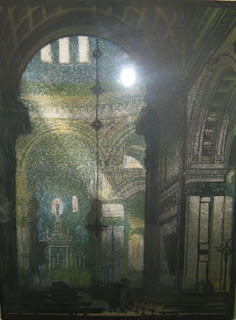
1912. Also his ”Interior of St. Pauls
Cathedral”, shown in black and white, and the mentioning and praising of “Interior
of King’s College Chapel”.
His 1912 print “the Tower Bridge” was printed in color
four months earlier in the May 1913 edition. So 5 of his prints at least can be dated with some accuracy as early as 1912-1913.
 |
E.A.Verpilleux: St. Pauls from Cheapside 1912
note the window screenes lower right and the fotograph below. |
 |
| Cheapside 1910 |
In some publications it is argued that Verpilleux changed from the traditional use of the Japanese baren (press), water based inks and thin papers to using a printing press, modern printing inks and thick absorbent papers. Urushibara arrived in London december 1910 giving lectures, showing the Japanese printing methods to artists and students. He returned to London in 1912 to stay, traveled and taught also in Paris. Comparing with the publishing dates of these prints I'm convinced Verpilleux wasn't trained that way in Anwerp. Nor had he the time to master it back in London and reject it before creating these prints. But maybe someone can throw light on this subject. Also I have not been able to locate the source of this statement.
 |
E.A.Verpilleux, Tower Bridge in London Fog, 1912
Note the lantern (left) and see were Frank Brangwyn stood
sketching Tower Bridge (below) at a slightly different perspective. |
 |
| Tower Bridge, Frank Brangwyn |
 |
| Tower Bridge, Luigi Kasimir |
 |
| A foggy day in London Town , 2011 |
Many great printmaking artists visited London, Paris and Antwerp. Frank Brangwyn (1876-1956), Luigi Kasimir (1881-1962) and Frantisik Tavik Simon (1877-1942) for instance. They surely will have had greater influence on the young Verpilleux. As I intend showing you later.
Verpilleux' St.Pancras Station print must have been inspired by Claude Monet's Gare St. Lazare painting (one of its versions). Most Impressionist painters (and the post Impressionists) visited and painted London and the Thames.
 |
| Claude Monet: Gare St. Lazare Paris 1877 |
Besides the achievement of great atmoshere in this print (that was after all the starting point of this series) it is incredibly detailed and acurate. Verpilleux showing both his skills as a classic taught wood engraver in Antwerp but also he already is a very modern block-printmaker. These contemporary photographs proving. The perspective, the hurrying crowd, the structure of the station and the impressionist atmosphere are created with the greatest skills and great knowledge of using color (and inks and paper). Acccording to J.B.Mansion in 1913. And he was besides a critic also an accomplished artist.
 |
| Yoshijiro Urushibara (after Frank Brangwyn) |
 |
| The railway engine: Frank Brangwyn. |
To be continued soon.
Suggestions and comments welcome!


+St.+Jacob+Anvers.jpg)


