Showing posts with label Edna Boies Hopkins. Show all posts

Monday, 5 November 2012

Brueghel, Dow, Mars & Squire: Winter Time !

Although my "factual memory" (abillities for remembering and memorising facts and names) is gradualy but definitely on the decline (not what is was 50 years ago), my visual memory (storing and remembering pictures) seems to grow and without any signs of limitation. One of the benefits, aided by a powerful computer, is recognising, "seeing", or thinking one sees, ties and connections. Hail the aging process ! 

Pieter Brueghel the younger (1525-1569) "Hunters returning", winter in the Low Countries 1556. (see also here*)

Arthur Wesley Dow (1857-1922): "Moon over Marshland". From his first set of 15 designs Dow printed some 200 differently colored versions.


Ethel Mars and Maud Hunt Squire: "Winter Time", illustration from "A childs garden Verses" by Robert Louis Stevenson (1850-1894) first published in 1902. I can't help thinking this is a wonderful pastiche and even after 100 years a glorious wink to us and Masters old and new. Ethel Mars and Maud Squire, later, were tought printmaking in Paris by life long friend Edna Boies Hopkins (1872-1937) who had been student of Arthur Wesley Dow. Dow  was the first to develope Japanese printmaking without a keyblock. Before in the mid 1890's the three women had been students in the Cincinatti Art Academy. 


All pictures borrowed freely from the internet for friendly, educational and non commercial use.

Friday, 2 November 2012

Bror Julius Olssen Nordfeldt: continued

Some thoughts about Whiteline printmaking 
Today as promised in my before posting here are examples of Nordtfeldts’ Whiteline method printmaking. That is: the few I could find. If these prove to be all his output they are outnumbered 3:1 by his traditional Japanese style prints. 10 years after his initial printmaking he seems to have shifted his attention to  summer residence Provincetown. The local people and village views, with the emphasis on dresses and patterns, probably influenced by the ideas and trials of his female printmaking friends. To wich extend the temporarliy returned from France couple Ethel Mars and Maud Squire were influenced by possibly the earliest of creative printmaking endeavours by Wasili Kandinsky (1866-1944), who Mars called  the "grand-father of the group of Provincetown printmakers, Nordfeldt no doubt being the father and Blanche Lazell the daugter), and Edvard Munch (1863-1944) who experimented with partial and jig-saw printmaking as early as  in the late 1890's is beyond my capabillities of judgement.   
Upper: Wasili Kandinsky 1903, Lower Edvard Munch 1899 

I dare not jump to any conclusions but maybe Nordfeldt wasn’t so convinced by the results after all. His style changed dramatically and he is very far from the original and pioneering Fletcher and Dow adept and artist he was in and around 1906 (when Mars and Squire were still in Paris). His printmaking activities seem to have stopped after 1916 altogether. 
The new possibilities using the Whiteline method (more, and more easy coloring) smothered the artistic creativity required by the difficulties and limitations in traditional Japanese printmaking. The effect, I think, often reduced to “painting by numbers”. Moreover the general use of separating colors makes it very difficult if impossible to make distinctions between the works of different artists other then their compositional originality and choice of location and subject.

The unanimous choice of using the same harmonic Japanese color combinations isn’t a big help in distinguishing them either. Besides a pivotal figure in the invention and early development, Nordfeldt seems to have been the only male printmaker that has ever given it a try before WW2. The method and its popularity in America never crossed any ocean either to the East or  to the West.

There are exceptions of course. Edna Boies Hopkins (1872-1937) and Ethel Mars (1876-1956) succeeded best by exploring and combining the best of two worlds of printmaking avoiding with success the before mentioned effect. But only because they were among the most accomplished traditional printmaking artists of their time years before. 
Left: Ethel Mars and Maud Squire by Edna Hopkins. Right: Woman with sunflowers by Ethel Mars.


Tea: Ethel Mars and Maud Squire by Maud Squire

With Nordfeldt these two ladies were the real creative geniuses (geniae?) of that perticular group of early printmakers that tried combining the Japanese traditional with Old-world pioneers and new-World ideas.


All pictures borrowed freely from the Internet for friendly, educational and non commercial use.

Thursday, 1 November 2012

Bror Julius Olsson Nordfeldt

Bror Julius Olsson Nordfeldt
(1878-1955) 
American painter, etcher and printmaker


Reading and learning from Charles’ Modern Printmakers recent posting* on American printmaker Bror Julius Olsson Nordfeldt and explaining his use of color gray, another Swedish, but outside Sweden hardly known printmaker came to my mind. 


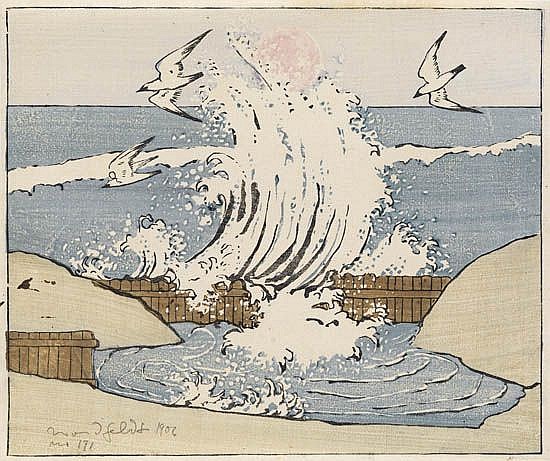
While organizing my pictures files I stumbled upon some subtle but nevertheless not before detected or discussed elements in Nordfeldts printmaking. I hope it is interesting stuff for who likes Nordfeldts prints. Who doesn’t ?
So, before disclosing, this other Swedish printmaker's often humorous prints today some printmaking details in Nordfeldt’s woodblock prints. The artist signed always B.J.O. Nordfeldt but there are academic books on his etchings titled Nordfelt. Nordfeldt's added his mothers family name Nordfeldt to his  after arriving in Chicago in 1891. He has a namesake Albert Julius Olssen(1864-1942) a British marine painter he most probably will have met when staying in  Cornwall in or soon after 1901. Ollsen was leading a painting school in St. Ives.

I always thought these differences in color were due to aging, discoloration  and loss of quality but closer examination shows he not only experimented with the grays but also with combining different color accents and a choice of traditional Japanese color combinations. Sometimes these are minute: count the red flowers in the bowl !
Many of the prints' edition numbers are not clear enough to make conclusions here. Besides some prints are so rarely seen that I know of only one (public) example, like these two below. 

Although very few examples are available some edition prints show no differences in color choice or accents like the fishermen in the mist and the birch twig other then the individual characteristics of every individually inked and pulled print. What is clear: 1906 was his most prolific printmaking year.
  
But different examples of other prints showing clearly his trials and ideas. Sometimes  only minor differences, never radical.


This seeking aesthetic perfection and color harmony leading in the mid 1910’s, in the Provincetown Art Colony, to the American way of printmaking: the White Line method enabling the application of different colors and/or different combinations more easily. 

Nordfeldts co-developing whiteline printmaking (he did not invent the idea  entirely alone as was often suggested) enabled him to use more colors and his style changed as dramatically as the new possibillities allowed him. I will show them in next seperate posting. Sticking to Japanese colors, by Nordfeldt and all other Whiteline pioneers is what amazes me most. 

This method was first embraced and used by Provincetown colony artists like Edna Boies Hopkins, Ethel Mars, Maud Squire and Blanche Lazell the most famous. But there were more, highly original printmakers like Ora Inge Maxim (1895-1992), Mary Mullineux, Mildred McMillen and a handful of others. Many of them changing eventually their Japanese way of printmaking into this new way. Sometimes even combining both.   

As Charles stated: Nordfeldt also was a teacher. Elisabeth Colwell (1881-1954) who created not many prints but most are very delicate and original, was a student. 
This perticular print reminding me of Takahashi Hiroaki (Shotei)(1871-1945 ): Snow at Ayase River

And finally for those who'ld like to know how traditional printmakers like Nordfeldt created his early prints here's a print I've stumbled upon, in status nascendi: three colors applied. An example of the the finished print however I've never seen. Maybe he's abonded this project.  


Next: Whiteline prints by Bror Julius Olsson Nordfeldt.

All pictures borrowed freely from the internet for friendly and educational non commercial use. 

Thursday, 10 March 2011

Erna Fenkohl - Herzer (a surprise)


Erna Fenkohl neé Herzer
(1882 Glogow – 1975 Berlin)

Portrait painter and woodcut printer


Once in a while it is great to make a discovery, or rediscovery. I have hesitated keeping this secret to myself. But today I decided sharing (if you promis to keep it our secret by leaving a comment) and present from almost total obscurity the printed works of German printer Erna Fenkohl. I stumbled upon this small website of a German professor showing the works of Gustav Fenkohl (1872-1950), from Memel (now Lithuania). A German landscape painter studying and living in Berlin since 1895 (see the link below).

Gustav Fenkohl married Erna Herzer in 1914, they will have met in the artistic scene in Berlin were Gustav had studied and exhibited his paintings from 1913 on all major exhibitions. Gustav was invested chairman of the Berlin Artists Association and held many other functions until WW II.

In 1943 they were bombed out of Berlin and most of their work was destroyed in the fires. Würzburg Professor Hans-Joachim Vollrath traced many surviving paintings displaying them on his website. Sideways he was send pictures of prints by Gustav’s wife Erna who was listed as a portrait painter in Berlin. I even found another example. The couple returned to Berlin after the war.

It is hard to believe that these wonderful prints are so unknown. The square designs, the colors and the compositions are great. I presume these 6 flower and butterfly prints belonged somehow together. And could easily have been made from the back garden because flowers and butterflies are of the common type. It is hardly possible to compare these very original prints with others but stylish, somewhere in the back of my mind is Edna Boies Hopkins (1872-1937). If she was familiar with the great Hopkins’ work I think she came very far with her art. Just as "Strong and Colorful". If she wasn’t it would be all the more extraordinary. Won’t you agree? And what to think of what has been destroyed in 1943 ?

3 prints by Edna Boies Hopkins:


(This last example by E.B.H. I deformed to a square for comparing)
These 3 pictures taken from the book by Dominique Vasseur

Please let me know what you think of them by leaving a comment. Hopefully more prints have survived and will show-up in time.

Prof. Vollrath's website of Gustav Fenkohl:

Book: (still available, a must have):
Edna Boies Hopkins, "Strong in caracter, Colorful in Expression"
Ohio University Press 2007, by Dominique Vasseur.
ISBN-13: 978-0-8214-1769-0
ISBN-10: 0-8214-1769-X