Showing posts with label Fanny Remak. Show all posts

Sunday, 4 September 2016

Carl Anton Reichel, early Vienna modern printmaker.

Until october 3th 2016 the great exhibition Color Woodcuts in Vienna around 1900 ("Kunst für Alle", Art for All) is held in Frankfurt. Besides discussing the importance of the Vienna woodcut to all later users of the technique, among all fine prints there was one in particular, by Carl Reichel that irresistibly drew my attention. By the way, there's a great catalogue accompanying the exhibition available, condensed, digitally (PDF) here.  

Researching I found Reichel, in the early years of woodblock printmaking like many others liked to experiment with the effect of colors.


Reichel, Carl Anton
(Wels, Upper Austria  06-04-1874 – 25-10-1944 Vienna)

Austrian painter, art collector, art dealer, graphic artist and printmaker. Son of notary Anton Reichel (1843-1884) and Carolin Rabl (1851-1914). Began as a self-taught artist studying in Prag (1894-1895), Munich, Vienna and Paris (medicin, psychiatry, psychology). Worked in Großmain, Salzburg, Heiligenkreuz in Austria. Living in Munich 1903-04 he met graphic artist and book illustrator Alfred Kubin (1877-1959).

  
He married Hilde Konstanze Dolmatoff (b. Riga) probably in 1905, they had three children but Reichel left his family in the 1920’s to live in Paris with his great-niece, a daughter of his mothers nephew anatomist Carl Rabl (1853-1917) who was married to Marie Virchow (b. 1891) a daughter of famous “father of modern pathology” Rudolf Virchow (1821-1902). Virchow, a very famous German indeed, in 1855 had stolen the work of his colleague Robert Remak, the grandfather of Jewish artist Fanny Remak. Fanny Remak  was discussed extensively in this blog last year. It is funny and interesting to experience how things are connected.


In 1933 Reichel married actress Tony van Eyck (1910-1988). Initially he created prints with woodblocks but later turned to etching. Several astonishing modern colour woodblock prints, mainly female nudes, were conceived around 1909.


After WW1 he became close friends with Bavarian crown prince Rupprecht von Bayern (1869-1955) leading on his behalf the negotiations concerning the prince's royal status with Adolf Hitler. Although Reichel was imprisoned in Buchenwald concentration camp after “der Anschluß“ (Austria joining Germany in war) in march 1938 he was released the same year, it is said because of his friendship with the Führer himself in who’s home a work of Reichel was shown in 1943.  Reichel is buried in Vienna “Zentralfriedhof” together with painter Rudolf Sternad (Reichenberg/Bohemia 02-09-1880 - 05-01-1944 Vienna ) although I have no idea why........ They both died in 1944.   


Reichel is mentioned in Hans W. Singer’s 1914 “Moderne Graphik” (page 228/229), as a former physician (“ehemals ein Artzt”). Singer (his 540 page book is a must have for print enthousiasts) is particularly lyrical in describing the prints of  1) “a kneeling nude girl leaning with her left elbow on a chair” and the use and combination of colors: “silk-soft skin tones, dark carmosin, gray browns and the greens of the chair”, of 2) a”kneeling on the floor nude girl” with “Bordeaux red, palebrown, and dark skin colors forming a benevolent  trinity” and 3) a third girl with “almost red brown skin against a blue background”. The first prints mentioned I failed to find yet but the others are shown here after some internet searching. 


Singer further states that in Reichels landscapes “the colors combined have an almost mother-of-pearl lustre”. Helas: I could find no examples of landscapes by Reichel.


----------------------

  All pictures embiggen by mouse-click

All pictures borrowed freely from the Internet for friendly, educational and non commercial use only. 

Wednesday, 18 March 2015

Fanny Remak part VI: to Paris with friends

Helen Grund
German painter, writer, editor and journalist.
(1886-1982)


Auguste von Zitzewitz
German painter, portraitist and graphic artist
(1880-1960)

Self portrait Augusta von Zitzewitz

When Fanny Remak went to study in Paris, in 1912, she was accompanied by her friends Helen Grund and Auguste von ZitzewitzOf Helen Grund we know she was encouraged by her painting teacher (and Berlin seccesionist) George Mosson (1851-1933). His "Chrysanthemums in a blue vase" below. Auguste, although Mosson was her teacher too, supposedly was encouraged to go to Paris by Kathe Kollwitz.  


Mosson, a Frenchman living and working in Berlin since he was 14, taught also at the “Zeichen und Malschule" of the VdBK (Verein der Berliner Künstlerinnen) and was a member of the Berlin Secession. He lived and worked from 1901 at Nollendorfplatz 1, a large renting house, next to the studio of Seccesionist Lesser Ury (1861-1931) also ran a private painting school and was famous for his flower paintings. Auguste von Zitzewitz had also been among his students. 

Helen Grund photographed by Mann Ray (1890-1976), right. 


Mosson’s relation with Helen Grund however also was of an amorous nature although he was old enough to be her father they were lovers for 7 years until her departure for Paris.

Robert Henry (1865-1929), Café du Dôme, Paris 

Helen Grund came from a well to do family but in her family circulated some serious mental problems. Her mother Julie, her sister Ilse and brother Fritz ended their lives by suicide and another brother, Otto, died in a mental asylum. The rumour went she has had an incestuous relationship with her brother and a lesbian affair with Fanny Remak.


In Paris the women stayed in the circles of Café du Dôme and here Helen met writer and bon vivant Franz Hessel (1880-1941). They were married the year after and in 1913 their first (of two) son was born.


Some years before, when living in Munich, Hessel had been involved with "wild countess" Fanny zu Reventlow (1871-1918) whom I’d met in Fanny’s mothers home in Berlin (see earlier postings on Fanny Remak and Kathe Münzer-Neumann).

The turbulent life story of Helen Grund lead to the French Novel “Jules et Jim” by Henri-Pierre Roché  (the third party in this “ménage a trois”) and to the 1962 “Nouvelle-Vague” movie with Jeanne Moreau (b.1928). Helen became a publisher/editor and was well known figure in Paris society, Auguste returned to Berlin and developed a career as a successful portrait artist. 

Fanny Remak returned to Berlin, working and with Auguste von Zitzewitz sat  together in the board of the VdBK ("Verein der Berliner Künstlerinnen"). To this day I haven't been able to find any example of work by her hand.       

 ------------------------------------


When Fanny Remak went to study in Paris in 1912 she was 28 years of age so it was a surprise recently discovering she exhibited 5 years earlier in 1907 (!) in the Berlin art gallery of (Jewish) Paul and Bruno Cassirer: the prestigious Kunst Salon in the Viktoriastrasse 35 near Kemperplatz and Tiergarten

Julius Jacob (1842-1929), Kemperplatz and Rolandbrunnen

 Kemperplatz-Viktoriastrasse 1910 and 1945.

Recently the history and revelation of it's immensely interesting surviving archive of collections and exhibitions was published (here) in 4 volumes.  

Cassirers prestigious gallery, around the turn of the century, probably had no equal in the world representing and promoting the French (and Berlin) Impressionists and Vincent van Gogh (1853-1890).


In this exhibition Fanny was represented with 4 works in an Exhibition build around Impressionist Camille Pissaro (1830-1903) (30 works) together with  Ernst Oppler (1867-1929) (30 works), Fritz Rhein (1873-1948) (6 works), Heinrich Linde-Walther (1868-1939) (11 works) and Paul Baum (1859-1932)(17 works).  

The titles and catalogue numbers of the works Fanny exhibited:
  • 78. Yachthaven
  • 79. Duc d’Alben(*)
  • 80. Strasse in Travemünde
  • 81. Landungssteg.
(*) Duc d'Alben: "Dückdalben", derived from the name of the much hated Spanish tyrant the Duke of Alba (1507-1582) who ruled the Dutch 7 provinces until 1573. Engl.: Dolphin or bollard. Dutch: Dukdalf or meerpaal

Ulrich Hübner: "Tiergarten Berlin" 

How did Fanny, 23 years young, managed to be represented here amongst these famous and accomplished painters ? The titles (besides the great quality of her paintings might hold an unexpected lead or a clue: Berlin painter and seccesionist Ulrich Hübner (1872-1932). Hübner painted in summer in Travemünde and between 1909 and 1912 he even lived permanently in the seaport village. 

Ulrich Hübner: Travemünde: "Landungssteg und Duc d"Alben"

Hübner was well acquainted with Cassirer and with Berlin's and the international art world. Cassirer, on the other hand was well acquainted in the Paris Café du Dôme circles. 

Panther: Logo of Cassirer Publishing House
designed in 1902 by Max Slevogt (1868-1932).
 the same year Rilke (1875-1926) wrote his famous poem.   

-------------
Please send all information you might have concerning Fanny Remak: genealogical, family, paintings, examples  etc…. helping my investigations to shine light on the obscured life of Fanny Remak. At least some of her paintings could have survived the "entarted" or "degenerate" qualifications. Her belongings were seized (confiscated, stolen and auctioned) when she fled from Hamburg to London by the Nazi's (more about this in next episode)   


All pictures borrowed freely from the Internet for friendly, educational and non commercial use only.

Saturday, 7 March 2015

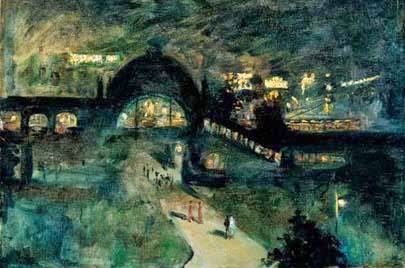
Emmy Gotzmann: first result & great find !

Emmy Gotzmann
(1881 - ?)


U-Bahnhof Bülowstrasse, Berlin 
(seen in the direction of Nollendorfplatz, next station)


U-Bahnhof Bülowstraße today.

The revealing of this painting is the result of using the immense possibilities of a friendly Internet. Combining knowledge, effort and research I'm really happy to show the world this wonderful painting that has not been seen, admired or enjoyed for so long. 
(Bülow station see in the direction of Nollendorfplatz, next station)

From Emmy's viewpoint side of the street looking towards the left: Luthers Kirche. Looking right would give the exact view on Bülow station and Potsdamerstraße crossing. This view before the line was raised, the station build and a passage was created through the wall of houses. 


And after raising the line and creating a passage. Around 1905   

This posting is also an announcement and a welcome to Emmy Gotzmann's biography that will appear later this year in honor of the obscured life and career of this wonderful and neglected painter. Who knows what other great paintings will be revealed. It's publication will be announced in this Blog. 

The newly build Bülow station, the front is situated along Potsdamersträße.   

This station is one of three rather famous stops in Berlins basic first "Hochbahn" line build in the late 1890's and opened in 1902. 

Between the Luthers Kirche and Berlin-Zoo/Kaiser Wilhelm Memorial Church  completed in 1906 on Auguste-Viktoriaplatz and Kurfürstendamm): Wittenbergplatz, Nollendorfplatz (with "Kaufhaus des Westens" founded in 1905) and Bülowstraße crossing Potsdamerstraße. The iconic station buildings were destroyed, like anything else, in the allied bombing in the last year of WW2. However, Bülow Bahnhof was rebuild.


Emmy must have taken the Godfather of Impressionists Camille Pissarro's (1830-1903) 1897 depictions of Boulevard Montmartre with high viewpoint and  diagonal compositions in mind. Pissarro was exhibited in Berlin with 40 paintings in Kunstsalon Cassirer in 1907 in nearby Victoriastraße 35 (along with 4 works by my research subject Fanny Remak by the way).


Lovis Corinth: Berlin, "Unter den Linden" and the Brandenburger Tor (were the Liebermanns owned a city palace).
 
Max Slevogt: "Unter den Linden". 

Berlin Seccesionist Lovis Corinth (1858-1925) and Max Slevogt (1868-1932), with Max Liebermann (1847-1935) the three leading Berlin impressionists, likewise choose the high viewpoint and diagonal composition in their "Unter den Linden". And maybe Slevogt had the greatest of impressionists in mind: Claude Monet's Rue de Montorgueil from 1878 (left) 


Lesser Leo Ury
(Nollendorf Station)


Emmy's painting is all the more important because there are so few examples of Berlin street views in painting. Let alone of the U-bahn, build after the example of New Yorks above-ground system. That is besides the paintings by a painter who was always to stand in the shadows of this trio: Leo Lesser Ury (1861-1931) owned a studio at Nollendorfplatz(1) and he just had to look outside to paint in the rainy atmosphere that is so characteristic for much of his work.

(1) The name of Ury's neighbor George Mosson (a Berlin seccessionist) keeps popping up in many artists biographies. Mosson, a painter of flowers, also taught and ran a painting school. 
   
Thank you Hartwig D.(2) and author Ferdinand Ruigrok van de Werve ! 


All pictures borrowed freely from the Internet for friendly, educational and non commercial use only. 
(2) to the protection of the owner of the painting.