Showing posts with label Henri Verstijnen. Show all posts

Friday, 4 April 2014

Bernard Willem Wierink: in Artis ZOO

Bernard Willem (Ben) Wierink
(1856-1939)

Dutch drawer , painter, juwelry and toy designer
bookband designer and books illustrator, printmaker.
and teacher.


Initially Ben Wierink was trained as a teacher, and working with Dutch architect Pierre Cuypers (1827-1921) he assisted in planning the building (1885) of the new Rijksmuseum in Amsterdam. The recently remodeled, reopened and truly spectacular museum was visited by president Barack Obama last week.


Wierink came along in my recent Jan Uri posting as one of the many artists that worked in Artis Zoo. Earlier I showed Gerrit Dijsselhof (1866-1924), Samuel Jesserun de Mesquitta (1886-1944). The list of fine artist working in Amsterdam Zoo is long: Nicolaas van der Waaij (1875-1936) who painted (and etched) one of the concerts that was given in Artis, obviously influenced by the Germany's greatest impressionist painter Max Liebermann (1847-1935) whom he would will have known: Liebermann visited and painted frequently in the Netherlands and van der Waaij was a professor in the Rijks Akademie for 30 years. 
 Nic. van der Waaij
Max Liebermann

But also Henri Verstijnen (188201940, Maria Kelting (1886-1969), Willem van den Berg (1886-1870) and so many others.  
I love  Wierink’s use of color and his fabulous drawing technique and although I know he created some very fine woodblock prints I've never ever actually saw one. So here’s a good moment to show what I scratched together from the Internet. 


This watercolor, below, was created for the “liber Amoricum for Artis director Dr. Coen Kerbert (1849-1927).  


This is Wierinks woodblock portrait of his friend the painter and etcher Maurits van der Valk (1857-1935) of whom I have a work, this lovely “Friesland”, as it happens, the place where I live. Closing nicely the circle of this posting. 


All pictures are mouse-clickable to embiggen. 

All pictures borrowed freely from the Internet for friendly, educational and non commercial use only. 

Saturday, 18 June 2011

Speaking of flamingo's ...........

Alice Schille
(1869-1955)
American watercolorist and painter.

This small but great flamingo's print (and poem) by Alice Schille is the only printed matter I've found made by this well known American painter trained in the Arts Student League of New York by William Merrit Chase (1849-1916)

And to make more complete this posting here are some other great Flamingo woodblock prints (some of them shown in earlier postings) and posters.
Helène Grande-Tüpke (Germany, 1875-1962)
 Ludwig (Heinrich) Jungnickel (Austria, 1881-1965)

Ethel Mars (American, 1882-1980), if this a fraction of a larger print: I failed finding it.

Viktor Wolfgang Pirkhoff (Tsjech, 1875-1962)

Robert Greenhalf (British, b.1950)

Charles Moser (Austrian, 1873-1939) thank you Lily
Martha Cunz (st. Gallen Suisse 1876-1961)
And I think Henri Verstijnen's  (Netherlands, 1882-1940) lithograph fitting in here very well.

Ludwig Hohlwein (German, 1874-1949)
Francis Lee Jacques (American, 1887-1969)
Julius Klinger (Austrian, 1876-1943)

And this recent Dutch bookcover
(Last flight of the flamingo)

Thanks also too: http://theanimalarium.blogspot.com/

Friday, 24 September 2010

Cacti and the Color woodblockprint; 2/3


Dutch and German printers


For starters on the left this flowering epiphyllum 1920's woodblock print by relatively unknown and obscured artist J. A. Kort.

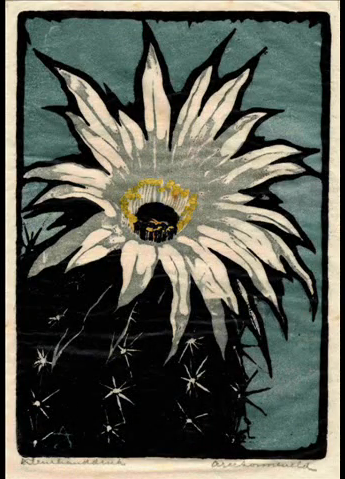
The most prolific Dutch lino- and woodcut printing artist in the Arts and Crafts period was without any doubt Arie Zonneveld (1905-1941). His prints were and still are, however out of grace and fashion, widely spread in Dutch homes.

Arie Zonneveld later in life decided he wanted to be an arts teacher rather than being the dullish office clerk he had become and attended the Academy for Beeldende Kunst from 1925 to 1929 in the Hague, Netherlands.


His early prints were relatively simple flower pieces. But very carefully designed and arranged. Often in one color + the black key-block. Later using multiple blocks and more colors creating more complex and landscape compositions.

His choice of subjects and composition is proof he undoubtedly had knowledge of and was influenced by fellow artists in Germany and America.


His art was sold through selected big city art-dealers who ordered prints from a modest list/catalogue on demand if not in stock. Arie only made few numbered and thus limited(?) editions. Careful not to kill the hen with the Golden Eggs. The number of surviving prints are evidence that his enterprise was a success. Although, after his untimely death, only 36 years old of appendicitis, his widow kept printing and selling from the blocks to survive WWII with 3 small children.

German contemporary Ernst Rötteken (1882-1945) in the same period followed a very similar selling strategy in Germany. Resulting in his widespread fame in the province of Lippe. Big editions and no edition numbers. Very popular in the Lippe province even to this day. They look deceivingly simple but are really very good works of Art when studied closely. I am planning a posting on Rötteken's flower prints soon.

There are distinct similarities between the works of Rötteken and Zonneveld. But also with famous Americans Frances Gearhardt (1869-1958) and William Seltzer Rice (1873-1963). The influences of art-teachers Pedro the Lemos and Arthur Dow are evident. Their books on composition and color that were used in art-schools all over the world and even to this day are considered standards or textbooks.

Even famous German Carl Theodoor Thiemann (1881-1966) couldn't resist the attraction of the wonderfull and exotic Epiphyllum flowers and created this wonderfull and spectacular print. Thiemann
created some prints with flowers but is mostly known for his landscapes, sailingboats and swans.

Arie Zonneveld to my knowledge the only artist creating so many different cacti and epiphyllum prints.

Other examples of Dutch Arts and Crafts artists that created color linoleum or woodblock prints of cacti are Jan Schonk (1889-1972) ( left) and Henri Verstijnen (1882-1940) (right). Both well respected and internationally appreciated Arts and Crafts graphic artist.


The makers of these last two Dutch prints not yet identified but the left (signed J.S.) is known with bright yellow flower also.

For some interesting further reading on Arie Zonneveld and his contemporaries: http://www.clivechristy.com/2010/05/arie-zonneveld-1905-1941.html

Cacti prints by German Hugo Noske (1886-1960) and Martin Erich Philipp (1887-1978) will be shown in 3/3 along with all other cacti prints by printers in the rest of the world.
I am sure my research nor my pictures files make a complete oversight of all woodblock prints with cacti. Don't hesitate to email me or leave a comment if you have knowledge of any others please.