
Jan (Johannes) Veringa
(1907 - 1982)
I already knew Jan Veringa from this little book on Linoleum cutting (cover right) published in 1938. In England and Germany many books on the subject were published from the beginning of last
 century. By many a "great name". But I think he was the first in the Netherlands. It's a Dutch classic and standard. It has been my guide into the world of blockprinting. I have collected most of the "foreign" books too over the years
It is a standard even to this day because it was written for the using in schools, like most of them were in the days when linocutting was an essential part of the school system in the developement and education of children.
Today linocutting is no longer taught in primary schools because of the "dangerously sharp knives and school liability". Times change. Also "computer creative artforms" are considered a substitute. You may think of it what you like. But I also know the Speedball company developed childrens fingers-safe linocutting knives in the USA (to be pulled instead of pushed). There should be a revival considering how many great and creative artists were bred in the old sytem.


Jan Veringa was to become a schoolteacher (drawing) in the Arts and Craftschools in Haarlem, Netherlands. In 1943 he married (aged 35) Wilhelmina Denison 1912 - 1994). Closely examining the big tree print (above, 35 x 50 cm) in the tree lower left I discovered the initials J.V. and W.D. engraved (in mirror, as to hide it) plus a heart. A very moving find I think.
Veringa's prints are regularly offered in sales and sometimes in auction houses. They are not rare and not expensive. A few months ago I allowed to let slip a very nice one. I am still full of regrets over these two very Arts and Crafts doves, but surely they will show up again.

Recently the above large print with beech trees showed up nearby and when I contacted the seller he told me he had another one matching, also with trees. He had picked them up at a church fundraising sale the weekend before. The two above prints made me curious enough to look into and investigate the life of this artist a little closer. Not v ery much was found but enough to share and put the lights on this artist.


Most if not all of Veringa's prints are in black and white. I know of only one print by his hand in color: his lovely Chrysanthemums. It has more than just some similarities with Bakufu Ohno's (1888-1976) Chrysanthemums (printed around 1949/1950). It is almost impossible not to believe Veringa took it as an example.
I think for a schoolteacher in this print he showes his very remarkable talent and skills. And to be honest, without knowing, I dare not say which print is the better or more pleasing.


Left: Jan Veringa, Right : Bakufu Ohno
Much of Veringas work is showing the simple rural and agricultural every-day surroundings near his hometown Haarlem. But he also impresses with great landscapes like the (above) "Dunes near Bloemendaal/Haarlem". See the enlargemen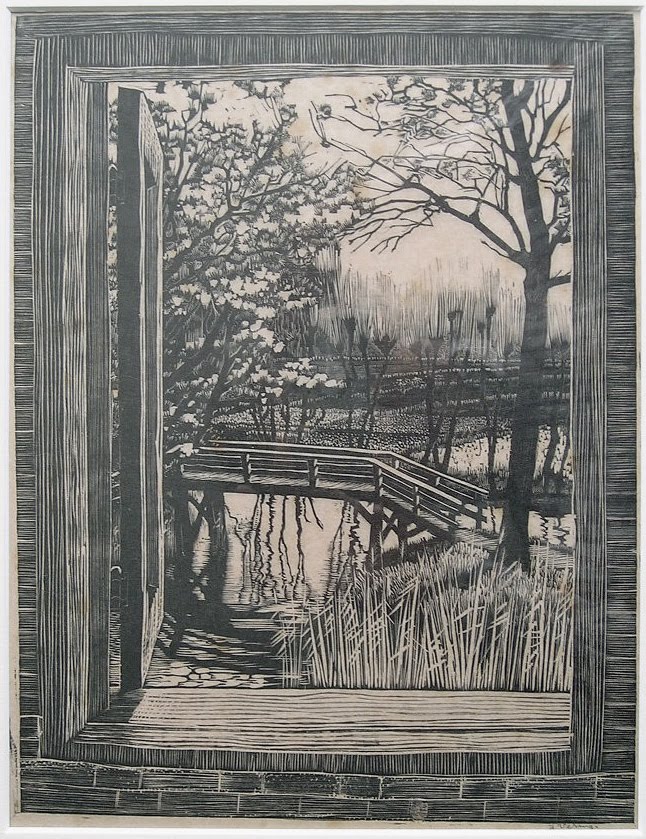 t (click) for the background details (skyline of the city of Haarlem)
The big beech-lane print is also very rich in details in foreground plants which are all identifiable and not a fantasy. I think he is "showing of" his skills as a woodblock cutter and printmaker and I honestly believe it is without comparison and amazingly I never found a mentioning of this perticular print before.
His rendering of animals showing refinement and humour. His flowerpieces, in more traditional Arts and Crafts style, equaling far more famous artists in quality and composition. There are so many Dutch internationally aknowledged and renowned Arts and Craft graphical artists in that period. Jan Veringa is not really considered one of them. I think that is a mistake and I hope this posting will do some justice to his skills and talent.


