Showing posts with label Käthe Kuntze. Show all posts

Sunday, 23 July 2017

Käthe Kuntze: Forgotten Dresden artist (part 7)

Some more Käthe and some puzzling: 


In 1910 Käthe drew her parents at Hamburg St. Pauli "Landungsbrücke" the floating passenger quais in tidal river Elbe in those days used by ocean steamers and today in use as a busy station connecting Hamburgs mainland with its network of waterway's. It is also an important tourist destination.


It can be (it will be) a co-incidence but in that same year 1910 Emil Nolde (1867-1965) stayed and worked here in Hamburg harbour at this same location (above). 


It can also be seen this is the location where the ferries came and left so Mrs. and Mr. Kuntze and Käthe probably were boarding one of these ferries for a trip along the river, visiting downstream Blankenese, the giant  imperial docks where Germany's (war)ships were build, it's warfs and ships moored to and from all over the globe and its warehouses. 


We see Kathe's parents and their dog probably boarding a ship named "There......." (see the gangway of probably one of the harbour ferries). 

----------


And then there's this lovely etching: "Strand-Idylle 1912" of a mother and three children and iconic beach chairs ("Strandkorben") my first impulse being: this might be Noordwijk on the Dutch North-sea coast. 


Noordwijk was Max Liebermann's summer retreat (the two drawings above).  He painted here every year between 1905-1913 and his many beach scenes and depictions of Noordwijks Lawn Tennisclub in etchings, drawings and oils are world famous. His friend, Berlin art dealer Paul Cassirer, owned a villa in Noordwijk overlooking the sea.  


The family believes Käthe's beach and dunes works were all created visiting the German North-sea or Ost-see coast. I ask readers to help identifying these locations.


The flag of Schleswick-Holstein (Blue-White-Red) the province north of Hamburg is faintly visible in some of her paintings while the Dutch flag is the opposite.


Schleswig-Holstein                                                Netherlands
But in Käthe's legacy is also this water color showing, unmistakable, a Dutch, Noordwijk (or nearby Katwijk) house and a local fisherman wearing wooden shoes suggesting she probably did visit the Dutch coast.

Käthe Kuntze: Noordwijk ?
Max Liebermann: Noordwijk.
Noordwijk: fishing village in the dunes 

All help identifying the locations of works in this posting + the possible name of the ship in Hamburg are much welcomed.


All pictures borrowed freely from the Internet (and with kind permission of the Kuntze family) for friendly, educational and non commercial use only.           

Friday, 21 July 2017

Käthe Kuntze: Forgotten Dresden artist (part 6) and Julie von Paul-Drowetzky.

Ginstersstrauss - Broom bouquet
Window overlooking Radebeul  
Busy organizing the works created by Käthe Kunze and made available for sharing by Käthe's relatives and working on her biography I recently stumbled over several drawings by a hardly known and equally obscured and forgotten artist. She also lived and worked in Dresden and may have travelled passed Käthe's house on her way to "Zum Pfeiffer" in Radebeul for a days sketching. 


"Zum Pfeiffer" was, and still is, a ***restaurant and popular panoramic weekend goal, to meet and enjoy a glass of local wine, a beer or a lunch on the terrace overlooking the many wine estates and river Elbe and enjoying the wonderful views. 


The restaurant is roughly situated at the same heights as the Küntze residence and maybe  600 meters away. So here are some more works by Käthe created in and near her house joined by Julie von Paul of whom I would love to know more. I share her biography scratched together from the few bits and pieces I was able to find.
"Andenkirsche, Peruanische Blasenkirsche, Judenkirsche"
Phylalis Peruviana


Like Käthe Julie von Paul found inspiration near her home and this "Hosterwitz" garden scene (below) is the only known other work by Julie von Paul. She is not mentioned in any artist lexicon. Hosterwitz is situated 6 km. upstream of Dresden, Radebeul 4 km. downstream.   


Julie Elisabeth (Elsbeth) von Paul-Droweztky

(Kimahlen estate near Goldingen in Kurland, Russia (now Latvia) 24-11-1864 – 1945 Hosterwitz near Dresden)
Painter and drawer. Studied in Dresden under Johann Walter-Kurau (1869-1932) and Georg Erler (1871-1950). Kurau also came from Latvia and ran a painting school in Dresden. He was of great influence and taught several other later well known printmakers. She is known from a port-folio with 8 drawings of panorama restaurant “Weinschänke zum Pfeiffer” in Radebeul Dresden situated not very far from the home of painter/printmaker Käthe Kuntze. Drowetzky is a not common Polish/Russian name. (In 1864 a miss Melanie Drowetzky in Mittau (Latvia) is mentioned donating one roebel to the church). 


Kimahlen is a Manor House near Goldingen (Kuldiga) in Latvia owned in the 1860-70’s by baron von Buchholtz and baroness von Offenberg suggesting Julie's father worked or was employed at the manor. In the later 19th century Kimahlen changed hands and was owned by several Baltic citizens of importance. Julie's known adresses:

Dresslers Kunsthandbuch 1921: Riga (Latvia), Artilleriestrasse 3. Member ADK, DrKG, VBK
Dresslers Kunsthandbuch 1930: Schloss Pillnitz (Hosterwitz) near Dresden. Member DrKG,VBK, RvbK.
----------------

All pictures borrowed freely from the Internet for friendly, educational and non commercial use only. 

NB: All works by Julie Elsbeth von Paul shown are currently offered by a Dresden art dealer in Ebay.      

Wednesday, 12 July 2017

Käthe Kuntze: Forgotten Dresden artist (part 5)

Käthe Kuntze 

(1878-1969)


After finding a portfolio with mixed works (drawings, etchings, lithographic prints, watercolors and a collection of prints by her Dresden artist friends) by deaf Dresden artist Käthe Kuntze in an auction last winter I started sharing its contents in 4 postings with the results of my research March 31th. Two weeks ago, a surprised and pleased family member finding these postings contacted me and shared details on Käthe's life and her family updating her biography that will be included in the upcoming book. The family also allowed me to share and show some never before shown in public marvels by her hand that are safely in the private collection of Käthes relatives. 


And I am also happy to announce some very personal and unique works by Käthe from that portfolio once belonging to Käthe are now on the way home to her relatives taking care of and watching over her legacy. She had a very close relationship with her parents Albert (1842-1933) and Marie (1852-1941) who encouraged her artistically and probably watching over her and her career living in the keepers lodge of the Villa.  


Her father Albert was also a well known entomologist (insect expert and collector, at work above and drawn by Käthe) and keen painter. After receiving  Alberts portrait (detail) it was also possible to determine an etching from the portfolio, "Gartenrestaurant", also shows her parents.


This adventure started with finding a picture of her print "Sonnenflecken" in a Frankfurt catalogue. Besides the relationship with her parents she obviously was very attached to her homestead, her only sister Helene and her family, the beautiful villa of her parents build by her father, her studio and the lovely countryside. This part of Germany is the home of many wine estates, grand villas, health Spas, overlooking river Elbe.


"Sonnenflecken" was for a long time the only known example (known to me) by this neglected and obscured artist, the result of my research now resulting in opening a treasure cove. These new examples also prove as an artist (with a handicap) she needn't go far away for inspiration (although her father enabled and financed her traveling abroad with Dresden colleaque Martha Schrag (1870-1957).   

The Villa Albert Kuntze as it is generally known in Radebeul near Dresden was also called Villa Hohenberg by Käthe. It is also remarkable Käthe, her sister Helene and both parents all lived to very respectable age (89-91 years). 


More wonderful woodblock prints by Käthe to come in next posting !
--------------

All pictures shared with kind permission of the Kuntze family for friendly, educational and non commercial use only !      

Wednesday, 5 April 2017

Käthe Kuntze: Forgotten Dresden artist (part 4)

Käthe Kuntze
(Part 4)

I have this "feeling", a hunch, the bundle of prints, documents and drawings once may have been in the possession of Käthe: things she kept for herself. There are notes to her printer with detailed requests for altering the plate of one of her etchings. Some have scribbled "Eigen" (own or personal) in a corner and several prints seem (to me) or at least could have had a personal meaning and significance. Besides, who else would have had a reason to keep this mixed and varied lot together besides herself or a close relative ? 
Farbholzschnitt, color woodblock print: Pianistin 

Any way, let's continue with sharing some more works I've discovered and in the meantime did my best conserving because they have been suffering from long time neglect although most of them were in pretty good condition.


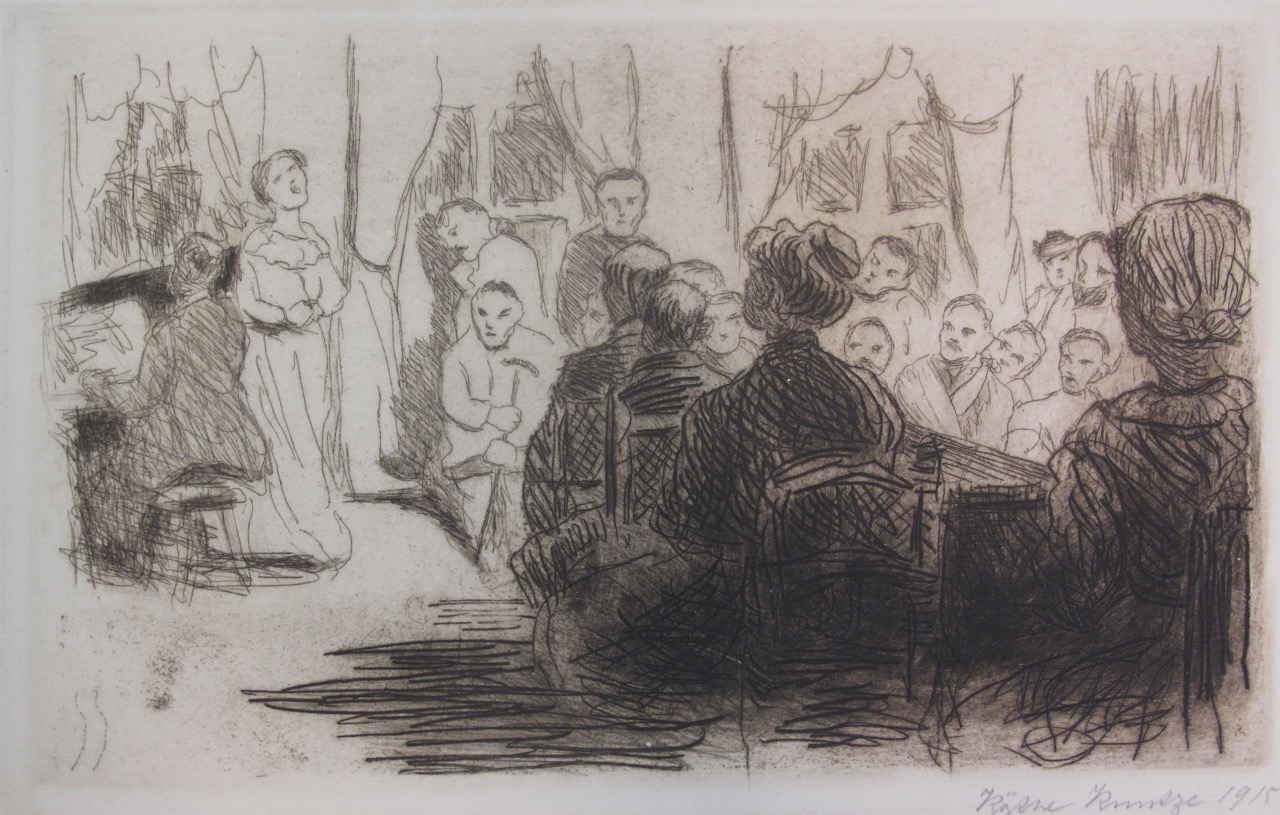
To begin with: it is remarkable there are several prints with musicians. Remarkable because Käthe was deaf mute and was therefore just an "eye witness". All of these works show great intimacy. 


Portraits, a house concert (recital) and a pianist. Could the young violinist be a relative, a brother or nephew and the pianist her sister or a niece ? Pure speculation of course. Hopefully we'll know the answer one day.  I've notified the local Radebeul Museum/Gallery of my treasure. All reactions will be shared.   


The room in the 1915 house concert/recital etching (without title) has two more interesting features. The windows are "similar" to the windows in her aunts house (I agree this is purest speculation) Haus Albertsberg (see before posting). Could it be ?


And secondly closely examining the audience: the men in the audience facing us are probably wounded soldiers ("Kriegsopfer"), the sitting man holding a crutch. This is obviously a charity concert. This would fit very well to the social status of the Kuntze family, "noblesse oblige" after all.


In the bundle were several other works showing Käthe's personal and social commitment and her keen eye observing children. I particularly like this 1915 lithographic drawing above titled "Kriegsopfer", Casualties of War. The composition (it reminds me of Felix Valloton) is brilliant and has several layers of interest, a message build like stage. Käthe who was deaf and mute is obviously trying to tell us something here in something much stronger then words: a haunting image that is carved in the soul inviting to commit oneself to some serious reflection. 


And maybe it is also to demonstrate a statement opposing war glorifying pictures like the drawings by propaganda artist Curt Schulz-Steglitz.  

The family in the foreground: a young mother with head bend and looking worried, deep in her own thoughts, the boy looking up at his mother (and uncle/father ?). An older women (a mother ?) on the right who could be in mourning. The company sitting in a shaded terrace in a busy street (Dresden ?), the men (the young man with iconic spiked helmet on leave from the front ?) observing the scene on the pavement, in the distance, but nearby just on the other side of the street: a girl offering flowers to a soldier who lost his leg in Flanders trenches. 1915. Closely examining this is a heart breaking and strong political message from a young women in the middle of an atrocious war. And what to think about the horse entering the composition on the right.....? Knowing more about the Kuntze family possibly can tell us also more about her personal involvement with this and other scenes. 
             

In these also created in 1915 large lithographic drawings, she shows, confronts us with "Soldaten spielende Kinder": Children playing soldier. Children do, but should they ?


This also counts for (above) "Kriegstrumpfstricken" children knitting soldiers socks as a war effort, the coordinated mobilization of society's resources. And below: "Abschied". Very powerful and at the same time moving images. 


Abschied, Adieu, Farewell !  
---------------------

And there's more to come. When you find these postings on Käthe Kuntze: please comment or contact me with more known works by Käthe and if possible biographical facts concerning the Kuntze family in Dresden-Radebeul for sharing. 

PS: Thank you Wolfgang in Frankfurt for translating the always difficult to read written in "Sütterlin"script titles. 

Tuesday, 4 April 2017

Käthe Kuntze: Forgotten Dresden artist (Part 3)

It could well be Käthe also participated in a 1906 Arts and Crafts exposition in Dresden because this poster sized document ("Plakat") was also found in the bundle of material. It is by Dresden graphic artist Georg Erler (1871-1951) of whom also other works were in Käthe's possession suggesting a friendly and/or professional connection.


What I know about Käthe's family follows here. Biographically it is less information then in many short biographies, but keep in mind it is far more then a lot of others too. In this case it may be due to the fact of the near total destruction of Dresden in 1945, historical or artistical neglect, and sometimes  families die out for natural or catastrophic (Holocaust) reasons. Along my years of research I've met examples of all these causes and possibilities. It may also be because certain families may have shielded personal or genealogical information from the internet for privacy reasons. Which shall be respected. 


"Blühende Flieder", 1917.
For instance I do not know when Käthe died (latest mentioning is in 1930 "Dresslers Kunsthandbuch", she is not in the before 1921 edition), nor the name of her mother and other family members, did she have brothers and sisters ? Hopefully these articles and the books publication will bring more to light eventually. My research (women artists born 1850-1900) has learned Käthe  families social status is at the top end of what is more or less "common" for artistic women born and, more importantly, bred in the second half of the 19th century. This is however not an exception.


Käthe was the deaf-mute daughter of Albert Kuntze a banker in the Dresden firm of Albert Kuntze & Co. founded by his father Friedrich Albert Kuntze (born around 1820 - 1892). In 1857 Albert sr. had bought Haus Albertsberg in Radebeul, Niederlößnitz near Dresden and had it refurbished to his wishes. It is a beautiful region just North of Dresden on the slopes of river Elbe with many vineyards, old wine houses, health Spa's and luxurious estates and villas. 


Albert Kuntze must have done very well because after his death his 4 children commissioned celebrated Dresden architect Oskar Menzel (1873-1958) to design, build and rebuild their villas in Radebeul.


1  1) Aunt Thekla, inherited her fathers Haus Albertsberg and had it rebuild and restored into a Barok villa. 


2) Aunt Frida (d.1945) married gymnasium teacher Karl Sommer (he died in 1899) and they commissioned “Villa Sommer” (build 1899/1900) at Radebeul, Oberlößnitz, Augustusweg 44 and within sight of her former parents and now her sisters "Haus Albertsberg", Frida Sommer-Kuntze lived there as a widow with a son, (Käthes nephew) after her husband died before the house was even ready. After WW-II the house became neglected but recently it was restored in a 5 year during restoration into its former glory and splendor. 


3) Uncle Max (Friedrich Albert Maximilian) Kuntze (1846-1917), banker in Albert Kuntze & Co, “Kommerzielrat” (honorary titel), member of Parliament and owner of  the “Ersten Kulmbacher Exportbier-Brauerei”, director in the "Dresden Papierfabrik", owner of several building companies and “Elbsandstein” industry. He build Villa Max Kuntze (build 1898-99): Radebeul, Niederlößnitz, Jagdweg 6 (below upper right).


4) Albert Jr., Käthe's father, banker (Albert Kuntze & Co.) build Villa Albert Kuntze, (1899/1901, Radebeul, Lößnitz, Hohenzollernstrasse (renamed Obere Bergstraße 14) with keepers lodge (see first posting) at its entrance, where is said lived and worked Käthe.


Villa Albert Kuntze and lodge at entrance (red roof)  

Now look back at the woodblock "Blühende Flieder" (Flowering elderberry) with which I started this posting. It gives such great pleasure and satisfaction, 100 years later being able to determine were exactly it was created. 


In the collection was also this watercolor. It shows her father Alberts dog "Lupin" (written on the back in pencil). It is moving to see where Käthe and Lupin once were so at home. 
  

In the meantime if you have any information about Käthe's family, know works by her or otherwise: please contact me. I also would love to know how this collection travelled from Dresden to Hamburg.  


Many more spectacular and surprising examples of Käthe Kuntze's art and her "Konvolut" will follow soon.

----------------------

All pictures borrowed freely from the Internet for friendly, educational and non commercial use only.