Showing posts with label Rembrandt. Show all posts

Tuesday, 26 April 2016

Rembrandt: Chaumière au grand arbre.

Barn with large tree 

("Chaumière au grand arbre") 
(Cat. B.226) 


Some time ago I (a flying crow....) stumbled over this battered, glued and browned impression of an etching in a broken frame. As in before posting it had evoked a "deja vue": I was sure I'd seen this composition before. Besides falling in love instantly (as a romantic it happens to me all the time), the frame told it was fabricated in a well known, posh, shop and it held an old (auctioneers) price tag. But even without those indicators....................... 


It measures roughly 25 x 42 cm. and it is (part of) an interpretation (not a copy !) of Rembrandts "La chaumières au grand arbre" (the barn with the big tree), catalogued as B.226. It's roughly twice the size of the known original. The right side is missing (I think, or maybe it was left out....). But even so it's very decorative and I would dearly like to know who made it, and when.  


In 1640 Rembrandt made this drawing, below, an etching of Amsterdam (catalogued B.210). Small as it is (a tiny 11,3 x 15,5 cm.) it shows the city with church towers, the harbor with ships, and the landscape with mills surrounding the city seen from the north side of the Y. 


In 1641 he drew two separate landscapes with a farm: one to the left and one to the right of his earlier vantage point in an oblong (13 x 32 cm.) format. Put together they form a wide angle view or panorama of Amsterdam. (B.226 and B.225), something like this:
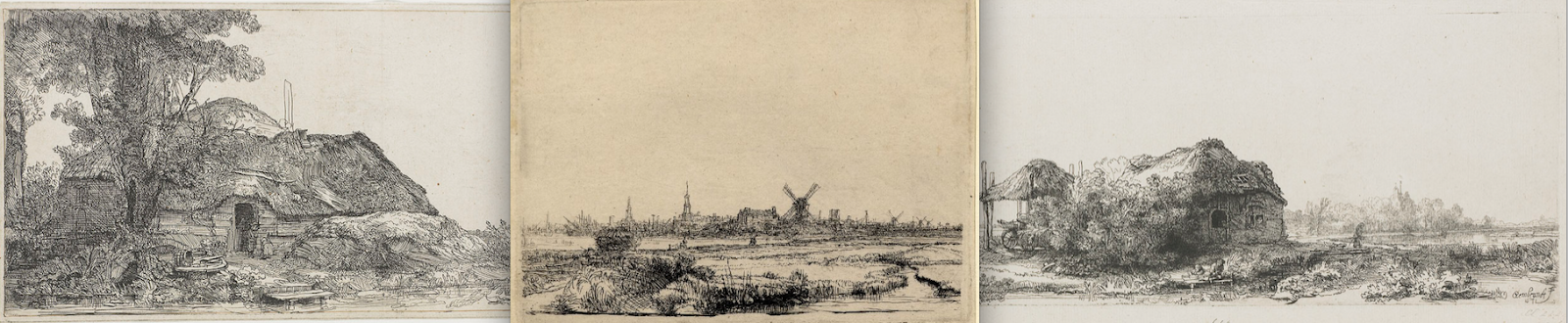


Master engraver Amand Durand (1831-1905) who was commissioned by the Louvre Museum director to restore its collection of worn Rembrandt plates used a revolutionary "reversed method" invention. A fine and original paper print was used to produce an etched image in a fresh copper plate with the help of an electric light: the Heliogravure. It could take up to 6 months to create an image. But then it was accurate within 1/100 of cm. to the lines drawn by the hand of Rembrandt himself. Needles to say these limited Durand (re)prints are highly sought after and recognizable from a red seal on the back. 


The Heliogravure technique, after Durands epic mission, was quickly abandoned: it had been used to prints stamps and it was so good it could also be used to forge paper money. 

After Charles rapid comment (thanks) I found this: William Baillie (1723-1810) known for his many "after" Rembrandt etchings................. 


All pictures borrowed freely from the Internet for friendly, educational and non commercial use only.

Monday, 25 April 2016

Marius Bauer: Susanna or Saskia ?

Recently I discovered this intriguing and charming etching in a fair. Going through a pile of other "stuff" this one stood out and since I could not find any new works created by my German woodblock printmaking ladies, I decided she was to be my fair consolation. 

What had caught my eye, and interest, was the Rembrandtesque light, the sketch like drawing and the slightly familiar interior and pose of the startled girl. See also the subtle slipper lower right. In both works ! 


It is obvious the artist was inspired by Rembrandts Susanna (but without the dirty old men euphemistically named.. "Elders"). 


And that she is actually situated in Rembrandts house (preparing and looking towards the bed) is maybe another a clue. This artist knew his Rembrandt (1606-1669) and showed his admiration in this "pastiche".
Rembrandt drew his love Saskia in the "box" bed. And she may also have been model to the most lovely, intimate and spontaneous nude drawings I know.


Even during his life Rembrandts sketches probably were inspiration for others. I can't help suspecting Rubens was inspired by Rembrandt in his Susanna (1636-40), but I'm not an art historian. 


It is known, Rembrandt probably was on his way with Hendrikje, his later wife, to visit her parents that Rembrandt stayed in the city of Amersfoort in the early 1650's. Here lived  his colleague Paulus Bor  (1601-1669). This location, the Westersingel, very near the place where I learned to play the piano. 300 years later.. 


Paulus Bor, sitting nude  ------------------

There has been a signature, obviously, but it looks like it has been clumsily erased. Why ? After some research I found this etching listed in the catalogue raisonée of one of the most important (consider by experts "the best") Dutch 1880-1930 etchers and "orientalist" Marius Bauer (1867-1932) and there it is titled "Saskia". 


The residue of the erased signature however resembling the signature seen in etchings by Etienne Bosch (1863-1933). Sadly the print has no margins. Another clue why the erased signature, was within it's borders ........A clue but not an answer. 


Etienne Bosch had been a class mate and friend of Marius Bauer in the Hague Art Academie (studying there 1880-85, yes Bauer entered aged 12 !). Like Bauer, Bosch probably shared the same teachers and thus also had been a student of controversial George Breitner (1857-1923) a most celebrated post-impressionist and early photographer who had once claimed Vincent van Gogh paintings were: "Art for Eskimo's"................ I think this was not ment to be an advice hanging Vincents colorful paintings in an Greenland iglo. It had to do with the colors Breitner could not approve of.  


 Bauer and Breitner, student and master.
Both considered controversial in the Hague's Academy. Both left.  

Who knows, Bosch "cheated" with Bauers copper plate and changed his mind later. There can be multiple explanations. As long there's no copy of the etching with Bauers actual signature I'll stay doubtful about the attribution. The original plate, but without makers markings or signature is said to have been found together with 50 others (by Bauer) and is now kept in Bauers reference collection. But "found together" is no proof either. 


Both men were involved in the "Nederlandse Etsclub" (Dutch Etching Club 1885-1896) and consisted of some 28 leading Dutch graphic artists publishing and promoting their work and organizing exhibitions showing the international graphic works of contemporary colleagues: Degas, Whistler, Rops, Pissarro and many others.  
         

All pictures borrowed freely from the Internet for friendly, educational and non commercial use only.