Saturday, 30 December 2023

Dick van Luyn in Paris (1920s)

Dick van Luyn (1896-1981) 

was a Dutch painter and graphic artist known for his etchings and linocut printmaking. After collecting some of his linocut prints this Paris etching of great charm was recently acquired from a collection that is being dissolved. The path of most collections. 

Pêcheur sous Pont Neuf 5/25 

This posting is to see if there's a clever way reviving this Blog and combining it with:

Das Haus der Frau

the new Collection Gallery and Website. A display of an exceptional collection of colour woodblocks by German pioneering women printmakers born 1850-1900. And many, many more things of beauty and interest.  

Visit "Das Haus der Frau" (www.dashausderfrau.nl) or follow the link to this artist's recently added representation:

https://www.dashausderfrau.nl/luyn-dick-van.html

Wednesday, 27 December 2023

Unknown Dutch artist: P. Huijsman

 P. Huijsman - 1977


These two "minimalist" and typical Dutch landscape drawings (they look like pen and ink drawings but are actually highest quality lithographic prints in an edition of 25) were found only recently in a bundle of graphic waste and surplus. The pollards in particular were an unexpected but very nice addition to my  collection of "Pollards in Art".   

Although I tried: the identity of the artist P. Huijsman (is what I read) remains a mystery. All help or suggestions are welcomed.  

Pollards: courtesy Dutch photographer René Moorman.

--------------------

Re-acquainted with "the joy of blogging" and finding a small but still faithful group of followers and interested readers, the Linosaurus may show signs of resurrection in 2024..............  


Monday, 25 December 2023

Suprise !

 Martinus Ursul Marie Gewin (1900 - 1976)

(obscured German artist born, lived, worked and died in Obermenzing near Munich) 

Although my active Blogging days are over, for sentimental reasons this special Xmas 2023 contribution. 

To my surprise I saw this humble Blog passed

1.000.000 visits !

eBay sometimes can be a real and unexpected treasure cove for those who are interested in art combined with history. Every day estates are being cleared, collections dissolved. Bundles of "old paper" are found in house clearings, in car boots and flea market. Interesting material surfaces, washing-up on the shores of history. 

Roaming eBay offers for interesting for my collection of woodblock prints by pioneering German women printmakers these stylised drawings of a typical Duch sailing ships probably seen in or near Rotterdam but surfacing a century later in Frankfurt-am-Main was what initially drew my attention.   

The small collection (a dozen pencil drawings) offered in eBay revealed some more interesting material including this 1920 pretty accurate drawing of the Hooge Brug in Overschie with the roof of the iconic "Vlasfabriek" in the background. 


Digging into the identity of the forgotten German artist, who happened to have Dutch aristocratic roots, the research ended (for now): 10 generations before in Merseburg near Leipzig in the beginning of the 17t. century. Although captain lieutenant Hans Christoffer left this world in a duel he managed to produce one son in his short marriage. This son's off-spring became rich dealing in cloth in Amsterdam, Rotterdam  and Leiden. The Gewins married into Dutch nobility, became pastors, scolars, manor owners, doctors and architects. And stayed faithful to their Dutch native city of Delden for three centuries. 

Ancestral lineage.  


2 Johan Christoph Gewin (Delden 1869 - 1942 Heidelberg) architect living Merzeburg and Heidelberg married 1: (ended in divorce): Olga Maria Diepold (b. Munich 1873 -?).  Married 2: Johanna Gezinena Stork (1875 - 1925). Married 3: 1930 Anna Cornelia Salm (b. the Hague 1900).


3 Dr. Marinus Gewin (Huissen 1839-1911) over 40 years working as physician in Delden married 1: Anna Salm (1842-1870)


4 Jan Christoffel Gewin (Rotterdam 1808-1887) married Justina Johanna Petronella van der Schooren (1802-1840)


5 Coenraad Gewin  (Amsterdam 1777 - 1831) married Anna Maria Ledeboer (1783-1840)


6 Jan Christoffel Gewin (Delden 1751-1808)  married Maria van der Port (1753-1815)


7 Coenraad Gewin (Delden 1705-1767) married  Elisabeth Werninck (1713-1765)


8 Johann Christoffer Gewin  (Delden 1674/87 - after 1743) married Maria Lentelinck (1671-1743)


9 Hans Christopher Gewin (Merseburg near Leipzig 13-10-1644 - before 1678). Married Ootmarsum 1674 Anna Sophia  Staverman, daughter of mayor Egbert Staverman. He served as captain.lieutenant in the“Regiment dragonders van de Heer Overst Berlepsch. Said to have been killed in a duel.  


10  Georg Gewin (ar. 1610 -1656), judge in Merseburg married Maria Benigna (1613-1661).


Martinus' father Johan Christoph was a Dutch architect who, after 8 generations re-immigrated from the Netherlands to Obermenzing starting his career, marriage and family. Remarried with a 30 year younger wife he lived from 1930 in Heidelberg. Martinus returned to the Netherlands as a young man to visit and draw and even came to live here for a while in the 1930's but eventually returned to Germany. 


For those interested in this artist: I passed the offers and the whole bunch is still "on offer". Among them are some interesting and artistic drawings of historic villas in Aerdenhout. 

Merry Xmas 2023 

(do visit my new website & collection: www.dashauserfrau.nl)


Monday, 8 August 2022

 GET LOST  !


in 

DAS HAUS DER FRAU

4 months after starting my private collection Website the main structure is standing. 

Although far from ready, there's enough to see, explore and discover on a rainy day. 

Admission is free !

Thursday, 14 April 2022

New website

Under construction

(Daily uploading of collection material to the gallery).  


___________________________________

New Book 
2 Volumes - 475 pages
(limited private edition, 20/25 available)  


Return and resurrection of the Linosaurus 


Tuesday, 29 September 2020

Hildegard Schwartz : Lübeck and the Mondschein sonata

 Hildegard Schwartz

(born 1890/91 - 1960 Niendorf) 

Forgotten Schleswig printmaker and illustrator

Finding a new, not mentioned before, forgotten printmaker with a nice find (print) after so many years of researching women German printmakers, is not an every day event. It happens sometimes with the help of friendly readers, fellow collectors with a heart for history and combing the beaches and shores of auctions and washed-up and discarded art: Ebay.


As a printmaker Hildegard Schwartz obviously is not acting in the same league as f.e. Helene Mass or Helene Tüpke-Grande. Besides: the  print is hand coloured (by her ?) which is not exactly every prints collector's cup of tea..... But charming it is 


Some investigation learned Hildegard happened to be a typical local artist, illustrating local publications on local history. The half a dozen prints I was able to find show local landmarks, the surrounding villages and landscapes. She was however pretty accurate in her designs. 


About het life (where was she born ?, who were her parents and her family ?, typical starting questions for the biographer) almost nothing is known. I have a hunch she was of local, possibly Lübeck descent: she studied locally. Hopefully an interested person "on the spot", interested  in local history joins in ....  

She studied in Lübeck, acted in the Gothsmund artist colony and lived in Niendorf (not far away village on the coast (where "her family had a summer house"...........) and where she also is buried.  


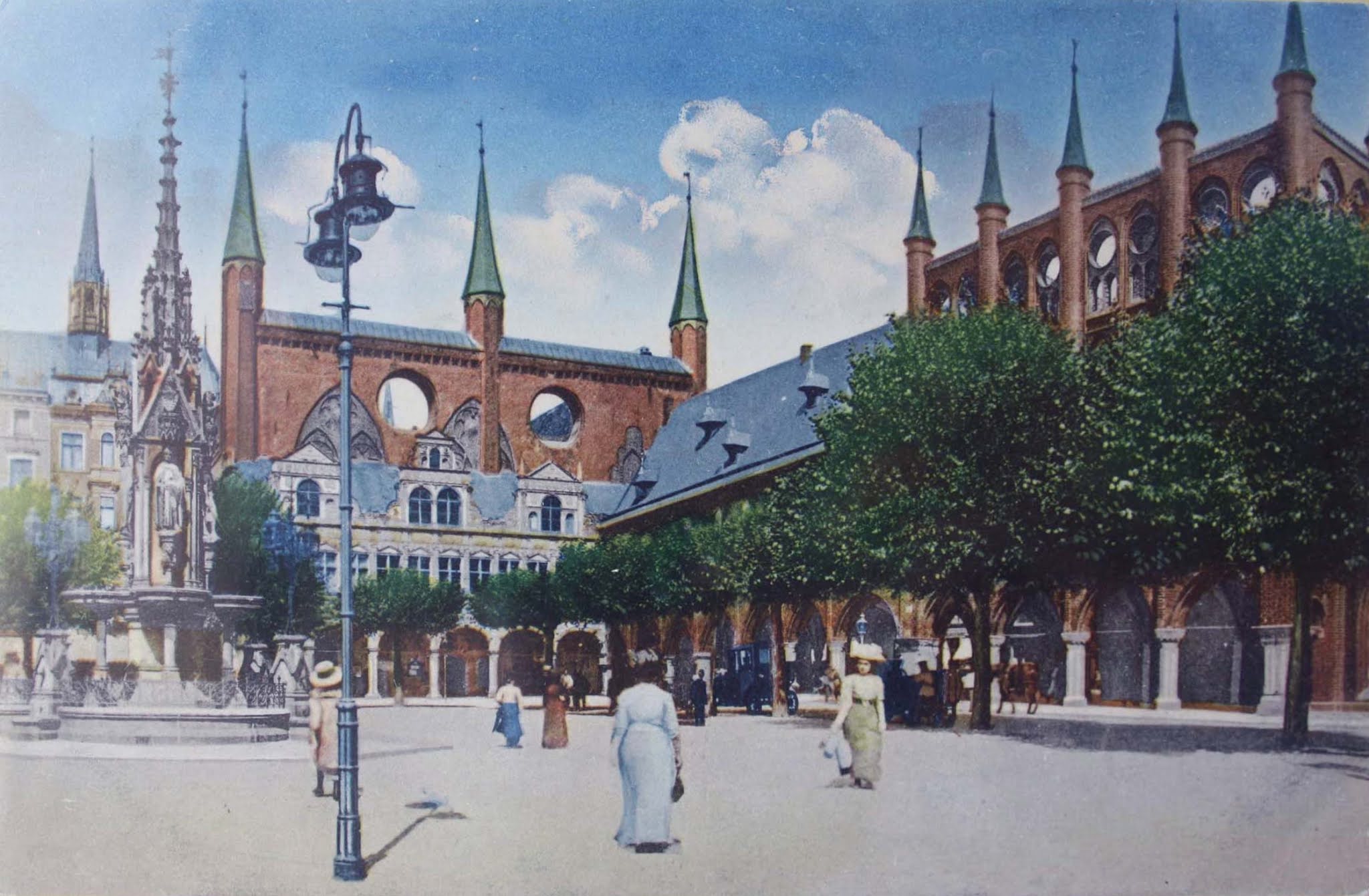
Lübeck: "Marienkirche, Markt" and "Rathaus" 


Lübeck before March 29th 1942 was one of the most beautiful well preserved medieval Hanseatic trading cities with a rich history and a wealth of historical buildings situated on the Trave river and estuary. It had Germany's most beautiful  and preserved "Rathaus" or city hall dating back to the 11th and 12th century. It lies east of Hamburg, and south of Kopenhagen. It was for centuries the gateway to the Baltic: to Stockholm, to Danzig and Saint Petersburg. 

400 tonnes of bombes dropped by RAF Bomber Command in a perfect frosty moonlit night turned it into rubble. 


A first (!) retaliation for the destructing of Coventry (and the Baedecker raids) two years earlier in what the Nazis named "Operation Mondschein Sonate"......(they had a euphemistic name for all their atrocities). An eye for an eye....    Historic Hamburg, Dresden, Berlin and dozens of other German cities were to follow, Lübeck was just target practising.....  Tooth for tooth...... Hammurabi's Law.  4000 years of civilisation, or was it marking the end of it ? Had there been another, a civilised way ?


Hildegard saw the still peaceful market presumably around 1930. She lived nearby and possibly was born here. People dressed in winter cloth but the one tree (in the centre) still in leaves: october, november ? Children looking eagerly to the balloons: no cell phones yet. 


Lübeck was rebuild, where and if possible, to its former glory, like Coventry, Berlin, Hamburg and Dresden were eventually rebuild. Mankind is great in repairing and rebuilding. We are the absolute champions in repairing and rebuilding. We have to be. The weakness and eventually "Untergang" of our destructive species is our greed and disability to prevent destruction. To prevent destruction while playing the Mondschein Sonata. All other species on the planet seem to have a build-in warning and survival strategy: not to completely destroy the environment from which it evolved and in which it lives, not destroying the environment of its neighbours. There seems to be something fatally, Pathetically wrong in our design.  


   Detail of "Das Lübeck Spiel", illustration by Hildegard Schwartz

All fresh information on Hildegard Schwartz is very much welcomed: gerbrandcaspers@icloud.com

-----------------

Hildegards short biography will be part of the upcoming (this winter) publication:

Das Haus de Frau (Vol. III)*

1914-1939: BUGRA Leipzig revisited 

An ABC, a Lexicon, a Who is Who containing 400 pages of short biographies of hundreds of German women printmakers born 1850-1900 pioneering and active with woodblock printmaking 1900-1935. Their Dutch, Scandinavian and Baltic sisters, the art galleries, academies, artist associations, many of their male colleagues, the roots to the Paris printmakers, their schools (not being allowed to study in the Academies), their teachers and inspiration etc....  

    * This volume accompanying my collection of prints presented in Volume I and II.

Many (most) of the best loved artists-printmakers of pur times before were still never properly researched. They are collected by their name and fame and at best dates of birth and death. 

"Collecting art without knowing about the artist is like collecting stamps without a catalogue"............

The identities, lives and careers of hundreds of forgotten artists revealed; disappeared and murdered Jewish artists retrieved, links to addresses, schools and colleges, exhibition and gallery records and work inventories etc...   

Sharing my archive of 20 years collecting biographic notes and the result of many years of research.   

The publication date will be announced in this Blog. 

The first edition will be available and printed by subscription only 

(Please wait:  no reservations before). 

------------------------

All pictures for this Blog article borrowed freely from the Internet for friendly, educational and non commercial use only. 

Saturday, 19 September 2020

Roman Black (Blachowski) (1915-1969): Unknown British printmaker

Roman Black 

(Poznan 1915 - 1969 ?)

 too good to stay unknown 

 Polish-British printmaker 


Three Graces (linocut) 


This copy of Roman Blacks 3 graces was found in the National Gallery of Victoria in Melbourne Australia; it was purchased in 1955 from the Estate of the artist. It is the only example of his printmaking I was able to find after stumbling over it accident, researching the various classic 3 Graces engraved and lithographical copies after antiquity sculptures and old-master examples.


It is distantly reminding of the 3 Graces (painting) by his contemporary Austrian painter and graphic artist Otto Rudolph Schatz (1900-1961)


Roman Black was born in 1915 in Poznan (Poland) as Roman Ian Błachowski where he studied geography. He might be related to a prof. Stefan Blachowski (1898-1962), a psychologist and after WW-II rector of Poznan Academy. Roman Blachowski is the author of 20 scientific papers in the field of geography published before 1940. 


Before WW-II he was interested in painting and had his first exhibitions in Poznań. The war found him in Great Britain where he took the pseudonym Roman Black. After the war ended he studied, among others at the Polish School of Painting in London, exhibiting his work in London and Madrid. 


His naturalisation was approved march 10th 1949 (“seaman and artist, living 15 Winchester Road”). He is only otherwise known from a series of colourful linocuts with Spanish landscapes kept or exhibited in Poznan, but I could not retrieve any pictures.  


A 1959 watercolour showing the historical bridge in Mostar in (Bosnia-Herzegovina) was auctioned as a lot of 4 in a 2018 sale (+ “Teatro Roman, Verona” and two others) by Roseberys in London. 


All pictures borrowed freely from the Internet for friendly educational and non commercial use only.