Monday, 14 December 2015

Sergej Kolesnikov, life and Mongolian prints.

Kolesnikov, Sergej Michajlovic 
(Kalgan, Zhanjiakou/China  25-01-1889 – 10-09-1952 Weixdorf near Dresden)

Painter, sculptor and printmaker. 

Thanks to faithful reader Tom in Boston (his insomnia sometimes leading to nightly internet excursions) occasionally new (to me) artists are brought to my attention. Like this interesting painter-printmaker (and sculptor) with a famous name-sake also signing S(tepan Fedorovitch) Koleshnikoff (1879-1955) but who was not related (follow the link meeting the works of this most interesting painter). Doing some homework I managed to find 5 woodblock prints by Kolesnikov from earlier auctions etc.. and composed this biography and  blog posting. 


Sergej was the son of a Russian consulate official growing up in Kjachta on the Siberian-Mongolian border. He started in 1908 a forestry study in St. Petersburg and travelled through Russia, followed by an artistic study 1910-1913 in the painting school of Leon Bakst (1866-1924) in Petersburg and a student of Kusma Sergejewitsch Petrow-Wodkin (1879-1939). 


In 1913/14 he took part in a scientific geological expedition in Mongolia exhibited for the first time with “Mir Iskusstva” (World of Art)(*) in St. Petersburg as a member.


He served as an aircraft pilot in WW1 and was later in the artillery. After WW1 he lead the art department of the Moscow “Proletkunst” also working as free creating artist. 


In 1925 he was send by the WOKS(**) to Berlin to study West-European art. Exhibiting 1926 with Amsler & Ruthardt in Berlin and later also in Königsberg, Leipzig, Cologne, the-Hague, London and Oxford. Travelling to Paris 1927 and 1930 living and working in Berlin 1929-1943 losing everything by the bombing of the capital he moved to Weixdorf near Dresden. Member of the “Verbandes Bildender Künstlers” in Dresden.  


Many of his prints and paintings show his love for the Mongolian landscape and its habitants and traditional way of life

*) Mir Iskusstva (World of Art): Kolesnikov no doubt will have been introduced and taught printmaking by Vasily Mate (Matai) (1856-1917) who was the pivotal figure in St. Petersburg   concerning the development of early Europenan (Modern) printmaking. Much like and possibly  even earlier as Emil Orlik in Berlin. Vasily Mate also taught Anna Oustramava-Lebedeva and probably St. Petersburg students Academy students and artists members of "Mir Iskusstva" Aleksander Laszenko and Vadim Falilieev. More in next posting 
    
(**) WOKS: Wesojusnoe Obschtschestwo Kulturnych Swjasei s Sagranizei = “All-Unions-Gesellschaft für kulturelle Beziehungen mit dem Ausland” = International foreign cultural relationships organization.


All pictures borrowed freely from the Internet for friendly, educational and non commercial use only. 

Monday, 30 November 2015

Thea Spangenberg, unknown Bauhaus student & printmaker

Spangenberg, Thea 
(probably Dorothea)  
  (b. ? - d. after 1935)

Painter, graphic artist and script/typographic designer. 
"Heraklen a.d. Brucke".
(Heracleum Sphondylium: "Bärenklau", Hogweed)


Thea Spangenberg is known to me by one colour woodblock (above Hogweed and Bridge) print in my collection and a  woodblock print titled “Rhodos 1935 that I've found in an old auction announcement which is strikingly similar, although simpler, in design to Emma Bormann’s (1887-1974) “Constantinopel” print. 


And there's this gouache titled “Winternacht, Erinnerung an Walpurgis 1909".

Walpurgisnacht: 30 April, so called because it is the eve of the feast day of Saint Walpurga, an 8th-century abbess in Germania. In Germanic folklore Walpurgisnacht is also called “Hexennacht”).     

The Weimar Bauhaus School’s archives has in its records a student Thea Spangenberg in 1919-1920. No further biographical details are known. Several typographical articles/ essays by Thea Spangenberg were published around 1930.

A 1922 woodblock calendar (and typographical proof ?) by Thea Spangenberg (similar to the “Wiener Werkstätte” calender designs) is in the LACMA (Los Angelos County Museum of Art, USA) collections.


Die zeitgemäße Schrift: Heft 14 (1930), “einführung in die Schrift”  (Thea Spangenberg, Düsseldorf); Heft 19, 1931“neue Wege zur Schrift ”. Edited by: Heinze und Blanckert, Berlin/Leipzig.

--------------------------

I suspect a possible family relationship (Greece and Walpurgis) with Berlin Acadamy painters Louis Spangenberg and his brother professor Gustav Adolph Spangenberg.

L. Spangenberg exhibited in the “Grafik und Aquarellen” division in the 1905 “Grossen Kunstausstellung” in Berlin. This, most probably, will be Louis Spangenberg (Hamburg 1824 - 1893 Berlin) an architectural painter living and working in Berlin who in 1857 had followed his brother Gustav Adolph Spangenberg  (Hamburg 1828 - 1891 Berlin) to Berlin and was also a painter and taught as professor in “Berlin Kunstakademie”. Their stepbrother Wilhelm Spangenberg (Hamburg 1819 – 1892 Hameln) was a politician. Of Louis Spangenberg it is known he travelled to England, France, Italy and Greece (*). Their grandmother was Dorothea Magdalena Sibeth (married to Peter Ludolph Spangenberg).

A family tie of these three brothers with a third painter active in Berlin, Paul Spangenberg (Güstrow 1843-1918 Berlin) is suspected. 


A woodcut (xylographic copy) of five witches on their way to the sabbat, titled “Hexenritt” [the Witches Ride] is known. It is dated 1870 and is a copy of an original drawing by Gustav Adolf Spangenberg (1828-91). In 1862 Gustav Spangenberg produced a large painting titled Walpurgisnacht” which is  in the collections of the Hamburger Kunstmuseum which  houses a large part of the paintings collection by these brothers father: Georg August Spangenberg  a doctor in Hamburg who had also lived for years in Rome.


This concludes or sums up about all I was able to collect on printmaker Thea Spangenberg. Maybe this contribution in future will help to bring some more information to light. If you happen to stumble over this Blog article and have any further information about Thea and the Berlin/Hamburg Spangenberg family I suspect she belonged to, please contact me. Any help is much appreciated. 


All pictures borrowed freely from the Internet for friendly, educational and non commercial use only.  

All pictures embiggen by mouse-click. 

Wednesday, 11 November 2015

Varia

A varied posting with help requested to identify some more prints and printmakers. 

Graz: Grazer Dom and rooftops 


Printmakers Carl Rotky (1891-1977) and Norbertine von Bresslern Roth (1891-1978) both were natives of Graz, but I'm very curious about the signature on this rather nice woodblock print: W. (Wilhelm, Walter ?) Hörgler, Hirgler ? (see also the Monogram in the block: WH


Unknown Printmaker: Girl with a scarf.


Carl Moser (1873-1939) certainly was intrigued by scarfed and bonneted (Brittany) girls, but also by the fabric and patterns of lace, cotton, dresses, cloth etc.  He for ever was experimenting, changing and altering designs, horizons and compositions seaking perfection as I am planning to show in next posting.  


And because of the attention to fabric and patterns this print reminds me also of prints by illusive printmaker Dagmar Hooge (1870- after 1921).


Until a good signed example or copy shows up only the help of a reader who recognizes this print may help to identify.

Friday, 6 November 2015

E. Mussler, unknown 1970's German printmaker

E. Mussler 
(living in Wiesbaden and later Kronberg near Frankfurt) 
unknown German contemporary linocut printmaker. 


Finding this contemporary (1976) meandering poplars linocut in Ebay recently rang a bell. This posting I hope will be inspiring to all who dare at the black arts. 


The printmaker obviously was inspired by one of Claude Monet's many "Poplars at Giverny" painted in the summer and fall of 1891 inspired by the perspective possibilities of meandering roads, rows of majestic poplars and the influences of the light and the weather. All on walking distance from his home and famous gardens.

Well, inspired is maybe not the word: copied, simplified and created a mirrored image ..........    

Unknown printmaker E(lisabet, Emma, Erika, Edith, Else ?) Mussler was from Wiesbaden and later lived in the nearby village of Kronburg (Taunus) near Frankfurt Germany. That's all the information the friendly seller was able to add. The dates scribbled on the prints (I could not resist to purchase the "Konvolut" or bunch) that arrived last week range roughly between 1970 and 1982. 


She obviously was experimenting with much enthusiasm, like Monet, with colors and light too and there's even another Monet painting she "used" to create a print, this time correctly cutting mirrored blocks of the painting first. The joy of creating a very nice image with the knife, press and paint is eminent in each and every print . 


Although these prints are some 40 years old I hope a reader or visitor one day stumbles over this posting and reveals to us the true identity of Frau E. Mussler from Kronburg (Taunus).     


These prints are of course not considered to be "great works of Art" but show how much fun it can be creating them and how pleasing and sattisfying the results of planning, cutting and printing can be.  

Please send information by comment or email (gerbrandcaspers@icloud.com) for sharing.  

All pictures embiggen by mouse-click   

Saturday, 31 October 2015

Hedwig Matthiessen: new finds

Until recently Berlin printmaker Hedwig Matthiessen (1878 - after 1921) wasn't even represented in my archive of some 200 German women printmakers pioneering with color woodblock printmaking in the beginning of the XXth century. Summing up what I was able to find about her resulted in the Blog article only three weeks ago: here. After today four examples of her work are behind her name.  


Last week another print surfaced, leading to a rather unexpected and pleasant identification of a print in my archive of yet unidentified pictures of prints. It had an illegibly faded signature. It shows unmistakably the same location, same path and row of birches.  And besides, the date mentioned on this last print gives us a time-line: 1915. Located in Berlin who other then Emil Orlik could have taught her this type of printmaking.       


Whoever owns this last print with the spring Goddess (I think I saw it in Ebay long time ago) is requested to send me a good photographic copy. Considerations of swapping the original will be met with generous enthusiasm. 

These pictures were also added to the recent biography article on Hedwig Matthiessen. 

Saturday, 17 October 2015

Robert Budzinski: Dance Macabre

Robert Budzinski 

(Niederburg in Prussia 1874 - 1955 Marburg)

German painter, grafic artist, teacher, writer, illustrator, bookplate artist and storyteller.


Born in a small town in Prussia called "Klein Schläfken" (Little Sleep) and later becoming a ferry-tale storyteller can not be a coincidence. He studied in Art Academies of Königsberg and Berlin later moved to, worked and lived in Königsberg in  Prussia then a province of Germany now Kaliningrad a Russian enclave (and ice free gateway to the Baltic) situated between Poland and Lithuania. He later moved to Marburg in Western Germany. 


Robert Budzinski was a master of all graphic techniques but is mostly known and remembered by his 8 woodblock prints of "Totentanz", or Dance macabre. Sinister pictures, by some experts or critics he was later even qualified as  an occult printmaker. 


These prints are of course not "occult" but related and referring to Franz Liszt's (1811-1886) piano music/ Liszt was fascinated by Dante's (1265-1321) Devinia Comedia and the illustrated Neurenburg Chronicles by Hans Holbein the younger (1497-1543) telling of the massacre caused by the plague ravaging Europe in 1346-1351. 


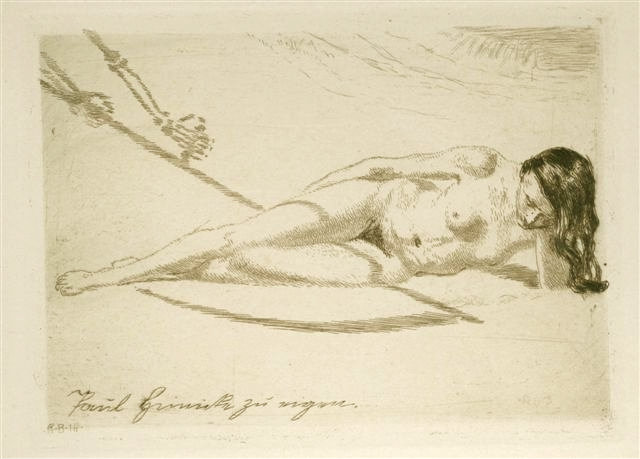
Erasing the (shadow of) Grim Reaper (Photoshop) renders an altogether nice picture of a young woman reading on the beach. It also removes the balance Budzinski created in the composition and of course removes the several layers of thought, bewilderment and reflection printed on the paper and, most of all, carved in the mind of the observer. Watching them too closely they almost seem to hurt. 


However fascinating these haunting pictures are I like even better his dreamlike compositions and captures of transcendent emotions: love, passion, longing, yearning, sleeping and dreaming. Each print seems to tell a personal and highly sensitive story of love and attraction, of distance and nearness, of storm and calm. Lovers drifting and floating in the universe and also of attraction and alienation on earth and in the heavens, almost prophetical. 


These scenes Budzsinki often situated in the infinite and desolate landscape of endless sand and dunes and Baltic sea: the Curonian Spit and Lagoon ("Kurische Nerung") a natural sandy reef and Ice age remnant in the North of Poland. 

Not far from his home. It is where the village of Nidden with its artists colony is situated in its heart. 


Most of his prints offered (in Ebay) are unsigned and, an educated guess as he also wrote in his memoirs, published as calendar plates. Often not very successful editions, the backside of stacks of unsold calendars serving him as cheap drawing paper.    


This fine last example (there are several others to be found in the Internet) is almost an amalgam of a print by Dutch printmaker Wijand Otto Jan Nieuwenkamp and Turner's most famous painting and is seen regularly in German Ebay. 


--------------------------
  
All pictures borrowed freely from the internet for friendly, educational and non commercial use only.