Showing posts with label Frank Morley Fletcher. Show all posts

Monday, 20 June 2016

Siegfried Berndt: pioneer printmaker from Dresden (I)

Several years ago (2011 !) Charles wrote his posting and spoke in admiration of Siegfried Berndt (read here). Berndt's influence on Modern Printmaking is probably much greater then until now is realized. In 2013 a booklet, referred to in the comments of Charles posting, was published. 


Winning a first price at the end of his studies enabled Siegfried Berndt (1880-1946) to travel to Brussels (where he'd lived the first 4 years of his life because his father had moved there), to Paris (engaging his wife), England and Scotland in 1907-08. Although the price was awarded to an oil painting created in 1906 ("Heu-ernte") in the final stages of his studies he was already heavily involved (and experienced !) in creating prints "the Japanese way". 


Here're the two earliest examples I could find (also 1906 !) showing the steps of Pillnitz Castle near his native Dresden on river Elbe, and Windstille" a truly remarkable early print. It shows he already was heavily inspired, influenced and experienced with printmaking "the Japanese way". In those years (from 1905) Emil Orlik just had started teaching in Berlin. I often wonder about the possible connections. It is even said Berndt taught and trained his teachers and professors in Dresden in woodblock printmaking (!) And because of that his printmaking influence must be in every Dresden later trained printmaker including the later expressionist "Brücke" artists, Martin Erich Philipp and many others.   


This is a fine opportunity showing you some remarkable things that I've discovered recently comparing pictures of prints by Berndt from my pictures archive (I actually own just one print by Berndt, the iconic sailing boat print (later) as my interest and true field of investigation and collecting is pioneering German women printmakers born before 1900 (they were all followers, not teachers, but it is the influence of their possible teachers that is so interesting)


I noticed Berndt played with composition comparing this color print of Notre Dame and a similar, also 1912, monochrome print obviously inspired by his Paris visit. (Meeting Henri Riviere , August Lepere and the Beltrand brothers ?) The question is wether he elongated or shortened the composition: I suggest the first. 


(Note he actually separated the lower part from the upper, moving Notre Dame to the right by adding a bridge arch to the left but stretching the ships to the right !) probably to position the hauling sailor underneath the large vertical spire dividing the composition more harmoniously.


He did the same with the sailing boat print, changing the composition from square to vertical. In this case by adding an inch or so to the bottom with an extra block. 


And then it struck me I could hardly find two identical prints of the same print/composition (there are, probably when he was content printing an edition) showing he experimented happily with his blocks. 


And then, by sheer co-incidence, I stumbled over this Japanese woodblock by (I think by Hasagawe Satanobu II 1848-1940 or his father HS I (1809-1875). Could this be the print for  Berndt's inspiration ? 


Some serious research has been done into the Japanese prints that inspired Vincent van Gogh (1853-1890) and comparing is besides great fun revealing much about the artists history and history of Art.


In Scotland-Edinburgh I suspect Berndt will have met Frank Morley Fletcher (1866-1949) who was head of the Edinburg college of art from 1907 and before he had been experimenting, like Berndt, making prints in the Japanese way in London. Around the time Orlik came back from his Japan experience in 1901 and moving from Munich to Berlin. 

Experimenting Berndt did with almost all his prints. These are just examples that I managed to find and safe, there must be many others available. Here's a 1911 print showing a Polish village and landscape in different colors which made me think of Fletchers print made in 1916.  


Please consider these are just personal observations and in no way to be valued having  any art historical relevance. And beware: there's even more to come ...........

All pictures borrowed freely from the Internet for friendly, educational and non commercial use only. 

Friday, 4 September 2015

Eve and the serpent: 1896

Eve and the Serpent 


A copy of the original print

This print (in 1896 called a chromo-xylograph) is regarded the first modern woodblock print created in England. The original, I really have no idea how many or how few prints were pulled from the original blocks nor about their where a-bouts, I've found only one copy of it in the internet. 

It was created in 1896 by John Dickson-Batten (1860-1932) and Frank Morley-Fletcher (1866-1949) in a joint effort. Some of the struggle creating it, technical details concerning the method of printing and registering, was revealed by JDB himself in the Studio Magazine in 1896 with this article and the issue also held a "photo-mechanical reproduction" of the print. (Click pictures to embiggen and read: interesting stuff !) 


Taken the Magazines reputation it must have been the best available high quality technical method of reproduction and quite an achievement.

Copy of the Studio print 

I have also no idea how rare this Studio photo-mechanical edition is. How many copies may have survived time ? But I did find this offer in America, wondering about the selling price (?) 


Read more and all about Dickson-Batten and Morley-Fletcher in Charles' Modern Printmakers Blog. He is after all the expert on British printmakers. There's nothing I could wish to add there, but:  


I found these two lovely contemporary computerized designs (said to be) based on illustrations by Dickson Batten for "Celtic Ferry Tales" (1892) but so far I have not been able to find the original illustrations. The book on the shelf (right) seems to have  the name Remark on its back. I wonder which book this was. 

And I found this charming Mermaid printed (with a kind of "Japanese wash" background)  as  a bookplate by Dickson-Batten. I hadn't seen it before. 
(As Charles stated in the comments it was actually created by his brother) 


Batten and Fletcher followed in the footsteps of Auguste Lepère (1849-1918) and Henri Rivière (1864-1851) who just a few years before were the first to try at the Japanese way of printmaking. Here's Lepère with a very Japanese print of his convalescent wife on the Brittany coast. It is 1892 ! 


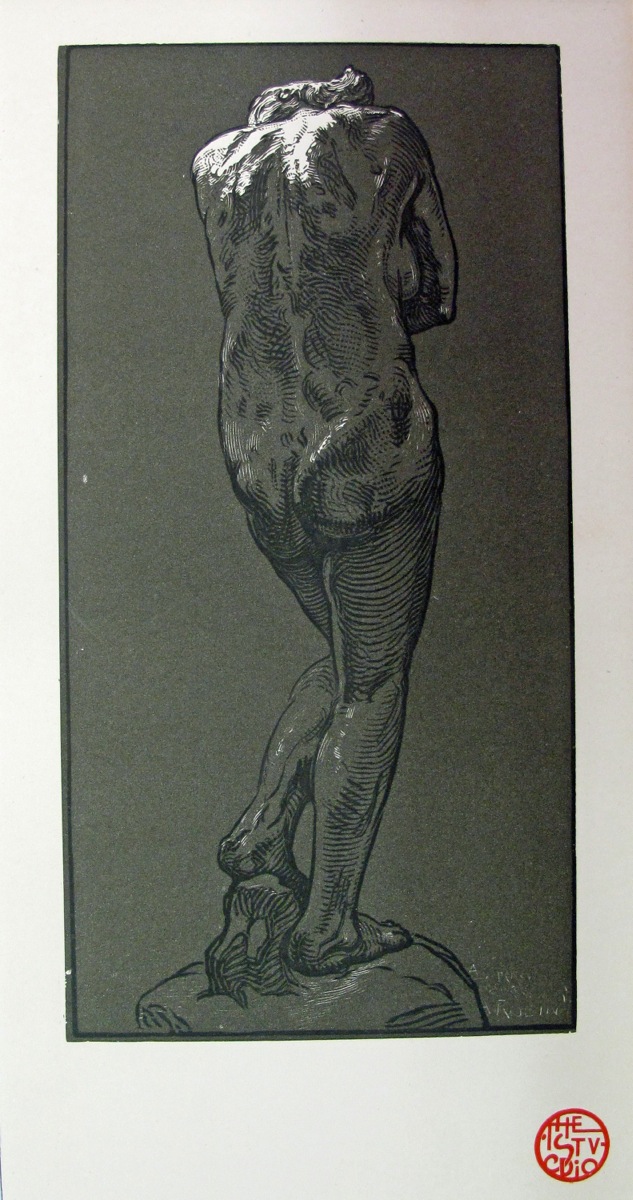
and here in 1898 in a more traditional way of (European, claire-obscure) printmaking with "Eve Repentant" after the statue of August Rodin. She was published as a print in the Studio in 1898. Its method of reproduction was not given as "photo-mechanical" but as "woodcut in two blocks by A. Lepère after the staue of A. Rodin". Signed in the block lower right: the real thing ?


Studio supplement prints are very sought after and highly collectable prints. The   earliest ones said to be extremely rare. I, however, have no idea concerning their market value of true scarcity but it a lovely print it is. Maybe an expert reader can enlighten me (us).  

-----------------------------------


All pictures borrowed freely from the Internet for friendly, educational and non commercial use only.  

Visit my renewed Galerie Ondine with nice pre-owned art.

Weekly upload of many nice prints. 
(Both Studio Eve's are available, 
see there for suggestions and conditions) 


Thursday, 21 November 2013

Henri Guerard, French pioneer printmaker

Henri-Charles Guérard

(1846-1897)

French painter etcher and printmaker.

As a result of my on going interest in prints and printmakers this French artist emerged from the past and I hope sharing my personal research laced with a choice of  Guérards work will be of interest to readers of this Blog.


Le Palais de Justice, vu du Pont Notre-Dame (1889) edition of 6 prints by August Leperè dedicated to his friend Guérard.


Henri Guerard was born three years before August Lepère (1849-1918), considered the godfather of French and possibly European Modern Printmakers. They were of course acquainted Lepère encouraging Guérard to create prints the new way. (Read here*)

And Guérard became befriended with Éduard Manet (1832-1883) who’s pupil (Manet’s only one), impressionist model and painter Eva Gonzalès (1849-1883) he would marry in 1879. The couple moved to Honfleur in Brittany meeting many of the impressionist painters and etchers. 

I always assumed (dangerous !) the Paris World Exhibition of 1889 was the start of rising interest and influence in and popularity of Japanese printmaking in Europe. 
In 1890 the Ecole des Beaux Arts held an exhibition leaving Felix Valloton (1865-1925) involved in Japonism. His cygnes (swans) a very popular item in the 1890’s and 1910’s dating from 1892 and in next posting I intend hurdling them all together. Guérards swans, below, dated a few years later: 1895.
But well before 1890 I learned Leon Gonse (1846-1921), art historian and director of la Gazette des Beaux Arts, organized exhibitions on Japan art and in 1883 published his most important and influential 2 volume book “ L’Art Japonais” (edition of 1400) and illustrated by his friend Guérard.

Manet considered Guérard the best French aquatint etcher of his time. With Felix Bracquemond (1833-1914) Guérard founded the Societé des Peintres Graveurs in 1890. 

Portraits of Éduard Manet, Whistler and 
Whistler's mother (after the painting) 

Guérard died young dating all his known work before 1897, about the year the first  British, Austrian and German examples were conceived by printmakers like Frank Morley Fletcher (who had studied in Paris), Otto Eckmann, Emil Orlik and of course many others. 

Honfleur harbour.
 
It is from 1905 onwards a steadily growing stream of prints by a growing number of artists influenced by and/or printing in "the Japanese way' can be traced but in that last decade of the 19th century there obviously was much more going on in this field then I’d imagined before.
 Tiger head and print of a monkey's hand 

Eva Gonzalès died from an embolism giving birth to their sun Jean, six days after her teacher and friend Manet passed away. This lovely painting “le Chignon” (the Bun) is by her. Guérard married her sister Jeanne a few years later. Left little Jean Guérard's portrait  by his father.

Guérard with Jean Francois Raffaelli (1850-1924) are considered the pioneers of aquatint etching. 

Etching by Guérard of Hokusai's chess players

With Lepère, Guérard preceded and stood at the very beginning of the first “generation” of French Modern Printmakers: Felix Valloton, Henri Rivière (1864-1951), Jacques Beltrand (1874-1977), Amadee Joyau (1873-1913), Jules Chadel (1870-1942), Henri Amedee-Wetter (1869-1929 and Prosper Alphonse Isaac (1858-1924)
Guérard at work. 

Read here* and here* in "Adventures in the print trade" on Lepère, Raffaelli and Guérard.

All pictures borrowed freely from the Internet for friendly, educational and non commercial use only.