Showing posts with label Siegfried Berndt. Show all posts

Wednesday, 24 August 2016

Hans Reissinger: Berndt student in Bayreuth

These two prints of the park and palaces of the "Eremitage" in Bavarian Bayreuth surfaced in German eBay last week. Once the seat of dukes and princes it was also the hometown of composer Richard Wagner (1813-1883).
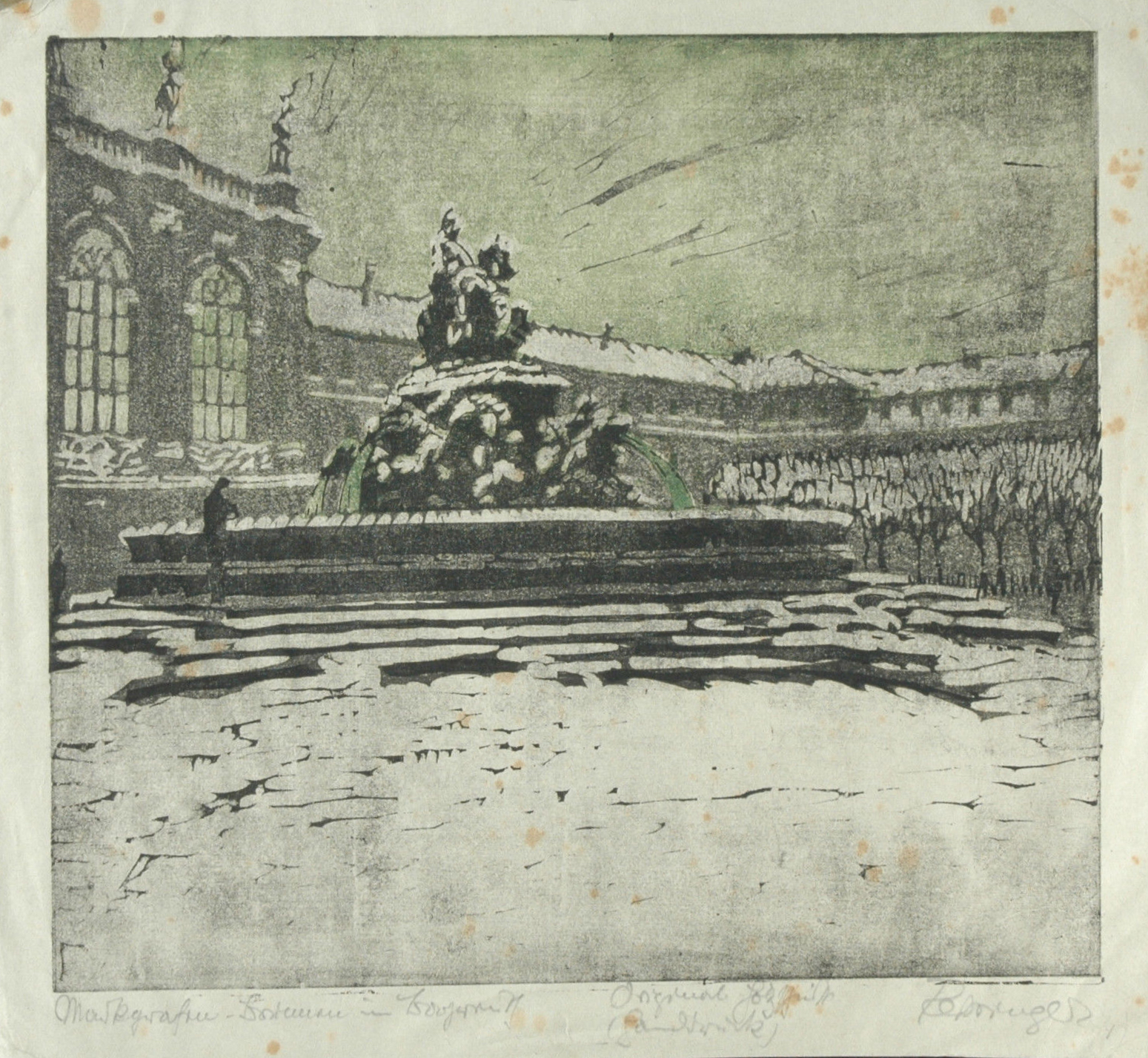


It is not hard to recognize who might have taught the architect Hans Reissinger the principles of printmaking. Just compare the pictures of prints in this posting (that were shown before) of Siegfried Berndt,  himself, and two other students. It is funny to see Reissinger, who must have been a good drawer of buildings, printed his "Markgrafbrunnen" mirrored because I had to mirror this contemporary photograph to match it up.  


Reissinger, Hans Carl 
(Bayreuth 10-04-1890 – 23-11-1972 Bayreuth)

Painter, architect and printmaker, (also Reisigner, with one s). Studied 1908-1912 in Munich “Technischen Hochschule” with painter and architect Friedrich von Thiersch (1852-1921), architect Theodor Fischer (1862-1938) and Karl Hocheder who was president of the High Court in Leipzig. Worked 1912-14 as assistant of architect German Bestelmeyer (1874-1942) in Dresden. Bestelmeyer succceeded von Thiersch in 1922 and acted as president of the “Akademie fur Bildende Künste” 1924-1942 organising an exhibition of popular Norwegian painter, drawer and caricaturist Olaf Gulbranson (1873-1958), (below).


After graduating in 1918 he settled in Bayreuth and worked as “Stadtbaurat” (chief cityplanner) 1927-1929 in Düsseldorf. He became a member of the NSDAP in 1934 and was promoted by the Nazi mayor as the cities overall planner also arranging the funeral of Hans Schemm an important Bavarian Nazi, attended by Adolf Hitler and all high ranking party members. During the Nazi period he build several buildings and monumens in Bayreuth. After WW2 he designed the stage for Wagners opera “der Meistersinger” after the “Bayreuth Festspiele” were continued and was involved designing many memorials and monuments and restauration of the many historic buildings in Bayreuth.
Dresslers KHB 1930 (Reisinger): M(aler), A(architect), Bayreuth, Richard Wagenerstrasse 39.
     
Steps of Pilnitz Palace near Dresden.

Examining Reis(s)ingers prints there's no doubt he was a Siegfriedt Berndt (1880-1946) apprentice possibly during his stay in Dresde. The two prints showing the “Eremitage” palace and the “Markgrafenbrunnen” in Bayreuth, buildings he took actively part in restoring  . They surfaced in German Ebay august 2016.

Dresden, Zwinger palace,  by Haine Rath(1873-1920)
Dresden by Bertha Schrader. (1845-1920) 
These prints by Heine Rath (1873-1920) and Bertha Schrader (1845-1920) are very similar in execution and sparse use of paint and color. Both artists died in 1920 which, with the years from Reissinger's stay in Dresden this gives us a nice clue dating these prints. Bertha Schrader, as an accomplished and successful painter must have tried at woodblock printmaking late(r) in life because she is the earliest born (German female) artist in my printmakers research. She will have met Berndt in Dresden. Berndt studied in Dresden 1899-1906 while Rath taught there at the Academy 1901-1919, from 1903 as a professor. 


Follow the labels in this posting for further reading.


All pictures borrowed freely from the internet for friendly, educational and non commercial use only. 

Monday, 20 June 2016

Siegfried Berndt: pioneer printmaker from Dresden (I)

Several years ago (2011 !) Charles wrote his posting and spoke in admiration of Siegfried Berndt (read here). Berndt's influence on Modern Printmaking is probably much greater then until now is realized. In 2013 a booklet, referred to in the comments of Charles posting, was published. 


Winning a first price at the end of his studies enabled Siegfried Berndt (1880-1946) to travel to Brussels (where he'd lived the first 4 years of his life because his father had moved there), to Paris (engaging his wife), England and Scotland in 1907-08. Although the price was awarded to an oil painting created in 1906 ("Heu-ernte") in the final stages of his studies he was already heavily involved (and experienced !) in creating prints "the Japanese way". 


Here're the two earliest examples I could find (also 1906 !) showing the steps of Pillnitz Castle near his native Dresden on river Elbe, and Windstille" a truly remarkable early print. It shows he already was heavily inspired, influenced and experienced with printmaking "the Japanese way". In those years (from 1905) Emil Orlik just had started teaching in Berlin. I often wonder about the possible connections. It is even said Berndt taught and trained his teachers and professors in Dresden in woodblock printmaking (!) And because of that his printmaking influence must be in every Dresden later trained printmaker including the later expressionist "Brücke" artists, Martin Erich Philipp and many others.   


This is a fine opportunity showing you some remarkable things that I've discovered recently comparing pictures of prints by Berndt from my pictures archive (I actually own just one print by Berndt, the iconic sailing boat print (later) as my interest and true field of investigation and collecting is pioneering German women printmakers born before 1900 (they were all followers, not teachers, but it is the influence of their possible teachers that is so interesting)


I noticed Berndt played with composition comparing this color print of Notre Dame and a similar, also 1912, monochrome print obviously inspired by his Paris visit. (Meeting Henri Riviere , August Lepere and the Beltrand brothers ?) The question is wether he elongated or shortened the composition: I suggest the first. 


(Note he actually separated the lower part from the upper, moving Notre Dame to the right by adding a bridge arch to the left but stretching the ships to the right !) probably to position the hauling sailor underneath the large vertical spire dividing the composition more harmoniously.


He did the same with the sailing boat print, changing the composition from square to vertical. In this case by adding an inch or so to the bottom with an extra block. 


And then it struck me I could hardly find two identical prints of the same print/composition (there are, probably when he was content printing an edition) showing he experimented happily with his blocks. 


And then, by sheer co-incidence, I stumbled over this Japanese woodblock by (I think by Hasagawe Satanobu II 1848-1940 or his father HS I (1809-1875). Could this be the print for  Berndt's inspiration ? 


Some serious research has been done into the Japanese prints that inspired Vincent van Gogh (1853-1890) and comparing is besides great fun revealing much about the artists history and history of Art.


In Scotland-Edinburgh I suspect Berndt will have met Frank Morley Fletcher (1866-1949) who was head of the Edinburg college of art from 1907 and before he had been experimenting, like Berndt, making prints in the Japanese way in London. Around the time Orlik came back from his Japan experience in 1901 and moving from Munich to Berlin. 

Experimenting Berndt did with almost all his prints. These are just examples that I managed to find and safe, there must be many others available. Here's a 1911 print showing a Polish village and landscape in different colors which made me think of Fletchers print made in 1916.  


Please consider these are just personal observations and in no way to be valued having  any art historical relevance. And beware: there's even more to come ...........

All pictures borrowed freely from the Internet for friendly, educational and non commercial use only. 

Friday, 15 April 2016

Margarete Donath, quest for a forgotten Dresden painter & printmaker (2/3)

Margarete Donath (II) 
Hermann-strasse 2 (renamed Lauritzerstrasse in 1922) 
Weißer Hirsch, Loschwitz, Dresden 
around1920-30


The Loschwitz neighbors:

Oskar Kokoschka (1886-1980) 


A few streets away lived and worked for several years 1916-1919 modernist/expressionist Oskar Kokoschka gathering a circle of artists around him in Hotel Felsenburg. He was  recovering from his war injuries and was a professor in Dresden Kunstakadamie 1919-1924.

Rosa Petzel (1831-1912)

At the Rißweg in “Weisser Hirsch” at Villa “Sonnenleite” lived Rosa Petzel  with her two artist sisters Marie and Minna. She is considered one of Germany’s first professional woman (portrait) painters.


Oskar Pletsch (1830-1888)


a popular genre painter and books illustrator had lived nearby generation earlier.
  

Oskar Zwintscher (1870-1916)


symbolist painter and with Koskoschka professor in Dresden "Kunstakademie”. He taught one of Germanys best known printmakers Martin Erich Philip (1887-1978) who settled  later in nearby Dölszschen, west of Dresden.


Hans Kallmeyer (1882-1961) 

lived in Loschwitz and later moved to Königsberg and Nidden and was knicknamed “der Elchmaler” (the moose-painter). Like so many German artists Kallmeyer he lost all his belonging in bombing (of Königsberg)


Rose Friedrich (1867-1953)


Painter and printmaker who studied in Dresden Kunstakademie but also with Max Liebermann, Max Slevogt, Lovis Corinth and in Paris with Claude Monet. She lived Loschwitz, Schevenstrasse 2 in Villa "Te Deum Laudamus" near the river. 


Neumann, (most probably not Hermann Fritz Neumann (1858-1920 Dresden Loschwitz) as often claimed or stated by sellers, auction houses etc..


Still unidentified graphic artist, known for his animal (dog) etchings. Which is remarkable since the quantity and quality of his work. Neumann has been the focus of research by several print collectors but to this day without proper result. All help, knowledge etc.. is welcomed. 
Please contact me or Christian Mahnke (c.mahnke@gmail.com) and/or Wolfgang Barina (post@wolfgang-barina.de

(Added note april 2019: There is still controversy, mistaken identities and mix up with the biographical dates of painter Hermann Fritz Neumann who is obviously not the printmaker Neumann creating mainly colour etchings of animals and active almost certain after 1920, the year of death of Hermann Fritz N.) 

-----------------

More artists involved in  early printmaking lived in Dresden centre, Elisabeth AndraeDoris am Ende expressionist Ernst Ludwig Kirchner (until 1911) and in nearby Radebeul lived the illustrious (deaf mute) artist Käthe (Kathi) Kuntze from a prosperous Dresden bankers family .


Siegfried Berndt 
(1880-1946)

who was trained in and later taught at Dresden Kunstakademie lived Wittenbergerstrasse 51 near the entrance of the Loschwitz-Brücke (Blaue Wunder). He was with Orlik one Germany's pioneers of Japanese style printmaking introducing and spreading the gospel of this new craft to his colleagues in Dresden academy, possibly even to Oscar Zwintscher and Martin Erich Philipp (above). 


All pictures borrowed freely from the Internet for friendly, educational and non commercial use only. 


Next: the Donath family: working, business and living in the area.