Elly Proempeler-Ebeling
(05-01-1883 –
25-05-1972 Osnabrück)
Author of “Kriegsgefangen quer durch Afrika”
(“POW through
the heart of Africa”)
published in
1918 (Otto Elsner Verlag, Berlin).
 |
| Feluccas on river Nile, Egypt, signed L. Zimmermann 1913. |
Finding a name
of a previous owner written on the back of a framed work of art that has been
cherished for a century is always intriguing. It is mostly very difficult for the untrained to read German Sütterlin. The script ("Fraktur") was introduced in 1915, became the official German script in 1935 but was banned by Hitler himself six years later.

Even to modern Germans Sütterlin or "Fraktur" writings (signatures, titles, specifications) are often described: "unleserlich" (eligible).


Reader Mathias send me a picture of a print signed “L. Zimmermann” with moored feluccas, traditional (North) African sailing vessels, suggesting the printmaker visited Egypt and river Nile. The other two prints (above) are also by the same printmaker. I could tell you one or two things about L. Zimmermann here but that must wait for the book. Emil Orlik (1870-1932), working and teaching in Berlin also traveled Egypt and Sudan, in 1912, and in later years published several works like this "Feluke" and river Nile .

It would also be interesting to know in which exact year (between 1911-1920) Helene Tüpke-Grande (1871-1946) travelled to Egypt (below).


However: this contribution is not supposed to be about prints and printmakers but about Elly Proempeler probably the first owner of the print.

Even to modern Germans Sütterlin or "Fraktur" writings (signatures, titles, specifications) are often described: "unleserlich" (eligible).


Reader Mathias send me a picture of a print signed “L. Zimmermann” with moored feluccas, traditional (North) African sailing vessels, suggesting the printmaker visited Egypt and river Nile. The other two prints (above) are also by the same printmaker. I could tell you one or two things about L. Zimmermann here but that must wait for the book. Emil Orlik (1870-1932), working and teaching in Berlin also traveled Egypt and Sudan, in 1912, and in later years published several works like this "Feluke" and river Nile .

It would also be interesting to know in which exact year (between 1911-1920) Helene Tüpke-Grande (1871-1946) travelled to Egypt (below).


----------------

The name (partly in Sütterlin ?) was enciphered
by Frankfurt Enigma Machine Wolfgang as Elly Proempeler.

Elly (for Elisabeth ?) was the daughter of N.N. Ebeling and Johanna
Strick (12-10-1854 – 15-06-1928 Osnabruck) and married to lieutenant Karl Proempeler (born around 1878 in
Schweppenhausen near Frankfurt). Their names could fit “Proempeler
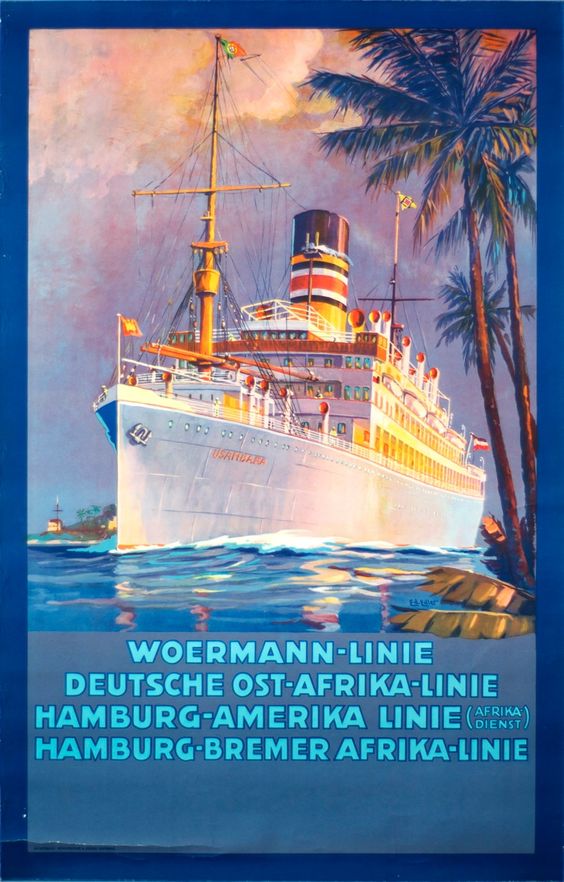
und Frau” found on the ships passengers list of Woermann shipping company (“Reichs Post Dampfer”) “SS Admiral” departing 21-04-1914 from Hamburg. They are mentioned in the Namibian (German West-Africa) “Lüderitzbuchter Zeitung”.


 |
| SS Admiral and Woermann sister ships: depart from Hamburg (river Elbe) and arrival in SW- Africa. |

The Proempelers, assuming they are Karl and Elly, could be returning from a leave to Africa because a 1913 photograph shows Elly Proempeler on the steps of a building in Tabora in German East-Africa (later Rhodesia now Tanzania). Karl
Proempeler was appointed “Kaiserliche
Bozirksamtmann”, an imperial colonial government official.

The colony of German East Africa was ruled (1912-1918) by its last governor Heinrich Schnee (1871-1949) who after WWI became a member of the “Reichstag”, the German parliament (below).

The colony of German East Africa was ruled (1912-1918) by its last governor Heinrich Schnee (1871-1949) who after WWI became a member of the “Reichstag”, the German parliament (below).


With the
outbreak of WWI the colony became involved in hostilities with the Belgian and
British forces although it was mutually agreed not to “fight over the colonies”
by all parties in the mondial conflict.


The region was considered by both the Germans and British very promising and important for the cultivation of rubber trees. Eventually the complex situation, the disagreement of Schnee with his military commander “Afrika-General” Paul von Lettow-Vorbeck (1870-1964) lead to the remarkable situation German forces kept fighting a succesfull guerrilla war with the allied (British, Belgian and Portugese and native) forces under command of von Lettow.

The famous general happens to be the older brother of Berlin printmaker Christa von Lettow-Vorbeck (1881-1945) (below).

With 2000 men he kept busy an army of 100.000 and managed to stay undefeated. Von Lettow used the dismantled guns of German cruiser SMS Königsberg which was scuttled by the British Royal Navy 11-06-1915 at Rufiji River.

When von Lettow, who was a hero even to his enemies and like Schnee a later Reichstag member, was offered an ambassadorship by Adolf Hitler he calmly and politely told Hitler to “go fuck off" and got away with it simply nobody had the balls to arrest him. He was declared an enemy to the State and was denied his pension which I suppose will not have posed him a big problem.


The region was considered by both the Germans and British very promising and important for the cultivation of rubber trees. Eventually the complex situation, the disagreement of Schnee with his military commander “Afrika-General” Paul von Lettow-Vorbeck (1870-1964) lead to the remarkable situation German forces kept fighting a succesfull guerrilla war with the allied (British, Belgian and Portugese and native) forces under command of von Lettow.

The famous general happens to be the older brother of Berlin printmaker Christa von Lettow-Vorbeck (1881-1945) (below).

With 2000 men he kept busy an army of 100.000 and managed to stay undefeated. Von Lettow used the dismantled guns of German cruiser SMS Königsberg which was scuttled by the British Royal Navy 11-06-1915 at Rufiji River.

When von Lettow, who was a hero even to his enemies and like Schnee a later Reichstag member, was offered an ambassadorship by Adolf Hitler he calmly and politely told Hitler to “go fuck off" and got away with it simply nobody had the balls to arrest him. He was declared an enemy to the State and was denied his pension which I suppose will not have posed him a big problem.

Lieutenant Karl
Proempeler, commanding a German military party, fell at the Battle of Saissi,
defending a hill near Jericho Farm in Tabora 05-07-1915.
 His wife Elly later
was taken POW and deported by the Belgian forces forced to march to Congo
across the African continent (“quer durch
Africa”) in a heroic journey. The graves of
the fallen German soldiers at Saissi were later opened by British forces to
find large amounts of ammunition thought to be hidden and used later by
returning German forces.
His wife Elly later
was taken POW and deported by the Belgian forces forced to march to Congo
across the African continent (“quer durch
Africa”) in a heroic journey. The graves of
the fallen German soldiers at Saissi were later opened by British forces to
find large amounts of ammunition thought to be hidden and used later by
returning German forces.



From Congo Elly
Proempeler was taken on a ship with other POW’s to be interned in London their
convoy hunted by German U-boats near Gibraltar. Surviving also that part of her journey she in London she was permitted to
walk free. London at that time was bombed and terrorized by German Zeppelins.


Elly Ebeling
later remarried Ernst Regula
(1875-1942) who had a career as a high ranking railway official (“Oberreichsbahnrat”). She was buried with
her mother and husband in Osnabrück.


--------------------
Danish Karen Blixen, barones von Blixen-Finecke, (1885-1972) married in 1914 and travelled to a
life on a farm in neighboring Kenia. The story of her life later became world famous with
the movie “Out of Africa” and was based on her 1937 book, published some 20 years after Eli Proempelers account.


An Otto Proempeler travelled 1913 between
Lüderitzbucht and Swakopmund (German West Africa now Namibia) and
returned to Hamburg with RPD SS “Kronprinz”
the same year. His name is amongst those citizens receiving a German Iron Cross medal in
German West-Africa.
Namesake Elisabeth Ebeling (1825-1905) from a merchants family was an
extremely prolific German writer of children and fairy tale literature and a
libretto (opera) and song writer. She travelled extensively through Turkey, Egypt, Tunesia and Spain.
All information
on this Proempeler–Ebeling family is welcomed as are offers of a copy of Elly Proempeler's book which must be interesting reading.
------------------------


Although besides this contribution I cannot withhold this great 1981 drawing "Feluken" by one of my favorite modern and more contemporary German sculptors and printmakers Heinz Theuerjahr (1913-1991).
All pictures borrowed
freely from the internet for friendly, educational and non commercial use only.




.png)


