Showing posts with label Martin Erich Philipp. Show all posts

Tuesday, 6 March 2018

Unidentified artist: Lohe in Schleswig ?

Please read next posting for finding the location of the "Alte Kirche" print.

After recently finding another example by this printmaker in the Internet I decided to launch a renewed effort trying to solve this old problem and mystery. 

Years ago I found this Maya the Bee ("Biene Maja") print with "unleserliche" (illegible) signature. Maybe Martin Erich Philipp (1887-1978) gave him/her the inspiration for this print.   


Since then, I saw a several others with the same signature which I to this day was never able to read properly or decipher. 


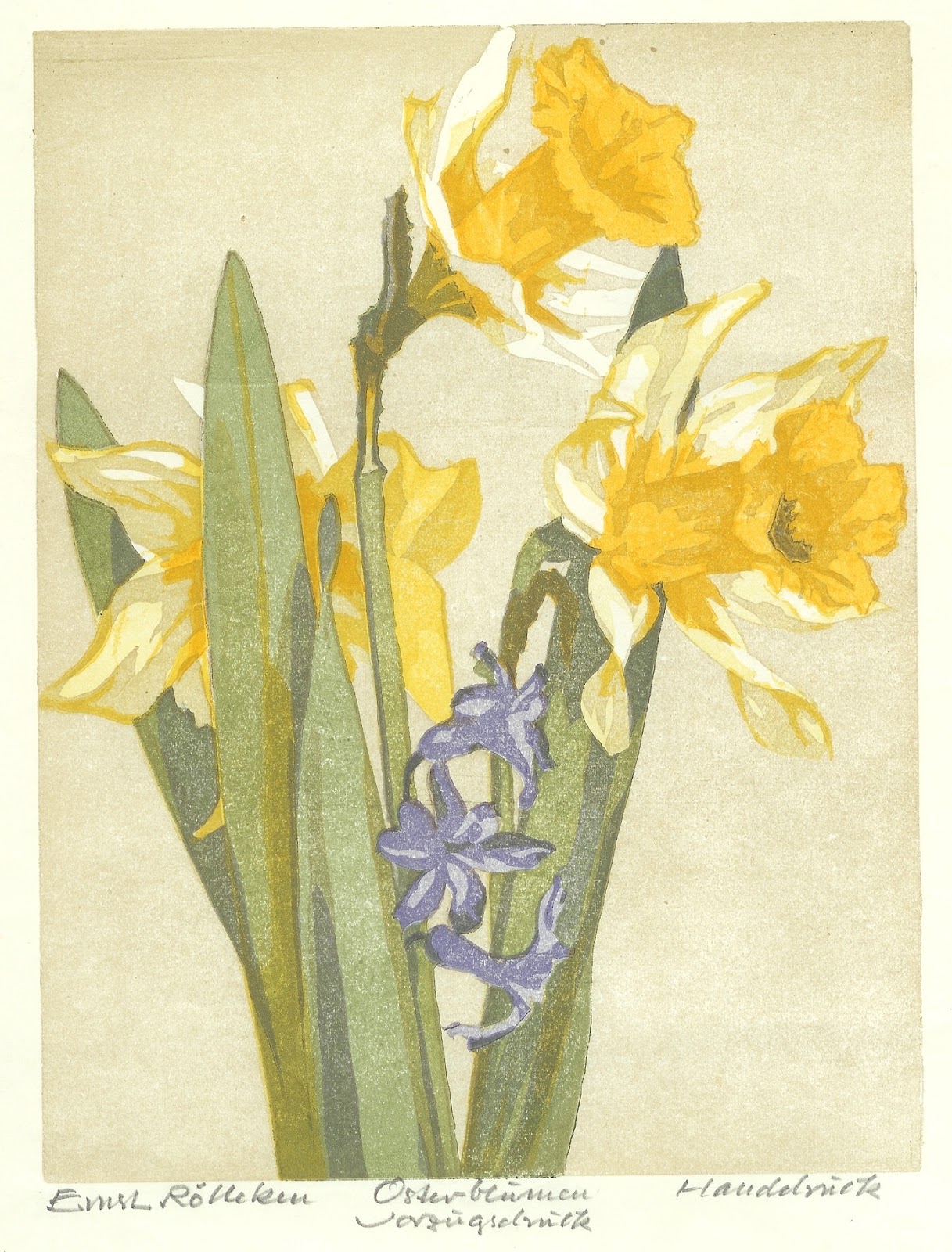
These prints are maybe not considered belonging to the highest regions of sophistication and artistic printmaking and probably are best described as "decorational". But they definitely have a certain charm and were never expensive. The flower prints are very reminding of Detmold printmaker Ernst Rötteken (1882-1945) (right) who's mission in life it was to provide Detmold households with "approved" yet affordable Art.   


But now this "Lohe, alte Kirche" surfaced. Assuming this print is not a phantasy composition it may hold a new clue to finally revealing the identity of this printmaker. Although the church, situated at the end (or beginning) of a small village street ("Dorfstrasse") is quite characteristic I have not been able, roaming the Internet for Schleswig church towers, to pin-point its location yet. 


Since the print surfaced in Cuxhaven, North of Hamburg and the bee print was found near Kiel (with 12 years in between) not far away but on the other side of river Elbe this could be a clue to a northern (possibly Schleswig-Holstein) artist. 
I have not been able to find a possible "candidate" (surname starting with a C. ?) in either "Lexicon Schleswig-Holstein Künstlerinnen" (Ulrike Wolff-Thomson) nor in "der Neue Rump" (Hamburg artists) (Maike Bruhns) both considered sources of importance and "weight".  


"Lohe" could point to a village in Schleswig-Holstein (near Kiel), but the church "does not fit". Maybe with the help of readers who are known locally it is now possible to finally identify this mystery printmaker.


Left: unidentified printmaker -Right: Ernst Rötteken (1882-1945)
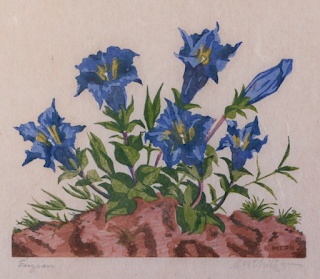


Gentian (Enzian): Martin Erich Philipp

(All pictures from my personal collection). 

Friday, 15 April 2016

Margarete Donath, quest for a forgotten Dresden painter & printmaker (2/3)

Margarete Donath (II) 
Hermann-strasse 2 (renamed Lauritzerstrasse in 1922) 
Weißer Hirsch, Loschwitz, Dresden 
around1920-30


The Loschwitz neighbors:

Oskar Kokoschka (1886-1980) 


A few streets away lived and worked for several years 1916-1919 modernist/expressionist Oskar Kokoschka gathering a circle of artists around him in Hotel Felsenburg. He was  recovering from his war injuries and was a professor in Dresden Kunstakadamie 1919-1924.

Rosa Petzel (1831-1912)

At the Rißweg in “Weisser Hirsch” at Villa “Sonnenleite” lived Rosa Petzel  with her two artist sisters Marie and Minna. She is considered one of Germany’s first professional woman (portrait) painters.


Oskar Pletsch (1830-1888)


a popular genre painter and books illustrator had lived nearby generation earlier.
  

Oskar Zwintscher (1870-1916)


symbolist painter and with Koskoschka professor in Dresden "Kunstakademie”. He taught one of Germanys best known printmakers Martin Erich Philip (1887-1978) who settled  later in nearby Dölszschen, west of Dresden.


Hans Kallmeyer (1882-1961) 

lived in Loschwitz and later moved to Königsberg and Nidden and was knicknamed “der Elchmaler” (the moose-painter). Like so many German artists Kallmeyer he lost all his belonging in bombing (of Königsberg)


Rose Friedrich (1867-1953)


Painter and printmaker who studied in Dresden Kunstakademie but also with Max Liebermann, Max Slevogt, Lovis Corinth and in Paris with Claude Monet. She lived Loschwitz, Schevenstrasse 2 in Villa "Te Deum Laudamus" near the river. 


Neumann, (most probably not Hermann Fritz Neumann (1858-1920 Dresden Loschwitz) as often claimed or stated by sellers, auction houses etc..


Still unidentified graphic artist, known for his animal (dog) etchings. Which is remarkable since the quantity and quality of his work. Neumann has been the focus of research by several print collectors but to this day without proper result. All help, knowledge etc.. is welcomed. 
Please contact me or Christian Mahnke (c.mahnke@gmail.com) and/or Wolfgang Barina (post@wolfgang-barina.de

(Added note april 2019: There is still controversy, mistaken identities and mix up with the biographical dates of painter Hermann Fritz Neumann who is obviously not the printmaker Neumann creating mainly colour etchings of animals and active almost certain after 1920, the year of death of Hermann Fritz N.) 

-----------------

More artists involved in  early printmaking lived in Dresden centre, Elisabeth AndraeDoris am Ende expressionist Ernst Ludwig Kirchner (until 1911) and in nearby Radebeul lived the illustrious (deaf mute) artist Käthe (Kathi) Kuntze from a prosperous Dresden bankers family .


Siegfried Berndt 
(1880-1946)

who was trained in and later taught at Dresden Kunstakademie lived Wittenbergerstrasse 51 near the entrance of the Loschwitz-Brücke (Blaue Wunder). He was with Orlik one Germany's pioneers of Japanese style printmaking introducing and spreading the gospel of this new craft to his colleagues in Dresden academy, possibly even to Oscar Zwintscher and Martin Erich Philipp (above). 


All pictures borrowed freely from the Internet for friendly, educational and non commercial use only. 


Next: the Donath family: working, business and living in the area.    

Sunday, 19 July 2015

Clotilde Schilling: what's in name ?

Clotilde Schilling
(1858 - 1934) 
German painter 

Clotilde (as German as a name can be as if it was taken from a Wagner Opera) Schilling was the daughter of Johannes Schilling (1828-1910). A celebrated son of Dresden, a famous sculptor. Read about him (here*)


I stumbled over Clotilde (1858-1934) trying to identify the printmaker of the two prints in before posting (read here*)


Clotilde's grave, and that of  Alexandra Schilling (1855-1936) in Dresden is adorned by a wonderful sculpture no doubt created (designed) by her sculptor father when she was young (there is a mentioning of this in Johannes' biography) Clotilde is not mentioned in her father's biography in the prestigious "Deutsche Biografie" (read here*). Unless her "official" name was Catharina Susanna. (Curious: Johannes married in 1857 so what about Alexandra born in 1855 joining Clotilde in eternity ?)


Clotilde is an artist-painter represented by just one painting (above) in the Internet while her brother Rudolf Schilling (1859-1933) has left proof of his successful career all over Dresden. He became a highly successful architect (read here*). (Below)


Clotilde Schilling exhibited in Dresden in 1904. She was organized and acquainted with art-sisters Bertha Schrader (1845-1920) a painter-printmaker I've met not long ago and honored with a posting (here*), and with graphic artist Doris am Ende (1857-1944). (both below)


Martin Erich Philipp studied and started his successful printmaking career in Dresden from 1913. So there are possible clues to Clotilde trying at printmaking. Her signature however has little similarity with the handwriting on the prints. 

Possibly the best known sibling of Johannes Schilling is his youngest daughter  Clara Elisabeth (1864-1913). She stood model for Germania, the symbol of Germany United. A huge and colossal monument overlooking the Rhine near  Rüdesheim created by her father.  


It was build commemorating the unification of Germany and the ending of the Franco-German war (1870-71). Ordered by the first Kaiser, Wilhelm-I himself, and his chief: Reichskanzler Otto von Bismarck. It's construction was completed in 1883. 


Germania to Germany is what Marianne is to France. Here (below), created a decade later in 1899 by Aime Jules Dalou (1838-1902), a French colleague of Johannes Schilling. It is located in the Place de la Nation in Paris.

-------------

All pictures borrowed freely from the Internet for friendly, educational and non commercial use only. 

Friday, 5 September 2014

Bertha Schrader: mother of all women printmakers ?

Bertha Schrader
(Memel, Lithuania 1845 - 1920 Möckritz-Dresden) 

German painter and woodblock printmaker. 


In my ongoing research Bertha Schrader was possibly the oldest female artist-painter to try at woodblock printmaking. She will have been taught in Berlin by  Emil Orlik, but lived in Dresden at the time, where Martin Erich Philipp (1887-1978) was active with printmaking as early as 1908. She must have been in her early 60's, after having already a career as an accomplished and successful painter. I know of only two prints by her, monogrammed BS, and here's what I've been able to compose from the collected bits and pieces.


"Der Zwinger", the grand and impressive barok palace in Dresden, destroyed in WW2 but was restored to the museum complex it now houses. Build for the King of Poland, August the Strong (1670-1733) between 1710-1728.


Two other woodblock printmakers choose the Zwinger Palace as subject: Heine Rath (1873-1920 in the same year as Bertha Schrader) en Otto Westphal (1878-1975) also from Dresden. 


   Dutch Canal woodblock print and oil painting by Bertha Schrader, after her travels to neighboring Netherlands.  
-----------------------------------------------------------------------------------------------------------
Born in Memel (Lithuania) Bertha but spend her youth in St.Peterburg (Russia) and from 1854 was living in Dresden (1894, Sidoniënstraße 14). Landscape and interior painter and printmaker  working and living in Dresden. Student of Paul Greab (1842-1892) in Berlin and Paul Baum (1854-1932) in Dresden. Eventually she embraced an impressionist style of painting. Only two woodblock prints of her are known at this moment. She started her career in Berlin but moved to Dresden Mockritz on the Elbe river. Travels to the Northsea and Ostsee, the Netherlands, Switzerland. Denmark and the North of Italy. 
Exhibited in Berlin, Dresden, Hannover, Hamburg and Bremen. She was a member of the VdBK in Berlin 1882-1916 and exhibited there 1882, 1884, 1886, 1888, 1892, 1894, 1901. She was chairwoman of the Dresden Women Artists Association. 

And here are two of her finest paintings:
Bertha Schrader: "An der Elbe" an impressionist impression 

Claude Monet: "River Seine at Vetheuil" 

Emil Nolde: "Elbe Schlepper" 

Max Liebermann: "River Elbe"

     -----------------------------------------------------------------------------------
Bertha Schrader: River Elbe near Möckritz-Dresden where she worked and lived. The Elbe flows all the way across Germany from Dresden to Hamburg on the North Sea.  

Rudolph Pöschmann (1878-1954), a local Dresden painter. 

In 1912 princess Mathilde of Saxony (1853-1933) opened a women artist exhibition in Dresden where a painting of Bertha Schrader was displayed. This was mentioned in the British 1912 Volume of the prestigious magazine "the Studio". See also "Mathilde Reuß, a royal printmaker ?" in this Blog by following the label below.  

All pictures borrowed freely from the internet for friendly, educational and non commercial use only.

All further information on Bertha Schrader would be very much welcomed. 

Sunday, 15 December 2013

Mathilde Reuss: a royal printmaker and a puzzle

Reuss, Mathilde

(Dresden 19-03-1853 – 1933 Dresden)
Princes and once heir to the throne of Saxony.

painter an printmaker.


(added 1-november 2015) It has become clear that the princes Mathilde is not identical with Mathilde Reuss, student of Angelo Jank and working in Munich. Mathilde Reuss known from a handful of color woodblock prints will be treated in an updated posting based on new information soon.   

Planning to compose a book on the first generation of German women  printmakers, born 1855-1900 and active before WWII I'm doing a lot of research lately, reading and checking biographies. Trying to fill up gaps and often starting with nothing. Like in this case. Who ever heard of Mathilde Reuss now considering there are two printmakers with that name.


It's combining archived pictures of prints gathered from old auction catalogues, books, on-line auction sites etcetera and the result of some serious puzzling together fragments, bits and pieces of facts and data. Today an example of my efforts unobscuring a forgotten and before unknown (unidentified) printmaking artist. My genealogical experience helping sometimes. 

The signature reads: Mathilde Reuß, München.  

Besides: Reuss or Reuß isn't a usual or "common" German family name either. It belongs to the House of Sachsen (Saxony), German (intermarried) royalty. Inherited from her great-great grandmother maternal: Countess Auguste Caroline Sophie Reuß zu Ebersdorf (1757 - 1831). Maybe her monogram in this African Storches or Marabus print is hinting at her royal status. RMR. the second R for Royal or Regina ?
Poster for the exhibition "Frauenkunst zum Besten fuhr Mutter und Kind" for the "Illustrierte Zeitung", Dresden 1912. 

So her full name is:  Mathilde Marie Auguste Viktorie Leopoldine Karoline Luise Franziska Josepha of Saxony, Duchess of Saxony. Eldest surviving daughter of King (for two years 1902-1904) George of Saxony  (1832-1904) and Maria Anna of Portugal (1843-1884). (They had 8 children but before Mathilde 2 girls died in infancy).
 Dresden Zoo Marabus or African Storks. Etching by Martin Erich Philipp

Princess Mathilde stayed unhappy and unmarried after being refused and rejected an arranged marriage by her fathers strategic choices. Twice. She was not a beauty and the lucky candidates obviously pernickety. Leaving the poor girl embittered,  seeking consolation in alcohol she was nicknamed “Schnapps Mathilde” by the Saxons. What a sad story. 
Marabus by Helene Grande-Tupke (1871-1946), in Breslau or Dresden Zoo.

Nevertheless Mathilde took up a career of painting and printmaking following painting lessons in Dresden with Alfred Diethe (1836-1919) from 1890 to 1901. And she was rich enough to have asked Norbertine Bresslern Roth (1891-1978) for some good advice because looking at her Marabus print she obviously was acquainted with her work. She certainly could afford summoning every artist in the land to her house in Dresden. 

She was given this villa in Dresden Hosterwitz. The von Sachsen-Coburgs were immensely, filthy rich: British Queen Victoria was one (by her mother) and she married one (prince Albert). Best way of keeping the money in the family and when you're lucky the children will turn out not too bad. Here Mathilde stayed, traveling, painting, making prints and posters, illustrating a book or two and maybe drinking once in while reflecting how her life would have looked like if she had married, had children like 3 of her 5 brothers and sister. Aunty Mathilde died in the villa aged 70 in 1933. What was left of the great house after the rage of WWII was broken up in shelters for the homeless first and later converted into dwellings for ordinary people. 

A bookplate made for Mathilde Reuss by Ferdinand Nockher, a Munich painter, illustrator and bookplate (ex-libris) maker.

See also the before posting for the Marabu print by Philipp Reisdorff: a coincidence. 

All pictures borrowed freely from the Internet fro friendly, educational and non commercial use only. 

The Marabu print by HTG: from the Japonism Blog. Thank you Lilly!