Showing posts with label Charlotte Rollius. Show all posts

Saturday, 15 August 2015

What has happened to Charlotte Rollius ? Trying to solve the mystery.

Charlotte Rollins

Charlotte, Confusion, Coincidences or Clues ?

Last week I received a most interesting email from American reader Melanie. She'd found the information shared in this Blog on the illusive printmaker and Emil Orlik student Charlotte Rollius/Rollins (here*)


Melanie inherited (or came to own from the artists family) four oil paintings on wood panels. By Charlotte Rollins (signed Rollins not Rollius). With the email came also bits and pieces of information about the artist Charlotte Rollins. Which I now share here. 
  

Charlotte Rollins(!), the painter, had arrived in America in 1919 from France with a ship, the ships manifest mentioning her profession as: teacher. Melanie has information she came from Paris (or le Mans (Fr.) and was from a wealthy or well to do (elite) family background. Shortly after arriving in the US in 1919 she  had married a Hugh Rollins(!). They had a daughter Jacqulene Rollins and lived in Ohio. In 1923 Charlotte traveled with her daughter Jacqulene/Jacqueline for three months to France. This Charlotte Rollins was born 1892.

Melanie states: "in december 1923 Emil Orlik was in Ohio on a two months stay for a private portrait sitting".....  


Still life  by Emil Orlik (1870-1932) 


----------------------------------------

Charlotte Rollius

was a Student of Emil Orlik (1870-1932) and worked closely with him on a work of art (woodblock print).
She is mentioned studying and working in Berlin 1905-1908 and 1910.
In 1912 (and 1913) she is mentioned, as Charlotte Rollius, in newspapers and exhibition catalogues in America concerning a large (traveling ?) exhibition with many great German artists (read the earlier blog-article).

In 1930 Charlotte Rollius is mentioned with the description of a print in a Chicago School Artists Society publication (which is confusing but it may concern a print created before her marriage.....)  


What if:

Charlotte Rollius (the Berlin artist and Orlik's student) immigrated to America in 1919 and married a Hugh Rollins in New York.

What if Charlotte Rollins/Rollius and Emil Orlik (1870-1932) had kept contact with het teacher, maybe meeting in Paris and maybe resulting in Orlik's 1923 American trip (could they have travelled together ?)

In that case Malcolm Salaman' s referral/critic in his book "the Art of the Woodcut" of a woodcut by "Charlotte Rollins" could after all be correct because of her marriage in 1919 to Hugh Rollins.  

-----------------------------

Publication of these puzzling pieces in the Internet hopefully will result in solving the biography of Charlotte Rollius/Rollins. Eventually. All your help is very welcomed.

Sunday, 16 February 2014

Carl Christian
 Oluf Jensen

(1871-1934)

Danish painter, printmaker, and ceramist.


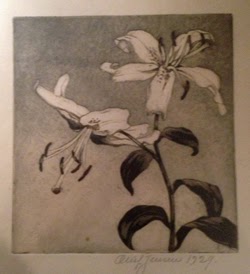
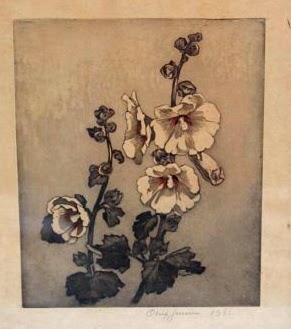
Stumbling over this small but very charming print and composition was an invitation to investigate further this obscured printmaker. And I've placed it on  my wish list. For future use and reference I show and share in this posting all prints  by Oluf Jensen I could find in old auction catalogues and websites.      

Oluf Jensen was born in Copenhagen, Denmark on February 17, 1871. He graduated from technical school in 1890 and then studied at the Royal Danish Academy until 1985. 

That same year he apprenticed at Royal Copenhagen as a blue painter and worked for the company until 1934, painting art pottery and porcelain and eventually managing the underglaze departments. Jensen also worked at Holmegaard Glassworks in 1924. 

Jensen is best known for his decorative painting on ceramic but he was also highly regarded painter in oil and watercolor. He also produced etchings in black and white, and in color whose motifs were floral or landscape. 


His etchings are often signed Oluf Jensen. Today Jensen is considered with Arnold Krog as the artists who had the greatest impact on the development the Danish underglaze porcelain. Examples of his decorated porcelain are in the Nationalmuseum, Stockholm. Carl Christian Oluf Jensen died in Copenhagen on January 31, 1934.

As an exception I’ve copied and pasted an artist biography (with permission, thank you Daniel) that I’ve found in Annex Galleries in Santa Rosa, California, USA. Couldn't have done any better myself. The delicate fuchsia etching is for sale among the many fine prints and varied stock of this renowned American gallery.


"Eger Tryck" = Hand pulled in Danish

For reasons I cannot explain almost all pictures I could find and scratch together by Jensen were of thumbnail dimensions. I have enhanced most of them in Photoshop to improve screen visibility and quality. 

---------------------------


Nice surprise, and "déja vu", was finding this watercolor, roses, by Jensen reminding me of a strikingly similar composition, in print, by a printmaker that I mentioned earlier in this Blog: Charlotte Rollius (aka Charlotte Rollins after an historical typo or simply a mistake by the great Malcolm Salaman in the Studio magazine in 1927). Rollius had been a student of Emil Orlik in Berlin, the Godfather of modern printmaking. 
Very little is known about either her person (born around 1885 and last mentioned 1944/45 in Berlin) or professionally: fewer then a hand full of most wonderful but hardly ever seen woodblock prints is all what remains to remember her. I'll show them in a next posting.   

Opening in march: my new Shop and Swap "Galerie Souris". For sharing and swapping of pre-owned and vintage woodblock prints, etchings, engravings and  drawings from my collections. 


All pictures borrowed freely from the Internet for friendly, educational and non-commercial use.      

Thursday, 13 September 2012

Charlotte Rollins = Charlotte Rollius

This is a follow up from posting on sept. 6th 2012.

Charlotte Rollius
(around 1885 – mentioned in 1944/45)
German printmaker, 

and the

Exhibition of Contemporary German Graphic Art
Chicago (USA)- januari 1913


Thanks to reader Archimandrill both identity and nationality of this supposedly British printmaker today is set right.  The enigmatic Charlotte Rollins who existed probably for 90 years is in fact Charlotte Rollius. The confusion and her obscuring are probably caused by Malcolm Salaman in 1929 in the Studio production "The Art of the Woodcut". Either by him or by negligence of the editor/corrector. Salaman’s expertise has great reputation but he is also reputed for his sloppiness.  
Martin Erich Philipp, "in der Grafische Austellung " 1912-1913
etching probably showing the Chicago Exhibition.
16 years before Charlotte Rollius stood in the light of critics and experts on both sides of the ocean. With four of her, at the time highly praised for daring colors, woodblock prints she was selected for the Exhibition of Contemporary German Graphic Art in the Art Institute of Chicago January 2d to January 19th 1913.
Max Liebermann: badende Junge (cat.nr. 190)
The New York Times of December 1th 1912 (note: Titanic sank in April) started the information to the public in a double paged illustrated article.

Carl Thiemann (3 works): Amaryllis, cat.nr. 297
This exhibition showed only the best of the German graphic artists and the catalogue summing up no less than 370 works of art by 90 artist on display and was organized by the New York branch of the Berlin Photographical Company renowned for its editions of high quality art work reproductions 1880-1920.
Lovis Corinth (4 works): Mother and Child, cat.nr.35
In Germany Dr. Otto Michael in Berlin is mentioned but I failed to find anything on this man yet. Maybe it was his collection or he worked for a Berlin Museum. In America the exhibition was organized and revised by Martin Birnbaum (1878-1970), scolar, critic, art dealer and the director of the BPC in New-York 1910-1916.
Max Pechstein (2 works) Somali Dancers, cat.nr.227 
Later, in the 1930’s, a selection of 36 reproductions probably made by this company was distributed for educational display in Chicago schools. Among them works by, Whistler and van Gogh but also by Charlotte Rollius ("for style and distinction") and to my surprise the Sunflowers woodblock print by Else Schmiedeberg-Blume as: "gay example of woodblock, for the lower grades". This print was not in the 1913 exhibition.
Else Schmiedeberg: gay Sunflowers
The exhibition comprises a selection of both established and renowned artists (“Giants” the catalogue states) like Max Liebermann (13 works), Emil Orlik (6 works), Max Klinger (15), Käthe Kolwitz (18), Franz Marc (3), Kandinsky (1), Emil Pottner (20 works, cat.nr. 241) Meta Cohn (2 ) and Walter Klemm (5)
Franz Marc (cat.nr. 6)
But also rookies like Martin Erich Philipp with his 1908 woodblocks no. D5 and D6 and 3 early etchings (cat 231-235). They nevertheless made his fame overseas and explaining why many of his (and others) prints often surfacing in America.
Martin Erich Philipp (cat. 231, 232 and 235)
Without a doubt there was a commercial aspect involved, prints sold or ordered. Probably through mediation from Birnbaum himself.
Emil Orlik (6 works)
Portrait of Ferdinand Hodler, cat.nr. 222
Charlotte may be the daughter of Julius Rollius and Mathilde Charlotte Elise Palm. Their daughter Elisabeth Maria Louise Rollius (born 1884) in 1909 marries into the established Berlin family Betke. As I experienced many of these German lady printmakers (and other artists) were from well to do families partly because University scientific studies weren't accessible for women in those days. 
Heine Rath (7 works cat.nrs 249-255): Pont Royal. 

There's still a lot to be investigated about Charlotte Rollius. First accounts are her studying with Emil Orlik around 1906-08, the last says she was probably still alive in 1944/45. 
Kandinsky Composition IV 1911 (cat.nr. 121) 

Anno 2012 it would be possible to reconstruct the entire exhibition digitally, an endeavour that would certainly be great fun. It would be a great book and time capsule too. But today I will limit myself to a selection interesting for readers of the Linosaurus. 
Max Slevogt (10 works) Nymph and Faun (cat.nr. 278)

I've found some very nice artist too, some famous some obscured but very interesting like etcher Erna Frank (1881-1931) represented with 4 etchings (cat.nrs 50-53, not found) In her days her work was compared to Whistler.
Erna Frank: Charlottenburg Ufer (Berlin), not in the 1913 exh.

Sadly the 4 prints shown by Charlotte Rollius I couldn't find, but I'm confident one day they will surface: (exh.nrs 258 -261, Geraniums, Landscape, Primula and Apples, Still Life).
Walter Klemm (5 works) "Pelican"

The chosen examples are just a fraction of the 370 artworks displayed in 1913 and used here only to illustrate this posting on Charlotte Rollius.
You can find the 1913 Chicago Exhibition catalogue 

Thursday, 6 September 2012

Charlotte Rollins: an enigma

This posting is updated sept. 13th with important new facts: here*

Charlotte Rollins
(born probably around 1880 and last mentioned in 1933)

(probably) British printmaker, 
a student of Emil Orlik in Berlin.

I was aware for some time of the existence of these two woodblock prints in the collections of one of the finest printdealers in America: Ed Ogul of Paramour Fine Arts (see here*) (a paramour: a significant other to whom you are not related by marriage)


But since these prints aren't meant for my collection, I decided it to be a good idea sharing them with you and try to discover maybe something more about this printmaker. And at the same time showing all prints by her presently known together in this posting. 


Also because as it happens there's another print by her for sale (Ebay) at this moment. But it is priced so considerably above my means and budget I can't  imagine my "best offer" will be interesting at all to the seller. It is a combination of a woodblock print and handcoloring. I'm curious to learn about the given date and location: 1920, Berlin. But a rare print it definitely is. 

It was very annoying to conclude there's almost nothing about Charlotte Rollins to be discovered at all. What we do know is she was in the teaching department of the Kunstgewerbe Museum (Arts and Crafts Museum) in Berlin, working with and probably a student of Emil Orlik (1870-1932) around 1905-1908*(see below). She is mentioned in the notes of the Reichskammer für Bildende Künste untill 1933. She is not mentioned in the memberships archives of the Verein der Berliner Künstlerinnen. Many of her contemporary colleagues, she must have met and known, are.

The buildings of the Kunst und Gewerbemuseum in Berlin (build 1880) were confiscated from 1933, around the last signs of life of Rollins. It was to  become the headquarters of the Nazis secret police, the Gestapo. The Art teaching Department in 1924 fused into the new Art Akademie Berlin and the buildings were slowly abandoned, the artists the last to go leaving their studio's in the rooftop floors. The buildings were destroyed in the conquering of Berlin in 1945 and finally demolished in the mid 1950's.

To my surprise the great Malcolm Salaman showed this copy of a print by Charlotte in his 1927 "the Art of the Woodcut" but forgets to mention her or the print completely in the text. Although he's honouring her by showing the print in full color. The book is a must for every print collector and reprinted (cheaply) in 2010. Together with the Studio/ Salaman's 1930 "the new woodcut" they show the world of modern woodblock printing 1910-1930. (This copy, carefully removed but nevertheless ripped from the book, is also available in Ebay, but you'ld do better and cheaper buying the complete book)


And finally here's the famous print by Emil Orlik and Charlotte Rollins that is signed also by her. I've found two dates for this print: 1905 and 1908* (see above). It's called "Still-life with fruits, pheasant and flowers". It's beautiful, complicated and elaborate. The postitioning of a piece of exotic leopardskin motive cloth (gown or dress) is an extraordinairy and modernistic find and greatly improves the compositions depth and  balance and is adding  a mysterious and oriental atmosphere. The year Rollins disappears from the records is the year of  Orliks death, 1932, and the year the buildings she may have once worked in confiscated and cleared. What did she do in the odd 25 years between 1905 /08 and 1933 ? Were did she come from ? 
I can't begin to understand why she hasn't left any other traces in history but I'm confident they will surface one day.