Showing posts with label scandinavian printmakers. Show all posts

Thursday, 9 February 2017

Fryklund, Gunhild Maria: Swedish printmaker


(Stora Kil Värmland 02-01-1892 – 1970)


Several years ago I shared the flower woodblock prints by Swedish printmaker  Maja Fjaested (1873-1961), today I share the prints I was able to find in the Internet by a student off her husband, but I have reasons to believe (below) she may have been more inspired by Maja in her printmaking.     


Swedish artist and printmaker. Daughter of arts & crafts artist Gustaf Fryklund en Josefina Nilsdotter. Studied 1911 with Otto Hesselblom (1848-1913), in Göteborg Valand art academy and with Gustaf Fjæstad (1868-1948).


Solo exhibitions in Gummeson art galery in Stockholm in 1925 en 1940 and together with Thor Fagerkvist (1884-1960) and Paul Grundmark (1887-1972) in the New Museum in 1929 and at Liljeval “Kunsthal” she was represented with 22 works. 


She created landscapes, interiors, portraits in oil and was a woodblock printmaker. Her work is collected in the Värmland and  Halmstad museums.


She is mentioned in several Scandinavian artists lexicons and this last print showed up recently in an online auction site. 


-----------------------------

All pictures borrowed freely from the Internet for friendly, educational and non commercial use only. 

Thursday, 12 February 2015

Gerda Nordling: a touch of royalty

Nordling-Ramberg, Gerda Carolina

(Helsingborg 1875-1942 Frameless)

Graphic designer, arts and craft artist, painter, etcher and printmaker. 


There are only Swedish (Wiki)entries to be found in the Internet referring to artist Gerda Nordling: how injust ! I stumbled over a woodblock print, found her etchings and a painting, became witness of her intriguing family secret and through meeting her was introduced to a Swedish painter she must have known closely and also is only "mentioned" in Swedish: even a greater  injustice. 


Gerda was the daughter of John Jönsson (b. 1837) and Eline Andersson (b. 1838). John Jönsson, as was recently revealed, was the illegitimate son of King Oscar I of Sweden (1799-1859) from a liaison with the maid Elsa Christina Trana (1795-1868). 


Gerda's secret grandfather: King Oscar I of Sweden.

The kings son became the city gardener of Helsingborg, well to do, a real estate owner and horse breeder. He also managed to breed 10 siblings. Gerda's brother was painter and graphic artist Gustaf Ramberg (1865-1916) of whom I could not find much details. She had 6 sisters and three brothers. 

Esther, Gerda, Hanna, Elsa, Anna, Gustava and Mia Ramberg

Gerda studied at the Academy in Stockholm and also in Paris. She made several trips in the 1920's to France, Germany, Italy and Switzerland. She was at one time a highly regarded artist. Many have said that she was actually better than her brother Gustaf. She was very successful and had several exhibitions, including New York. 


Her work is represented in the National Museum in Stockholm, Malmö Museum, Helsingborg Museum, Gothenburg Museum of Art, the “National Museum for Kunst” in Copenhagen, “Musée des Arts Décoratifs” in Paris and museums in Paris, Vienna, Rome, Copenhagen and Brussels.

 Stockholm, Ladugårdslandsviken.

After her death, a memorial exhibition in Helsingborg was organized. She was married to writer John Nordling, who was head of the women's magazine Idun (publ. 1887-1963). The couple lived alternately in Stockholm and Gamlegård, their residence in Helsingborg.

Catharina Erika "Carin" Lindahl (in 1912) born Sandström and later married Lindström and Nordström. (1886-1959), a Swedish writer (Carin Nordström) painted by Gerda Nordling.  

In the internet, researching her name, I ended up in an auction house that had on offer an impressionist painting that had been in Gerda's possesion once, her name scribbled on the back in 1941. It just took my breath away. More to follow on this Swedish painter soon !


All pictures borrowed freely from the internet for friendly, educational and non commercial use only. 

All pictures are mouse-clickable to embiggen. 

Tuesday, 17 June 2014

M. Snestrup, unknown printmaker from Denmark

M. Snestrup 
(Unknown Danish printmaker) 


Almost 4(!) years after showing this Danish mermaid print in this Blog (here*) I received a second example of a woodblock print by the illusive M. Snestrup by Danish reader Jeanett this week. 


Maybe this will help to find and identify this unknown printmaker. And maybe also the location of this remote harbor with fishing ships. Sooner or later there will be some-one who knows. Snestrup, by the way, is (today) a suburb and part of greater Odense (127.000 inh.) on the Danish Island of Fyn. It may have been the name of  a small dwelling or a farmhouse even. Very few people in Denmark are using the family name Snestrup.    


Sunday, 16 February 2014

Carl Christian
 Oluf Jensen

(1871-1934)

Danish painter, printmaker, and ceramist.


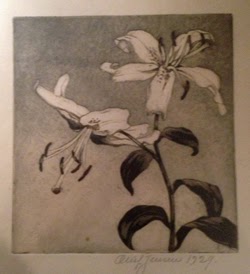
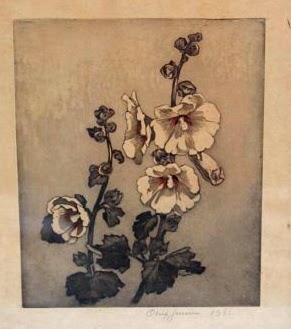
Stumbling over this small but very charming print and composition was an invitation to investigate further this obscured printmaker. And I've placed it on  my wish list. For future use and reference I show and share in this posting all prints  by Oluf Jensen I could find in old auction catalogues and websites.      

Oluf Jensen was born in Copenhagen, Denmark on February 17, 1871. He graduated from technical school in 1890 and then studied at the Royal Danish Academy until 1985. 

That same year he apprenticed at Royal Copenhagen as a blue painter and worked for the company until 1934, painting art pottery and porcelain and eventually managing the underglaze departments. Jensen also worked at Holmegaard Glassworks in 1924. 

Jensen is best known for his decorative painting on ceramic but he was also highly regarded painter in oil and watercolor. He also produced etchings in black and white, and in color whose motifs were floral or landscape. 


His etchings are often signed Oluf Jensen. Today Jensen is considered with Arnold Krog as the artists who had the greatest impact on the development the Danish underglaze porcelain. Examples of his decorated porcelain are in the Nationalmuseum, Stockholm. Carl Christian Oluf Jensen died in Copenhagen on January 31, 1934.

As an exception I’ve copied and pasted an artist biography (with permission, thank you Daniel) that I’ve found in Annex Galleries in Santa Rosa, California, USA. Couldn't have done any better myself. The delicate fuchsia etching is for sale among the many fine prints and varied stock of this renowned American gallery.


"Eger Tryck" = Hand pulled in Danish

For reasons I cannot explain almost all pictures I could find and scratch together by Jensen were of thumbnail dimensions. I have enhanced most of them in Photoshop to improve screen visibility and quality. 

---------------------------


Nice surprise, and "déja vu", was finding this watercolor, roses, by Jensen reminding me of a strikingly similar composition, in print, by a printmaker that I mentioned earlier in this Blog: Charlotte Rollius (aka Charlotte Rollins after an historical typo or simply a mistake by the great Malcolm Salaman in the Studio magazine in 1927). Rollius had been a student of Emil Orlik in Berlin, the Godfather of modern printmaking. 
Very little is known about either her person (born around 1885 and last mentioned 1944/45 in Berlin) or professionally: fewer then a hand full of most wonderful but hardly ever seen woodblock prints is all what remains to remember her. I'll show them in a next posting.   

Opening in march: my new Shop and Swap "Galerie Souris". For sharing and swapping of pre-owned and vintage woodblock prints, etchings, engravings and  drawings from my collections. 


All pictures borrowed freely from the Internet for friendly, educational and non-commercial use.      

Sunday, 24 November 2013

A stream of consciousness

Emile Gustaf Westman
(1894-1934)
Swedish printmaker

Stumbling over this Scandinavian etching of a blossoming tree and a visiting bee set a string of pictures and memories in motion that tells the story in what wondrous way the brain, my brain, is sometimes functioning. 

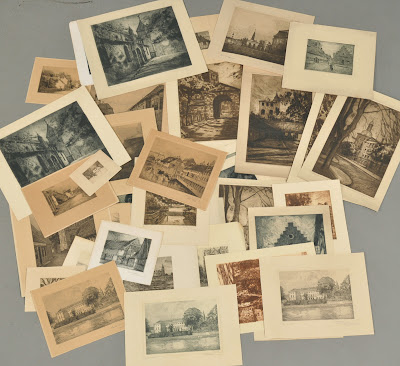
Because I'd never heard of this artist before I did my best to find out more about him but nothing much came up in the www. "Pupil of (Anders) Zorn"  the etcher-painterit said somewhere. But Emil Gustaf must have been locally known according to this big pile of prints I found offered in a Scandinavian auction site although he seems now largely forgotten. Many of the prints showing Malmö buildings and sites I discovered.
Only once his name popped up: in the entry to his son's biography: Gunnar Millet Westman (1915-1985) also an artist and remembered best for his sculptural work. And finding a picture of this granit statue called "Bro Bro Brille" immediately rang a bell. I've walked passed it many many times the last 10 years working in Groningen in the University Medical Centre. It's a very intimate statue of a family and the children encircling the parents in a game. You won't ever forget it, stroking the cold but smooth granite, and with a smile on your face, walking past, either to work or homeward. And I must have seen it in childhood.

It is hewn from a huge used granite press and it was placed in 1958, bought and donated to the city of Groningen (Netherlands) after a Danish sculpture exhibition in 1955 in the Municipal Park, to celebrate the opening of the big V&D warehouse. 


A decade after the destruction and rebuilding of what had been one of the best preserved and finest medieval market squares in Europe. 1955 was the year I (in my second year) returned with my parents from the tropics to the city of my forebears and living only a street length away to leave again a few years later the great and bustling and dynamic city of Groningen, capital of the North. 
With Zorn and the foraging bee in my head the "connections" were made. Martin Erich Philipp: besides printmaking and painting and much like Zorn, was an etcher too. This sensitive "Rückenakt" (is it his wife Else Staps or a model standing at the window ?) imho his finest. It is probably far more affordable then a Zorn etching who I cannot help thinking, often has the air of a voyeur, camera in hand. Besides being a great painter and etcher of course. And now at the end of the stream it becomes obvious why the mind took such a detour after looking at a bee and blossoming tree. I don't know when Westman etched his but MEPH created his woodblock print in 1933. Both are lovely.

All pictures in this posting are borrowed freely from the Internet for friendly, educational and non commercial use only.    

Friday, 8 March 2013

Emma Meyer (Mayer) 1888 Nordic Exhibition


In 1888 the Nordic Exhibition in Copenhagen was held to promote the Industrial, Agricultural and Artistic products of Scandinavia. Worries for Denmarks economic progress lay on the basis for organising this promotional “Expo of the North”, an effort drawing attention, visitors and capital to the capital. 
In the wake of this Nordic Exhibition Heinrich Hirschsprung (1836-1908) a self made tobacco millionaire and art maecenas, collector and personal friend of most contemporary Danish painters had the smart idea of organizing a parallel Art Exhibition to show, in the Charlottenborgh Castle, his important Danish art collection. 
The Charlottenborgh Castle is since earliest days the home of the Royal Danish Academy of Fine Arts. Every year exhibitions were and still are held in spring and a successful career as an artist began and begins here. In 1883 a new exhibition hall was added and build for the purpose.
After Hirschsprung’s death his extensive collections of Danish Art were to become part of the already important and famous Danish National Collection of International Art started in the 18th century and to accommodate it a new building was build near the National Gallery. 
I remember a perticular discussion in the Blog concerning the alleged use of photography in the etchings of Anders Zorn (1860-1920). In 1990 the opening of files in the Hirschsprung collection revealing a century(!) later the great Peder Krøyer (1851-1909) used photography in Denmarks most famous iconic and treasured paintings after buying his first camera in 1885. Krøyer painted his friends family in 1881 (above), probably without photographic aid, although the scene looks very much staged, everybody in it trying to behave extremely casual. 
In the 1885 Charlottenborgh exhibition among the many works of art and artists exhibiting was a young, still landscape painting, Edward Munch (1863-1944) and sisters Emma Leonora and Jenny Sofie Meyer. It was the year the idea for the Nordic Exhibition to be held in 1888 first arose in which the sisters were also present. Jenny Meyer was and still is famous for her applied art of painting for the Royal Danish Porcelain Factory. I'll tell more about them in next posting.  
Emma painted her sister Jenny at work at the Royal Kopenhagen Porecelain Company. Following the scarce facts on the www she is considered an important Danish women painter and belonging to a group named “the Pioneers”. More details on such a group I was not able to find.  But more about Emma and Jenny in next posting.
Sonderaften pa Skagens Sonderstrand, 1893 by Peder Krøyer

Read here* more about the use of photography in Krøyers paintings after 1885. 

The pictures in this posting show our ancestors didn’t go about these things half hearted. The efforts and expenses to organize big events like this, open for just a few months, in a world without flying machines, automobiles, telephone or radio must have been enormous. For the occasion even Tivoli was rented, locations cleared, new buildings designed, build, rebuild or destroyed afterwards. On the cleared exhibition grounds soon after Copenhagen's new Town Hall (Rådhus) and Square (Rådhuspladsen) was build.

Also held in Europe in or around 1888:
The Glasgow Exhibition on Science, Art and Industry: 5,7 million visitors
The Great Exhibition of Old Masters held in 1888 in the Royal Academy in London.
The London American Exhibition (1887) during Queen Victoria’s golden Jubilee (with the Buffalo Bill show): 2,5 million tickets sold.
And a year later in 1889 the World Expo in Paris, with the infant Eiffel tower, was held drawing over 6 million visitors. 

Next: Emma Meyer (1859-1921) Danish painter and unexpected woodblock printmaker.

All pictures borrowed freely from the Internet for friendly and educational use only.