Showing posts with label Margarete Donath. Show all posts

Sunday, 12 May 2019

Emile René Menard: intimiste

With this vintage postcard I thought to have found a nice copy of a perhaps lost painting. Since the day I found it I presumed it to be "Pomona" the goddess of fruitful abundance and protectress of gardens, harvest and fruits. I was probably blinded by the divine buttocks and jumping to conclusions I completely missed the point: there aren't any fruits ! 


Pomona was also the name of a "Reform" shop, selling bio-organic fruits and vegetables, healthy oils, brown cane sugar, nuts, "Protifar" (protein supplement) and the original Swiss Bircher Müesli of my youth in the Dutch city of Amersfoort in the 1950-60's. It was run by a friendly elderly (in my memory) Jewish (I think they were ) couple with the family name of Tobias. They were somehow related to my stepfather. It's too late to ask. 
Follow the label to an earlier article with Bircher Müesli and printmaker Margarete Donath. 

The goddess Pomona is usually associated and depicted with fruits, usually an apple or apples and she has been the subject of paintings and sculptures since ancient times. This example by an unknown artist telling the myth of Pomona being seduced (all mythical women were seducable and seduced by the gods) by Vetrumnis. 

Sculptor Aristide Maillol (if you happen to be in Paris visiting his charming museum is an absolute must) was also was intrigued by the goddess Pomona: he created several versions: in the nude and draped, with arms lowered and with arms stretched. Copies are kept and displayed in collections and museums all over the world: in Paris, Philadelphia, Amsterdam, Moscow etc.. and this version, with arms outstretched, is in Prague. I'll inform you about Maillol's  gorgeous model in a minute.


My Pomona however does not seem to be involved with fruits or apples although the artist did relate her posture to holding or inspecting some branches above her head. Maybe it was to emphasize "certain parts" of her beautiful body, I mean, when wearing high heels would be not an obvious or logic choice, standing in a field, being naked and obviously being invited to model in a pastoral landscape. 


The solution to the question "what is it ?", came to me recently: it is a copy of another version of (a detail of) a lithographic print by Emile René Menard (1862-1930) a French academic painter. Another version (in red chalk) is kept in the London British Museum. The detail, above right(now with fruits !) is from the original print below:   


His lithographic drawing "Automne" was published in the first album of the illustre editions of Estampe Moderne in 1897. 

The main figure is reaching and inspecting the fruit (oranges ?) and the title "Automne" is   referring to ripe fruit and harvest. Possibly Menard choose the title to avoid naming and explaining the relation with an annoyingly bored looking second figure.
My personal opinion is that it would have been wiser to dismiss the competing for attention  damsel on the left. It takes the attention from the gravitational centre of the original composition (the buttocks !).  I suppose Menard has wrongly added the bored "cousin" to balance his composition. He shouldn't have, as my photoshopped version proves: much, much better, I'ld say: near perfect.  


PS: I'ld love to find an affordable copy of the original print for my collection and to exhibit this story in the book. Offers welcomed. 

The best  description I found describing Menard he was an "intimist", a painter of intimate situations...... He'd studied under William Bougereau and was friends with Gustave Courbet and Lucien Simon. In this painting, composition-wise, he was smart not to disturb the centre of gravity (where the eyes come to rest) which im(not so)ho, is the classic updone red hair of the model.


Emile René Menard 
In his time Menard was famous and appreciated and commercially very successful for his "Italian" panoramic landscapes often with dramatic skies and often depicting a bathing women (a good reason to be undressed after all and suggestive of a mythical (non erotic) background. It is known he travelled to the Mediterranean regularly. 


Arisitide Maillol 
I suppose Aristide Maillol (1861-1944) must have been acquainted with Menards work while I think Menard would not have known about Maillol's model and muse Dina Vierny (1919-2009) who with her bequest, became the founder of Maillols museum. So what follows is probably co-incidental, chance, fiction and purely hypothetical. But also too good not to mention and share. 

      
This photo proofs the natural beauty of Maillols model Dina who was just 15 when Maillol "discovered her" and why she became his favorite model for so many of his sculptural master pieces.  


And then I found this 1937 photograph by photographer Pierre Jamet (1910-2000) of Dina in a posture (arms raised) that could have inspired Menard for his "Automne", or my Pomona, had he not been dead for 7 years in 1937. Maillol however had still 7 years of creativity ahead of him in which he would create many master-pieces with Dina.  


Maillol did several versions of a sculpture "Nue debout coiffant" (standing nude doing her hair). I have no idea if the old man was present sketching during this summery hozing of Dina (in Villeneuve sûr Auvers, not far from Paris) but I can imagine he was and created this drawing.      


With the possibilities of the modern internet Dina's classic beauty immortalised by Maillol can be admired 360C., almost in 3D, combining the hundreds  of good pictures from all over the world taken from every angle.  But these will do here. 


Dina also modelled for Pierre Bonnard and Henri Matisse and I think it could be Dina in here also, doing her hair. 


----------------

All pictures borrowed freely from the Internet for friendly, educational and non commercial use only.      

Monday, 18 April 2016

Margarete Donath, quest for a forgotten Dresden painter & printmaker (3/3)

Margarete Donath (3/3) 
Hermann-strasse 2 (renamed Lauritzerstrasse in 1922) 
Weißer Hirsch, Loschwitz, Dresden 
around1920-30


Only recently I discovered these 4 postcard drawings by Margarete Donath. They depict historic sites in Augustusburg, not far from Dresden and only miles away from her (I think) ancestral 19th century family seat: Bärenstein/Annaberg.


Augustusburg is where Duke August (1526-1586) ruler (King) of Saxonia had build his "Jagdschloß", a hunting castle. He was married to Anna (1532-1582) the daughter of King Christian III of Denmark. They were nicknamed "Vater August" and "Mutter Anna" and were married for 37 years. 

His portrait by Lucas Cranach the younger (1515-1586)


-------------------------------

Today the I shall try to sketch the world of the (a) Donath family in Dresded Loschwitz from the 19th into the 20th century, altough I have no hard evidence, no genealogical data or mentioning in any of the artists lexicons concerning her artistic studies that she belonged to this family.


In 1863 Carl Christian Rinaldo Donath (born Bärenstein near Annaberg, 70 km south east of Dresden on the Czech border 1823-1897 Dresden) a sculptor and inn-keeper in 1863 bought the esthablishment “Goethesgarten” in Dresden- Blasewitz which he eventually sold in 1872.  It was located at the crossroads leading to the entrance of the new “Loschwitzer Brücke” (“Das Blaue Wunder, completed 1893”) spanning river Elbe. 


Rinaldo Donath was also involved in the manufacturing of canned and preserved fruits. In 1875 he was joined by his brother Christian Hermann Donath (Bärenstein 1833–1909 Dresden) a woodturner (“Dreschler”), painter and early photographer. 

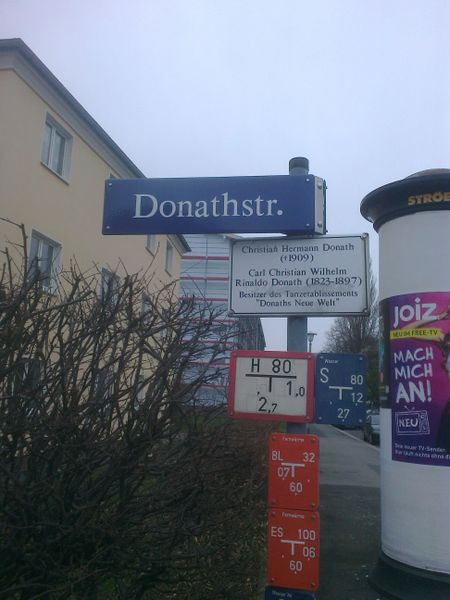
The brothers have been awarded a streetname: “Donathstraße” in Laubegast.


I could not find any evidence of Rinaldo being married but Hermann Donath married in 1855. With Mathilde Wilhelmine Estel a clothing adornment and lace worker and seemstress (“Posamentennäherin, Spitzenklöpplerin and Schneiderin”). They lived Laubegast, Hauptstraße no. 5. In 1921 it was renamed  “Östereicherstraße”.  The couple had 8 childrenAlbert (1863–1935) and Emil (1868-1945) who also studied in Dresden “Kunstakademie”, a sister Helene (1870-1974) never married, she is buried with her parents in Dresden and (I think): 


Max Oswald Donath (b. 1865) who started “Donaths Bäckerei” in 1897. This bakery still exists and today is run by his great-granddaughters Ute and Elke Donath and is still located at Königsbrücker Landstraße 69 in Dresden


Two brothers are said to have emigrated to America (Cincinatti) which leaves two unidentified children. I suspect that Margarete Donath, the painter/printmaker, might be one of them.


In 1875 the brothers Rinaldo and Hermann Donath were partners in buying the old “Tolkewitzer Gasthof” in  Laubegast, Tolkewitz near Dresden. It was also known as “Donaths Neue Welt”. They build and added attractions, a mini Zoo, playground for children, miniature Alps build from papier-mâché which were lightened in the evenings for a spectacular effect ("Alpenglühen"). 


It’s restaurant, dancing facility and beer garden etc. were a very popular outing for Dresden inhabitants. The Donath family owned the facilities until 1893. The Dance Hall burned down in 2004 and was not rebuild. The plot houses now a mall with a bio-food shop named “Donath’s Ganz Neue Welt”.  

_______________________


Brothers Emil and Albert Donath, were the founders of a health food company (“Reformwarenfirma”) the Firm Donath & Co. established in 1893 in Unterföhring near Munich manufacturing alcohol free and “biologic” fruit juices and in the same year started a business in Unterlockwitzgrund near Dresden winning a gold medal in 1906 in the “Internationalen Gartenbauausstellung”. 

Their interest and business in health food co-incides with the Health Spa business (rest, exercise, clean air, good organic food and fruit-juices) and its propagation (and invention) of Müsli by Maximillian Bircher-Benner (1867-1939) in Switzerland and Cornflakes by John Harvey Kellogg (1852-1943) in America. Also Brands existing to this day.  


This branch of the Donath familie in Dresden from then has built an imperium of organic fruit juice and wine manufacturing “Kellerei Lockwitzgrund”. 


The firm, although not in the same location is to this day in existence. The health food producers had come to the attention of and had led to some form of co-operation with Dr. Heinrich Lahmann (1860-1905) the health-spa owner and health food "guru". The Donath family lend their name to “Kurpension Donath” in “Weisser Hirsch”. (See part 1/3).


All pictures borrowed freely from the Internet for friendly, educational and non commercial use only. 

With the help of readers and passers-by I hope these Blog articles my lead to reveal more about the life and art of Margarete Donath.


email: gerbrandcaspers@icloud.com

Friday, 15 April 2016

Margarete Donath, quest for a forgotten Dresden painter & printmaker (2/3)

Margarete Donath (II) 
Hermann-strasse 2 (renamed Lauritzerstrasse in 1922) 
Weißer Hirsch, Loschwitz, Dresden 
around1920-30


The Loschwitz neighbors:

Oskar Kokoschka (1886-1980) 


A few streets away lived and worked for several years 1916-1919 modernist/expressionist Oskar Kokoschka gathering a circle of artists around him in Hotel Felsenburg. He was  recovering from his war injuries and was a professor in Dresden Kunstakadamie 1919-1924.

Rosa Petzel (1831-1912)

At the Rißweg in “Weisser Hirsch” at Villa “Sonnenleite” lived Rosa Petzel  with her two artist sisters Marie and Minna. She is considered one of Germany’s first professional woman (portrait) painters.


Oskar Pletsch (1830-1888)


a popular genre painter and books illustrator had lived nearby generation earlier.
  

Oskar Zwintscher (1870-1916)


symbolist painter and with Koskoschka professor in Dresden "Kunstakademie”. He taught one of Germanys best known printmakers Martin Erich Philip (1887-1978) who settled  later in nearby Dölszschen, west of Dresden.


Hans Kallmeyer (1882-1961) 

lived in Loschwitz and later moved to Königsberg and Nidden and was knicknamed “der Elchmaler” (the moose-painter). Like so many German artists Kallmeyer he lost all his belonging in bombing (of Königsberg)


Rose Friedrich (1867-1953)


Painter and printmaker who studied in Dresden Kunstakademie but also with Max Liebermann, Max Slevogt, Lovis Corinth and in Paris with Claude Monet. She lived Loschwitz, Schevenstrasse 2 in Villa "Te Deum Laudamus" near the river. 


Neumann, (most probably not Hermann Fritz Neumann (1858-1920 Dresden Loschwitz) as often claimed or stated by sellers, auction houses etc..


Still unidentified graphic artist, known for his animal (dog) etchings. Which is remarkable since the quantity and quality of his work. Neumann has been the focus of research by several print collectors but to this day without proper result. All help, knowledge etc.. is welcomed. 
Please contact me or Christian Mahnke (c.mahnke@gmail.com) and/or Wolfgang Barina (post@wolfgang-barina.de

(Added note april 2019: There is still controversy, mistaken identities and mix up with the biographical dates of painter Hermann Fritz Neumann who is obviously not the printmaker Neumann creating mainly colour etchings of animals and active almost certain after 1920, the year of death of Hermann Fritz N.) 

-----------------

More artists involved in  early printmaking lived in Dresden centre, Elisabeth AndraeDoris am Ende expressionist Ernst Ludwig Kirchner (until 1911) and in nearby Radebeul lived the illustrious (deaf mute) artist Käthe (Kathi) Kuntze from a prosperous Dresden bankers family .


Siegfried Berndt 
(1880-1946)

who was trained in and later taught at Dresden Kunstakademie lived Wittenbergerstrasse 51 near the entrance of the Loschwitz-Brücke (Blaue Wunder). He was with Orlik one Germany's pioneers of Japanese style printmaking introducing and spreading the gospel of this new craft to his colleagues in Dresden academy, possibly even to Oscar Zwintscher and Martin Erich Philipp (above). 


All pictures borrowed freely from the Internet for friendly, educational and non commercial use only. 


Next: the Donath family: working, business and living in the area.