Showing posts with label Heine Rath. Show all posts

Wednesday, 24 August 2016

Hans Reissinger: Berndt student in Bayreuth

These two prints of the park and palaces of the "Eremitage" in Bavarian Bayreuth surfaced in German eBay last week. Once the seat of dukes and princes it was also the hometown of composer Richard Wagner (1813-1883).
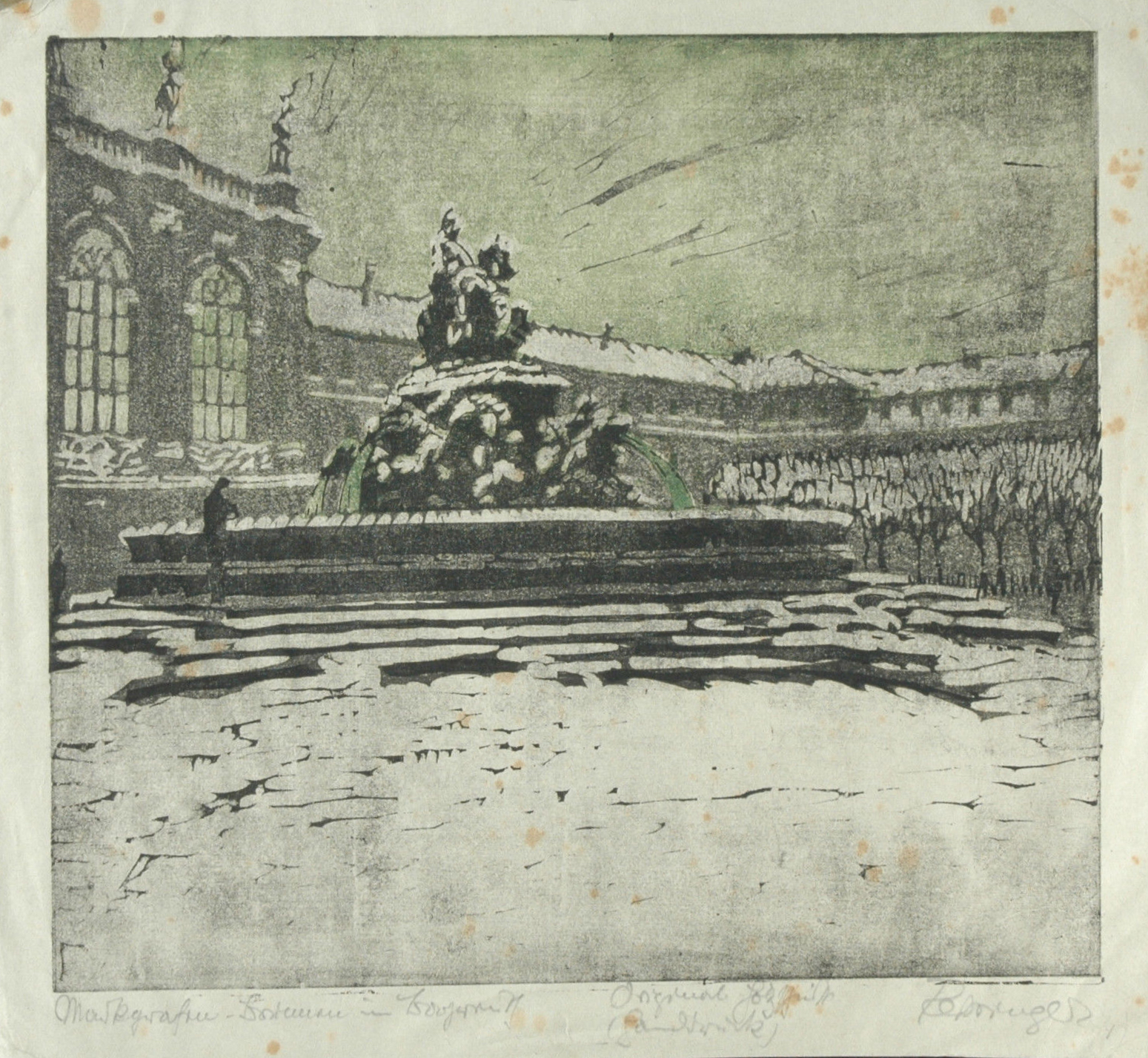


It is not hard to recognize who might have taught the architect Hans Reissinger the principles of printmaking. Just compare the pictures of prints in this posting (that were shown before) of Siegfried Berndt,  himself, and two other students. It is funny to see Reissinger, who must have been a good drawer of buildings, printed his "Markgrafbrunnen" mirrored because I had to mirror this contemporary photograph to match it up.  


Reissinger, Hans Carl 
(Bayreuth 10-04-1890 – 23-11-1972 Bayreuth)

Painter, architect and printmaker, (also Reisigner, with one s). Studied 1908-1912 in Munich “Technischen Hochschule” with painter and architect Friedrich von Thiersch (1852-1921), architect Theodor Fischer (1862-1938) and Karl Hocheder who was president of the High Court in Leipzig. Worked 1912-14 as assistant of architect German Bestelmeyer (1874-1942) in Dresden. Bestelmeyer succceeded von Thiersch in 1922 and acted as president of the “Akademie fur Bildende Künste” 1924-1942 organising an exhibition of popular Norwegian painter, drawer and caricaturist Olaf Gulbranson (1873-1958), (below).


After graduating in 1918 he settled in Bayreuth and worked as “Stadtbaurat” (chief cityplanner) 1927-1929 in Düsseldorf. He became a member of the NSDAP in 1934 and was promoted by the Nazi mayor as the cities overall planner also arranging the funeral of Hans Schemm an important Bavarian Nazi, attended by Adolf Hitler and all high ranking party members. During the Nazi period he build several buildings and monumens in Bayreuth. After WW2 he designed the stage for Wagners opera “der Meistersinger” after the “Bayreuth Festspiele” were continued and was involved designing many memorials and monuments and restauration of the many historic buildings in Bayreuth.
Dresslers KHB 1930 (Reisinger): M(aler), A(architect), Bayreuth, Richard Wagenerstrasse 39.
     
Steps of Pilnitz Palace near Dresden.

Examining Reis(s)ingers prints there's no doubt he was a Siegfriedt Berndt (1880-1946) apprentice possibly during his stay in Dresde. The two prints showing the “Eremitage” palace and the “Markgrafenbrunnen” in Bayreuth, buildings he took actively part in restoring  . They surfaced in German Ebay august 2016.

Dresden, Zwinger palace,  by Haine Rath(1873-1920)
Dresden by Bertha Schrader. (1845-1920) 
These prints by Heine Rath (1873-1920) and Bertha Schrader (1845-1920) are very similar in execution and sparse use of paint and color. Both artists died in 1920 which, with the years from Reissinger's stay in Dresden this gives us a nice clue dating these prints. Bertha Schrader, as an accomplished and successful painter must have tried at woodblock printmaking late(r) in life because she is the earliest born (German female) artist in my printmakers research. She will have met Berndt in Dresden. Berndt studied in Dresden 1899-1906 while Rath taught there at the Academy 1901-1919, from 1903 as a professor. 


Follow the labels in this posting for further reading.


All pictures borrowed freely from the internet for friendly, educational and non commercial use only. 

Friday, 5 September 2014

Bertha Schrader: mother of all women printmakers ?

Bertha Schrader
(Memel, Lithuania 1845 - 1920 Möckritz-Dresden) 

German painter and woodblock printmaker. 


In my ongoing research Bertha Schrader was possibly the oldest female artist-painter to try at woodblock printmaking. She will have been taught in Berlin by  Emil Orlik, but lived in Dresden at the time, where Martin Erich Philipp (1887-1978) was active with printmaking as early as 1908. She must have been in her early 60's, after having already a career as an accomplished and successful painter. I know of only two prints by her, monogrammed BS, and here's what I've been able to compose from the collected bits and pieces.


"Der Zwinger", the grand and impressive barok palace in Dresden, destroyed in WW2 but was restored to the museum complex it now houses. Build for the King of Poland, August the Strong (1670-1733) between 1710-1728.


Two other woodblock printmakers choose the Zwinger Palace as subject: Heine Rath (1873-1920 in the same year as Bertha Schrader) en Otto Westphal (1878-1975) also from Dresden. 


   Dutch Canal woodblock print and oil painting by Bertha Schrader, after her travels to neighboring Netherlands.  
-----------------------------------------------------------------------------------------------------------
Born in Memel (Lithuania) Bertha but spend her youth in St.Peterburg (Russia) and from 1854 was living in Dresden (1894, Sidoniënstraße 14). Landscape and interior painter and printmaker  working and living in Dresden. Student of Paul Greab (1842-1892) in Berlin and Paul Baum (1854-1932) in Dresden. Eventually she embraced an impressionist style of painting. Only two woodblock prints of her are known at this moment. She started her career in Berlin but moved to Dresden Mockritz on the Elbe river. Travels to the Northsea and Ostsee, the Netherlands, Switzerland. Denmark and the North of Italy. 
Exhibited in Berlin, Dresden, Hannover, Hamburg and Bremen. She was a member of the VdBK in Berlin 1882-1916 and exhibited there 1882, 1884, 1886, 1888, 1892, 1894, 1901. She was chairwoman of the Dresden Women Artists Association. 

And here are two of her finest paintings:
Bertha Schrader: "An der Elbe" an impressionist impression 

Claude Monet: "River Seine at Vetheuil" 

Emil Nolde: "Elbe Schlepper" 

Max Liebermann: "River Elbe"

     -----------------------------------------------------------------------------------
Bertha Schrader: River Elbe near Möckritz-Dresden where she worked and lived. The Elbe flows all the way across Germany from Dresden to Hamburg on the North Sea.  

Rudolph Pöschmann (1878-1954), a local Dresden painter. 

In 1912 princess Mathilde of Saxony (1853-1933) opened a women artist exhibition in Dresden where a painting of Bertha Schrader was displayed. This was mentioned in the British 1912 Volume of the prestigious magazine "the Studio". See also "Mathilde Reuß, a royal printmaker ?" in this Blog by following the label below.  

All pictures borrowed freely from the internet for friendly, educational and non commercial use only.

All further information on Bertha Schrader would be very much welcomed. 

Tuesday, 3 January 2012

Around Antwerpen School of Printmaking (VI)


Emile Antoine Verpilleux (III).
(1888-1964)
British painter, portraitist,
woodengraver, illustrator and
Modern Printmaker

 Thames view towards Charing cross (Hungerford) railway bridge.
Under Waterloo Bridge

Verpilleux' view of River Thames is a remarkable achievement in many ways. It's accurate, it's panoramic, has great colours towards a setting sun. And it's without any equivalent. The broad waters dramatically rushing towards the viewer. Again: remember this is not a painting but a woodblock print. On the far left South Bank: the bell tower of County Hall. The Victoria Tower and Clock Tower are in the centre. The two towers of White Hall Court and Cleopatra's Needle on the Victoria Embankment on the right.
Were the artist sat.

To emphazise his very low view point he shows a glimpse of one of those caracteristic Victorian lanterns on the Victoria embankment wall above him. Adding yet another element to the already very strong perspective.


Would it have been a painting and more known it would have been discussed and analysed by art experts all over the world. It would have hung in a prominent Museum on a prominent spot. But it's not. Not a painting, not well known, nor on display in any museum. Not even in London. A shame !
This above birds eye view of what Verpilleux is showing us from the centre of his print: Victoria Tower (the little yellow dot is where he sat.
Adelphi , Cecile and Savoy Hotels, around 1905,
 the pontoon  l.r. seen from Waterloo bridge.
Verpilleux choose a dramatic low view point. As low as he could find. On the surface of River Thames on a pontoon build in 1869 (it's no longer there) and in front of the Savoy Hotel and practically under Waterloo bridge
Thus, cleverly enabling him, placing the horizon and Westminster Bridge below the railway bridge with its caracteristic domed pillars and steaming engine driving towards Charing Cross Station. 


It is possibly the most depicted, painted and photographed London panorama.
View from the Cecile Hotel.
But there's really no equivalent to Verpilleux' print showing the greatness of River Thames. 
The only modern prints I know with a similiar scene and similar low perspective is "Pont Royal" with river Seine in Paris by German woodblock printmaker Heine Rath (1873-1923) 
and etcher Luigi Kasimir (1879-1937) with river Elbe and Hamburg.


There are many great and famous paintings of this grand panorama. Most but a handfull of artists however choose a higher position either from the Victoria Embankment, the bridge crossing or high up from the Savoy or Cecile (no longer there) Hotels. Painters, etchers and photographers.
From this perspective Claude Monet 1903 clearly choose higher grounds for this and countless other views in changing weather and atmosphere.


Here are some examples of the famous railway bridge as seen from Waterloo bridge. Massive White Hall Court dominating on the right.
French Impressionist Camille Pissaro (1830-1903): view from Waterloo Bridge (build 1865). Probably painted 1871, the year he visited London
American Impressionist Frederick Childe Hassam (1859-1935), 1929
Czech artist Frantisek Tavik Simon (1877-1942), one of the finest European painters and graphic artists of the xxth century, visited Antwerp and lived in Paris 1904-1914. This is his sketch of Thames tugboats and the railway bridge.
Andre Derain (1880-1954) 1906


And contemporary painter Claire Randall stood right above where Verpilleux sat. Restored RS Queen Mary (a restaurant) now moored at this location.


Under Waterloo Bridge in 1924 around the time Verpilleux sat there.  One of my favorite artists Dutch painter and etcher Willem Witsen (1877-1942) had a fascination for this spot too around 1905 (below). He made several paintings.


From the great many wonderful pictures I found researching Verpilleux' print these I cannot withhold sharing here: 
The railway bridge and the Victoria Embankment at night seen from the other (West) side, from Westminster Bridge. White Hall Court and Charing Cross station on the left, a 1904 photogravure (click!) by William Hyde (could find no biographical data). I will come back to him later. 


And Whistler's friend, American Joseph Penell (1857-1926) had a fascination for this bridge too: "under Charing Cross Bridge" and "Westminster and railway bridge" seen from Waterloo Bridge' South Bank.


In next posting I'll show a selection of the more celebrated and popular London and Thames impressionist views I found researching this article to emphazise the importance of Verpilleux' woodblock print. Impressionist views from the Grand Hotels on the Victoria Embankment between Waterloo Bridge and the Adelphi Terrace.


This posting has been my most extensive, time consuming and laborous contribution to this Blog so far. Leaving feedback and comments is always welcomed.