Showing posts with label Bertha Schrader. Show all posts

Monday, 23 January 2017

Hildegard Koch: forgotten.

Koch, Hildegard 
(1871 – after 1921 before 1930 ?)
Dresden painter and printmaker

I have to make corrections on this posting within 24 hours. The print described was not created by Hildegard Koch. The research however unexpectedly lead to the proper artist. Please see next posting on Wilhelm Koch. 
   
Hildegard Koch lived and worked in Dresden and (1898 - ?)  in Kipsdorf-im-Erzgebirge (20 km. south of Dresden) in the "Erzgebirge (Ore-mauntains). I have no proof source to where she was born. She is not mentioned in any of the artists lexicons.  


She had also been a member of the "Verein der Berliner Künstlerinnen" 1898-1916 and exhibited with the VdBK 1898, 1901, suggesting she may have studied in Berlin. This painting and the postcard below are the only examples of her work I as able to find. 


Later we find her also a member of “Gruppe der Dresdner Künstlerinnen”, around 1904, and exhibiting in 1908 in “Galerie Arnold” with Doris am Ende (1857-1944), Clotilde Schilling (1858-1934), Bertha Schrader (1845-1920) and Lina von Zieten (?) and others. Please help to identify this last artist ! 


Hildegard Koch is not graphically known by any woodblock print. This print surfaced in German Ebay last month showing a winter landscape and a twin towered “Kreuzkirche” possibly somewhere south of Dresden, in the Ore Mountains region (“Erz-gebirge”), possibly around Dresden. It would be nice to identify the church and its town. Reading the signature "Hilf." I wrongly assumed it could be made by her. It's not, but the print has lead me to her surprising adres in Dresden and more surprisingly to her printmaking colleagues and even neighbors. This mistake (wrong path of investigation) shows how little we know of the lives of so many wonderful artists. 
I am not ashamed to prove myself wrong. It is an accepted way of research when open for criticism and fresh ideas (thank you Wolfgang in Frankfurt for you help and suggestions).     


In Dresden Hildegard Koch lived in 1921 at Ostbahnstrasse 1, in a street were artist liked to have a studio because of North facing windows: at nr. 2 lived Elisabeth Andrae (1876-1945) and Erna Ottillie Bercht (1881-1966) while Clothilde Schilling (1858-1934) lived at nr. 16. Printmaking ladies whom we've met met before.


Ostbahnstrasse Dresden

Dresslers KHB 1921: Dresden, Ostbahnstrasse 1. Member VdK.
Dresslers KHB 1930: not mentioned, suggesting she stopped living 1921-1930.

Post card made by Hildegard Koch in Kipsdorf  

Hildegard Koch today is a largely forgotten artist. These are the only facts and examples of her art I was able to scratch together. But slowly pieces of the historic puzzle in artistic Dresden begin to form pictures: follow the labels: Andrea, Schilling, Schrader.        

Do send corrections and additions for sharing and help me in my research into early German woodblock printmaking by woman artists born 1850-1900. 

---------------------------
All pictures borrowed freely from the Internet for friendly, educational and non commercial use only. 

Wednesday, 24 August 2016

Hans Reissinger: Berndt student in Bayreuth

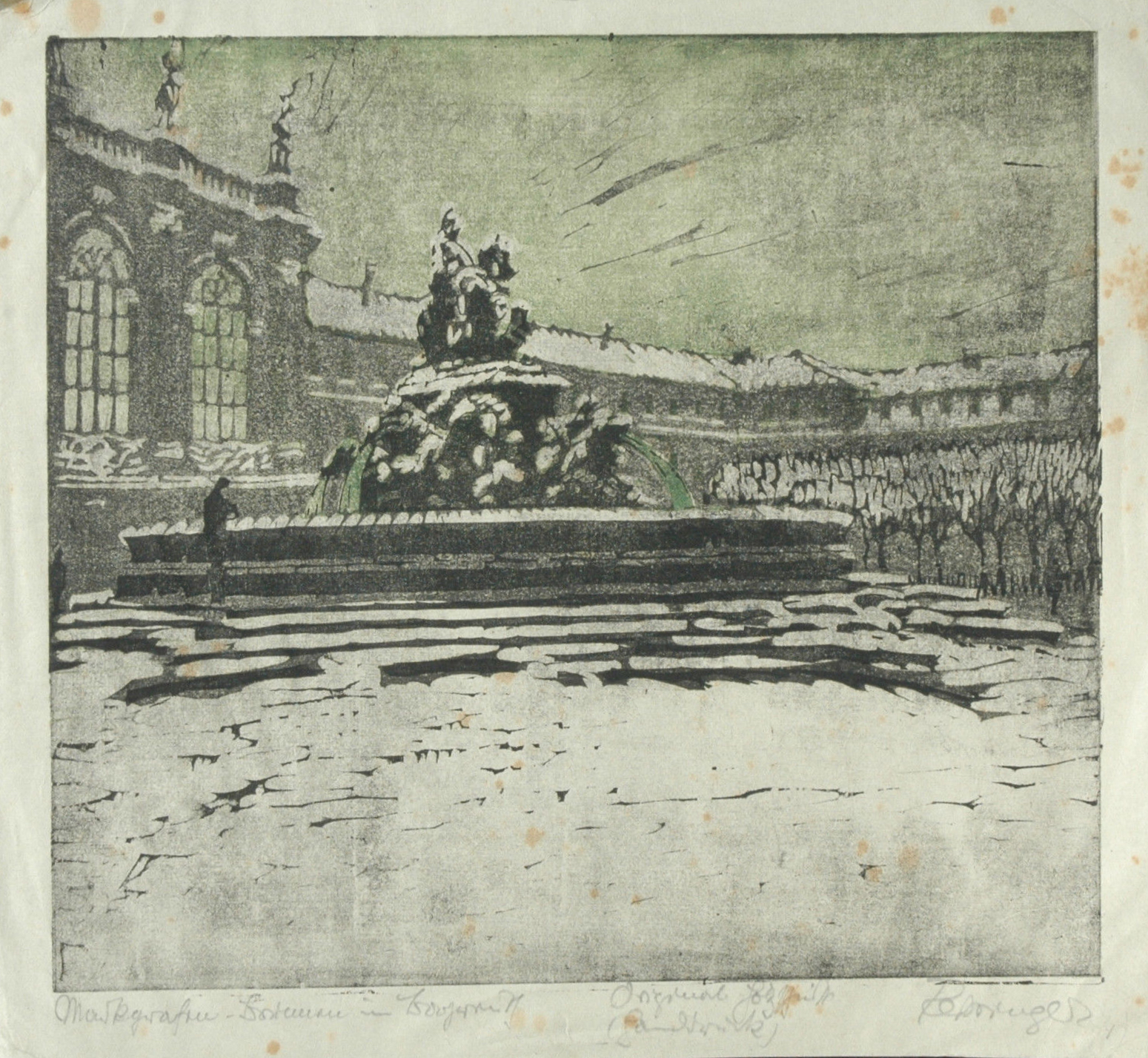
These two prints of the park and palaces of the "Eremitage" in Bavarian Bayreuth surfaced in German eBay last week. Once the seat of dukes and princes it was also the hometown of composer Richard Wagner (1813-1883).


It is not hard to recognize who might have taught the architect Hans Reissinger the principles of printmaking. Just compare the pictures of prints in this posting (that were shown before) of Siegfried Berndt,  himself, and two other students. It is funny to see Reissinger, who must have been a good drawer of buildings, printed his "Markgrafbrunnen" mirrored because I had to mirror this contemporary photograph to match it up.  


Reissinger, Hans Carl 
(Bayreuth 10-04-1890 – 23-11-1972 Bayreuth)

Painter, architect and printmaker, (also Reisigner, with one s). Studied 1908-1912 in Munich “Technischen Hochschule” with painter and architect Friedrich von Thiersch (1852-1921), architect Theodor Fischer (1862-1938) and Karl Hocheder who was president of the High Court in Leipzig. Worked 1912-14 as assistant of architect German Bestelmeyer (1874-1942) in Dresden. Bestelmeyer succceeded von Thiersch in 1922 and acted as president of the “Akademie fur Bildende Künste” 1924-1942 organising an exhibition of popular Norwegian painter, drawer and caricaturist Olaf Gulbranson (1873-1958), (below).


After graduating in 1918 he settled in Bayreuth and worked as “Stadtbaurat” (chief cityplanner) 1927-1929 in Düsseldorf. He became a member of the NSDAP in 1934 and was promoted by the Nazi mayor as the cities overall planner also arranging the funeral of Hans Schemm an important Bavarian Nazi, attended by Adolf Hitler and all high ranking party members. During the Nazi period he build several buildings and monumens in Bayreuth. After WW2 he designed the stage for Wagners opera “der Meistersinger” after the “Bayreuth Festspiele” were continued and was involved designing many memorials and monuments and restauration of the many historic buildings in Bayreuth.
Dresslers KHB 1930 (Reisinger): M(aler), A(architect), Bayreuth, Richard Wagenerstrasse 39.
     
Steps of Pilnitz Palace near Dresden.

Examining Reis(s)ingers prints there's no doubt he was a Siegfriedt Berndt (1880-1946) apprentice possibly during his stay in Dresde. The two prints showing the “Eremitage” palace and the “Markgrafenbrunnen” in Bayreuth, buildings he took actively part in restoring  . They surfaced in German Ebay august 2016.

Dresden, Zwinger palace,  by Haine Rath(1873-1920)
Dresden by Bertha Schrader. (1845-1920) 
These prints by Heine Rath (1873-1920) and Bertha Schrader (1845-1920) are very similar in execution and sparse use of paint and color. Both artists died in 1920 which, with the years from Reissinger's stay in Dresden this gives us a nice clue dating these prints. Bertha Schrader, as an accomplished and successful painter must have tried at woodblock printmaking late(r) in life because she is the earliest born (German female) artist in my printmakers research. She will have met Berndt in Dresden. Berndt studied in Dresden 1899-1906 while Rath taught there at the Academy 1901-1919, from 1903 as a professor. 


Follow the labels in this posting for further reading.


All pictures borrowed freely from the internet for friendly, educational and non commercial use only. 

Tuesday, 12 April 2016

Margarete Donath, quest for a forgotten Dresden painter & printmaker (1/3)

Margarete Donath (I)
( ? – after 1930)
German painter and printmaker


Just this one print in the Van der Grinten Collection shown in the indispensable “Frühzeit der Modernen Holzschnitts”, and her name is (almost) all that is known about this artist.  She is not mentioned in any Artist Lexicon but the equally indispensable “1930 Dresslers Kunsthandbuch” gives: “M (aler, painter), Dresden, Weisser Hirsch, Hermannstrasse 2”.
In an article treating Dresden street names “Weisser Hirsch” with distuingished villa’s and sanatoriums, private hospitals and guesthouses it is confirmed that Margarete Donath (“Malerin und Graphikerin”) lived here. In 1922 the street was renamed “Lauritzerstrasse” (which obviously had not reached Dresslers editorial staff in 1930). There are only 4 villas in this small stretch of street.

An attempt to reveal her identity with the help of readers.

1) The neighbourhood. 

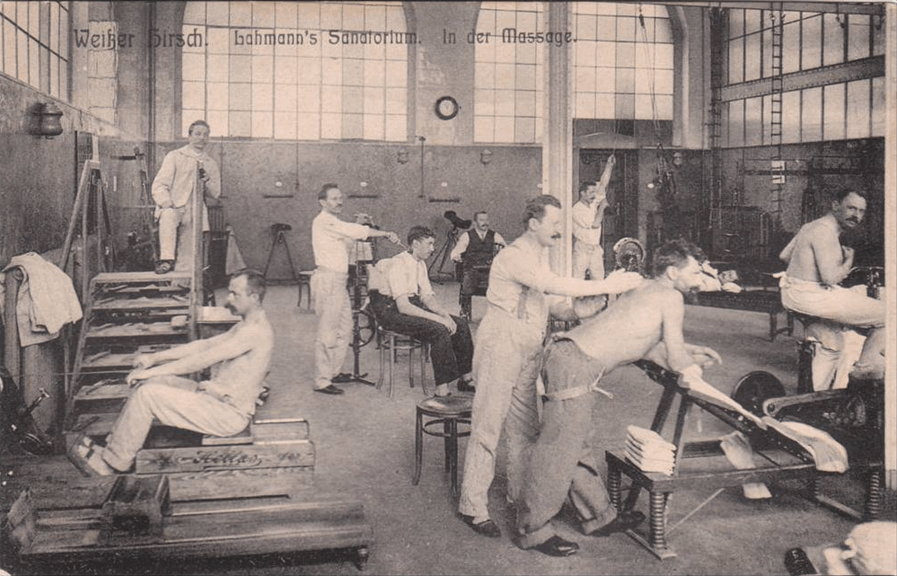
Weisser Hirsh,  Loschwitz near Dresden

Crossing river Elbe the “Loschwitzerbrücke", completed in 1893 and nicknamed “das Blaue Wunder”, connects Dresden with “Weisser Hirsch” a part of “Loschwitz”, today greater Dresden.
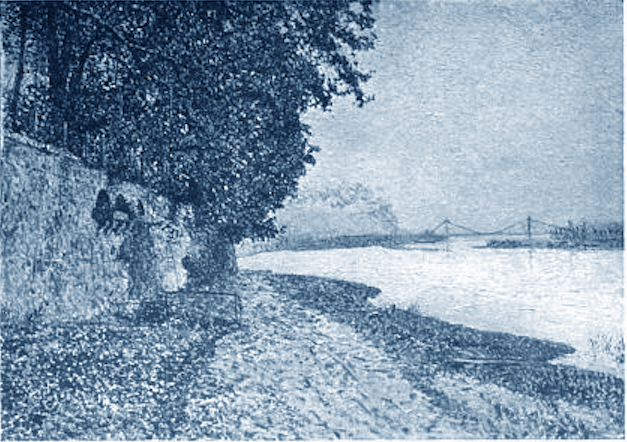
Bertha Schrader (1845-1920) painter and printmaker lived in the Christianstrasse 19 (the residence of  Dresdens specialists and doctors) in Dresdens “Altstadt” (I met her before in this Blog: follow the tag) painted the bridge and river Elbe.
After completion of the cast-iron bridge two steam driven funicular railways ("Stadtseilbahn") were build: a suspended railway leading to a panorama and a 550 meter stretch of railway connecting Loschwitz with "Weisser Hirsch" a villa quarter developed around an ancient Inn by that name.

This particular area of Dresden end of the 19th century became the centre of the "Naturheil-sanatorien". The treatment by natural remedies developed in contrary to the scientific medicine during the 19th century. Dresden was before and after 1900 a centre of "naturopathy": the pioneering therapy using primary the applications of diet, physical exercises, water and light. It saw some famous patients, writers, poets, artists: Franz Kafka, Rainer Maria Rilke, Thomas Mann and Oskar Kokoschka seeking treatment by natural remedies. read here*. 

---------------------
One of the most prominent and successful doctors running a sanatorium and health Spa in Weisser Hirsch was Dr. Heinrich Lahmann (1860-1905).  He started his business in 1887 and it became so successful, adding many building, baths and exercise facilities and in a short time added several (7) villas to his emporium to accommodate the flow of new patients.
One of them, Villa Eschebach, build in 1877 as a summer residence for Dresden industrial, art collector, Maecene and one of Dresdens richest inhabitants Carl Eschebach (1842-1905) he rented from 1887 as his house but after his untimely death it is known as "Kurpenzion Donath". The health related connection between Lahmann and the Donath family will be treated in next posting. Although I have no idea how the Donath name came to be attached to this perticular house. 
The villa was used as a hotel for patients of the sanatorium until probably 1918 when it was bought by Dutch Consul Willem van Ameyden van Duym (1857-1917) and his family who owned the house until 1930.
Both Lahmann and Eschebach died in 1905 of complications of the Influenza pandemic. Penicillin had yet to be discovered (Fleming, 1928) but it lasted until WWII becoming available as anti-biotic treatment. No sanatorium or naturopathy treatment could save these men. 


All pictures borrowed freely from the Internet for friendly, educational and non commercial use only.

All pictures mouse-clckable to embiggen. 

Next:

part 2) meeting the neighbors in "Weisser Hirsch" Loschwitz, Dresden 1900-20.
part 3) meeting some members of the Donath family in Loschewitz, Tolkewitz, Gartenlaube and Lockwitzgrund.    


Sunday, 19 July 2015

Clotilde Schilling: what's in name ?

Clotilde Schilling
(1858 - 1934) 
German painter 

Clotilde (as German as a name can be as if it was taken from a Wagner Opera) Schilling was the daughter of Johannes Schilling (1828-1910). A celebrated son of Dresden, a famous sculptor. Read about him (here*)


I stumbled over Clotilde (1858-1934) trying to identify the printmaker of the two prints in before posting (read here*)


Clotilde's grave, and that of  Alexandra Schilling (1855-1936) in Dresden is adorned by a wonderful sculpture no doubt created (designed) by her sculptor father when she was young (there is a mentioning of this in Johannes' biography) Clotilde is not mentioned in her father's biography in the prestigious "Deutsche Biografie" (read here*). Unless her "official" name was Catharina Susanna. (Curious: Johannes married in 1857 so what about Alexandra born in 1855 joining Clotilde in eternity ?)


Clotilde is an artist-painter represented by just one painting (above) in the Internet while her brother Rudolf Schilling (1859-1933) has left proof of his successful career all over Dresden. He became a highly successful architect (read here*). (Below)


Clotilde Schilling exhibited in Dresden in 1904. She was organized and acquainted with art-sisters Bertha Schrader (1845-1920) a painter-printmaker I've met not long ago and honored with a posting (here*), and with graphic artist Doris am Ende (1857-1944). (both below)


Martin Erich Philipp studied and started his successful printmaking career in Dresden from 1913. So there are possible clues to Clotilde trying at printmaking. Her signature however has little similarity with the handwriting on the prints. 

Possibly the best known sibling of Johannes Schilling is his youngest daughter  Clara Elisabeth (1864-1913). She stood model for Germania, the symbol of Germany United. A huge and colossal monument overlooking the Rhine near  Rüdesheim created by her father.  


It was build commemorating the unification of Germany and the ending of the Franco-German war (1870-71). Ordered by the first Kaiser, Wilhelm-I himself, and his chief: Reichskanzler Otto von Bismarck. It's construction was completed in 1883. 


Germania to Germany is what Marianne is to France. Here (below), created a decade later in 1899 by Aime Jules Dalou (1838-1902), a French colleague of Johannes Schilling. It is located in the Place de la Nation in Paris.

-------------

All pictures borrowed freely from the Internet for friendly, educational and non commercial use only. 

Tuesday, 10 February 2015

Bertha Schrader continued: Blaues Wunder !

Bertha Schrader
(Memel 1845 - 1920 Moritzburg/Dresden)  
Painter and woodblock printmaker 


In 1893 the “König Albert Brücke” spanning the Elbe River was opened. A marvel of technical engineering it was the worlds first bridge this length spanning an entire river without a central pillar. It connects the Dresden townships of Blasewitz and Loschwitz. It was named after King Albert of Saxony (1828-1902) but in 1912 it was renamed "Loschwitzer Brucke" and knicknamend lovingly "Blaues Wunder"


It was Dresdens 5th bridge across the Elbe river and the only one to survive WWII devastations (and German sabotage) undamaged.  


Bertha Schader will have witnessed its construction, completion and opening. In 1912 a painting showing the bridge in a "recent Exhibition of Women Painters" in Dresden is mentioned (below). Sadly I cannot find any records of it other then this article in the prestigious magazine “The Studio”. The painting is probably lost.


The exhibition was held under the auspices of H.R.H. princess Mathilde, (she appeared earlier in this Blog here*) and was herself also represented with a painting. She was the artistic daughter of Albert’s successor, his brother King Georg of Saxony (1832-1904) but he died after just two years of reign. 
     
Bertha's view on Loschwitzer Bridge, painting owned by reader Katy in America
Bertha Schrader was as most (all?) pioneering women printmakers an accomplished and professional painter first. Until last week her history (she came from Memel in the Baltic) was shrouded in the mist of time. And lost in the total destruction of Dresden. She must have loved this spot because from the few surviving and known paintings by her hand there are 4 she made from this bend in the river upstream from the bridge and the "Altstadt". In the pointillist style of her teacher Paul Baum (1859-1932) in Dresden and also in the style of another of her teachers: Paul Graeb (1842-1892) from Berlin (below). 


Both paintings by Bertha Schrader

Dresden, build over centuries, “Florence on the Elbe”, was destroyed in just two days between 13 and 15 February 1945 as act of barbaric retaliation by civilized nations on a scale the world had never seen before. Disguised as, justified a necessity by bomber command to end a war that already was coming to an end. We today judge. Probably 25.000 citizens died in the firestorms, nobody knows. Exactly. Today Dresden is rebuild to its former glory.


Bertha Schader appears only as foot-notes in the transcendent German "Thieme Becker Künstler Lexikon" and French “Benezit”. She had been a student of Paul Baum, a former Meissen porcelain painter. He had been living and working since 1890 in the Knokke “artist colony” in Belgium and had returned in 1895 to be involved in the Dresden Secession. He himself had been a student of landscape painter Theodor Hagen (1842-1919) in Weimar.


Paul Baum (above), considered Germany’s last impressionist, soon returned to the Low Lands living and working in Sint Anna-ter-Muiden, near Sluis in province Zeeland for almost twenty years (1895- 1914). But eventually he returned to Dresden as a professor in Dresden Art Academy. Comparing Bertha with Paul Baum one can see how close they must have been: paintings by the student and the master are hardly distinguishable. Bertha, I'm sure, stayed with Baum in Sluis (below) and I could see them painting together on the canal.
    

"Canal" (possibly Sluis) by Bertha Schrader and "Sluis" by Paul Baum
(added info, see comments) 

In Sluis Baum also was visited by Lovis Corinth (1858-1925) the master from Berlin who on the occasion painted him (below). Max Liebermann (1847-1935) also liked to paint on the Dutch and Belgian coast.


Meeting Dutch painter Theo van Rijsselberghe (1862-1926) and already a (late or post-) follower of the Impressionists Baum later adopted the pointillist technique and colour theories of George Seurat (1859-1891) and Paul Signac (1963-1935).   

As we shall see in next posting Bertha (above right, probably in the Netherlands, left: Seurat in Honfleur) had besides her colleague and teacher (and friend?) Paul Baum family connections in the Netherlands. As she had in Norway where she also travelled to, to visit and to paint. 


She visited relatives and family on a little island connected with a wooden bridge to the mainland and no doubt has met a couple of very illustrious and famous colleagues (like the one above who happened to live there). All this I learned thanks to Katy, the present owner of this “Blaue Wunder” painting which today is in America. She is distantly, not directly since Bertha stayed unmarried, related to Bertha Schrader and Katy has found me through the Blog. Wonderful ! More to follow soon.

All pictures borrowed from the Internet for friendly, educational and non commercial use only.