Thursday, 22 February 2024

Fernand Lambert 2: La Laitière

 La Laitière

Recently this large drawing was discovered and rescued after being dismissed by its former owners. I think, as best as I can, the signature may read "Fernand Lambert 1903". But it could also be Fernande (she) and/or Cambier ........  Benezit Lexicon does not give any other serious candidates besides the painter Fernand Lambert (before post) who was born in Lyon but studied and had a career in Paris. 

It is an exact copy of Jean Baptiste Greuze's (1725-1805) painting of "La Laitière" (the milkmaid). The painting is since 1900 officially part of the Louvre collection with its pendant painting "La Cruche Cassée" (the broken pitcher). We know Greuze's wife Anne-Gabrielle modelled for the milkmaid. They later divorced. Both paintings have deeper layers of symbolic meaning (virginity, virtue, status etc..).  


At least 2 engraved versions of "La Laitière" are known: by Greuze's contemporary Jean Charles Levasseur (1734-1816), which is a mirrored version, and a 1901 "Heliogravure" published by Braun Clement & Cie for "Revue de l'Art ancien et moderne". 


My suggestion is this drawing may have been an academic exercise, by Fernand Lambert while studying in Paris under Bougeareau and when the painting was not that long in the Louvre. 
I also think it far too accurate and professional to be created by an amateur. 

Any other suggestions or knowledge concerning the history of this milkmaid is very welcomed. 

PS: Milkmaids were often used as models in paintings because of their fair and unscarred skin: in times of small pocks and tuberculosis many milkmaids had built an immunity to the microbes causing these wide spread and devastating diseases. The fair skin of milkmaids helped clever physicians to understand better the cause and paths of the disease and ultimately leading to the development of vaccines, inoculations, prevention, medication and cure. For which we should be thankful instead of suspicious. 

Wednesday, 21 February 2024

Fernand Lambert 1

 Fernand Alexis Lambert (1868-1934/35)

was a not very well known French landscape painter and critic. He was born in Lyon, studied in Paris under Bougereau and is known by half a dozen really nice (post)-impressionist landscapes and river scenes (Rhone in Lyon nd Seine in Paris). He has only a few lines in Benezit, artists lexicon and the pictures of his works are scratched together from the Internet. 


If he is identical with the maker of a drawing after the famous painting "La Laitière" (the milkmaid) by Jean Baptiste Greuze (1725-1805) in the Louvre remains to be researched.

See next posting !


Monday, 29 January 2024

Jaxman or Jarman ?

 Elizabeth Jaxman or ? (....better suggestions)


Charming coloured ink portrait of a reading girl. I have no idea about the artist, Jaxman (what I read) as a family name is highly unlikely. Several other possibilities were tried but so far without result. 

Taken from the frame (it needs a nice fresh matt) scribbled on the back in pencil: 
tel que  ninove
Perhaps a clue leading to Ninove, a city (40.000 inh.) West of (French speaking) Brussels. The portrait was found in the South of the Netherlands, near Belgium. 

All suggestions leading to the identity of the artist are welcomed.
---------------

UPDATE
Febr. 22 2024

The suggestion:
Elisabeth Jarman was welcomed.

So far it has not lead to a candidate for the artist this drawing. 

Sunday, 28 January 2024

Lillsjönäsgårt

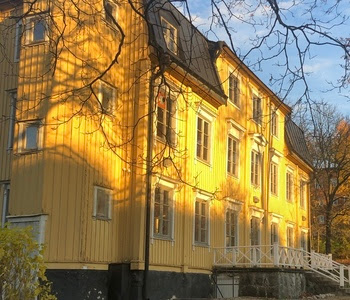
A stone's throw from Abrahamsberg metro station, we find a remnant of rural Bromma. Nestled in greenery, at the end of a lime tree avenue, is Lillsjönäs farm. A place with traces of the past.

The main building was built in 1834 by master shoemaker Magnus Sohlberg. Today the site is surrounded by dense 20th century buildings. In the 1830s, this was a rural environment at a reasonable distance from the city. There were opportunities for gardening, parties and fishing in nearby Lillsjön. The land was used for cultivation.
Lillsjönäs was a private summer resort until 1908. Then the property played an important role in the expansion of Bromma. By subdividing its own land, Lillsjönäs farm was one of the first to lay the foundations for a villa community. The last private owner, wholesaler P. Kindgren, started one of the country's earliest bus lines to increase the attractiveness of the area. The line ran between Lillsjönäs and Kungsbroplan.
In 1908 the City of Stockholm bought the farm buildings and the rest of the Lillsjönäs plots. An orphanage with an educational institution and a country school was established here. Boys were trained in 'agricultural and horticultural professions' and girls as 'domestic servants'. This educational and support activity was new and untested, and the one at Lillsjönäs was the first in the country. Since the 1940s until 2018, the building has housed various associations and a youth center.
The main building is well preserved and the style is typical of early 19th century ideals. It is a rare example of a summer resort from this period. During a renovation in the 1950s, much of the older furnishings were lost. However, the outdoor environment has been preserved as a rural oasis. Traces can be seen of the 19th century garden structure with a lime tree avenue, orchard and lilac bushes. A few tall deciduous trees stand next to the main building. Probably a remnant of an English park with winding paths, which was popular at the time.

Translated with DeepL.com (free version)

These two 1952c watercolour impressions, by an unknown artist visiting Lillsjönäsgårt  were recently discovered in a car boot: "the kitchen", with wood burning stove, and "ironing".

All information or suggestions concerning the artist are welcomed.

Wednesday, 17 January 2024

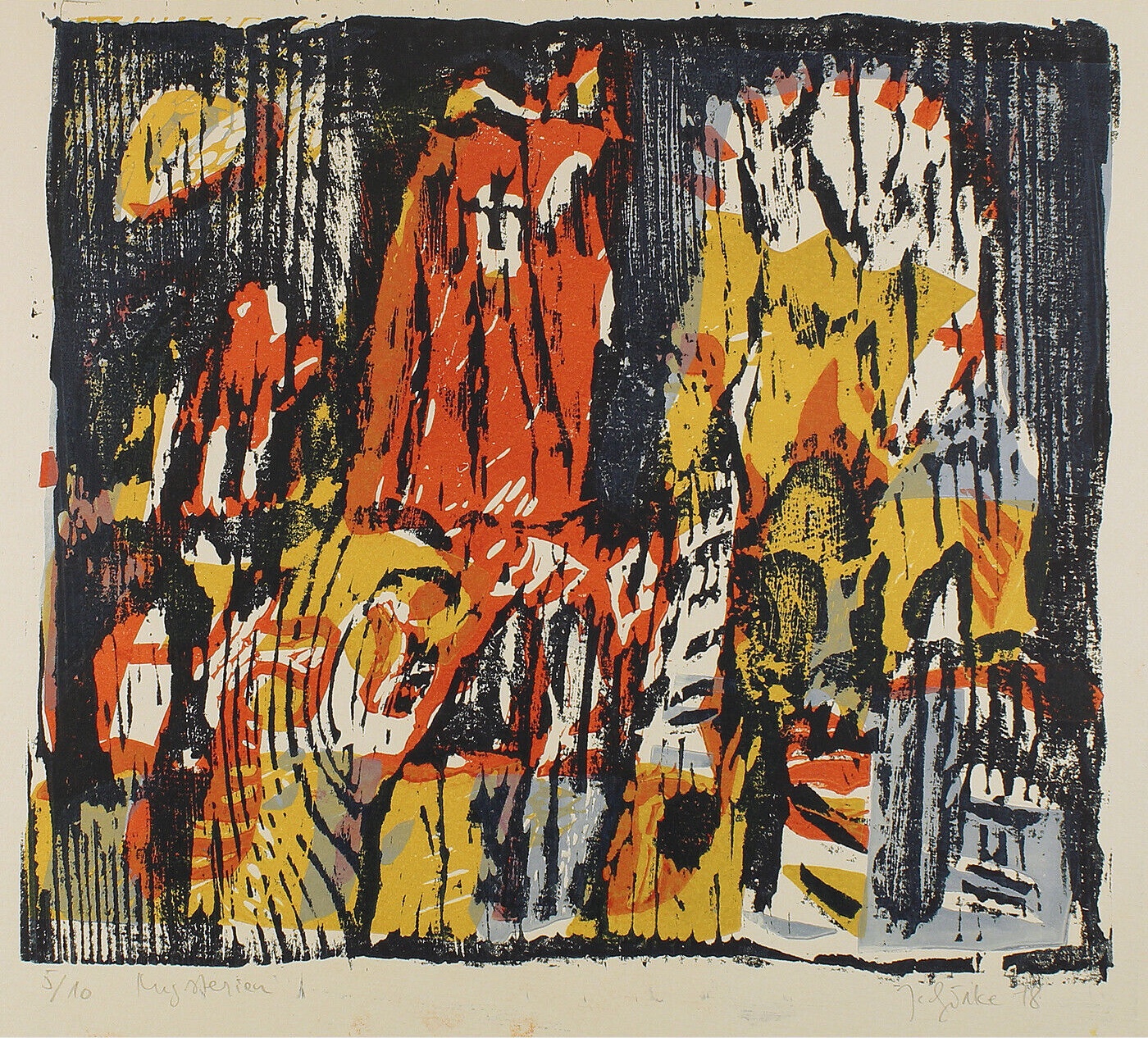
A mystery and mystic print......

Johanna Goerke-Cassirer (b. 1942) 

Contemporary Berlin painter and graphic artist 

It took me also some time to "see the image" of the jazz players in Kandinsky's abstract woodblock print. And I am convinced one day I will see the mystery in this "Misterien" (1978, edition 5/10) print by contemporary Berlin artist Johanna Goerke-Cassirer (b. 1942) (thank you Wolfgang identifying the signature).

I "see" (in a beautiful and very Kandinsky colour combination) a robed King, Maria and her cousin Elisabet and a crowd in an "Old Master" painting setting. Having acquired it I dropped the artist a letter (email to her website). To let her know the travels of her work, my happiness, admiration and content and of course also to inquire what has her inspiration creating her "Misterien".....  almost half a century ago. 


Speaking of Kandinsky: Gabrielle Münter did his portrait in a woodblock print in1906. It was re-issued by a German happy smokers club (Radford's) in 2001 in a limited to members edition appearing in eBay occasionally. Since the real thing is not meant for (us) mortal print collectors .......... I think I saw a copy washing up recently.  

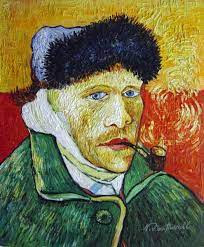
Vincent, in his self-portrait as an unhappy pipe smoker, used the same yellow and red combination. 
 

Although there are more Jewish Cassiser families, the artist's maiden name, Cassirer, to me as an amateur biographer makes curious. Is there a connection to Paul and his cousin Bruno: Berlins (and Germany's) most influential art dealers, gallerists and publicists 1900-1930, a century ago ?  

Paul Cassirer exhibited van Gogh's work in Berlin and owned some 55 works by Van Gogh. Both men ended their own life with a bullet. All things are connected .... creating a new circle of historic events connected to today and my new print. 
------------


Friday, 12 January 2024

Artificial Intelligence and the fishing woman

Jacques (Karel Maximilian Jacob) Comte de Lalaing

(London 4/14-11-1858 - 10-10-1917 Brussels)


was a Belgian sculptor and aristocrate mainly known for his many (animal) sculptures in the public space of Belgium.


Lalaing's classic marble statue of a crouching young women ("Femme penchant", after the old-fashioned  French meaning of "heeling over") is kept in Doornik (Tournay) Musée des Beaux Arts. Its title was also found erroneously as "Fishing Women", obviously a clumsy and somewhat hilarious (not so AI)  translation of the French "Femme pêchant". Probably also induced because the artists depicted a fish at her feet. But that was done, I suggest, to emphasise she was kneeling at a stream and not idling in the lawn. 

Although women today play a pretty decent football match: to my knowledge there aren't many nude women involved in the fishing game........... But However: ......as `always:" I may be mistaken.

Anyway: inquisitive by nature, a book was discovered containing 108 early original anatomical photographical studies, created by Lalaing himself and once belonging to his estate. It is since 2014 kept in the collections of the Amsterdam Rijksmuseum and: its contents been made digitally available. To my surprise I found these pictures, obviously his own studies for the crouching nymph. 


I think the connection between the actual work Doornik (Tournay) and the pictures in Amsterdam has not been made before.  

For the inquisitive mind the next and 1000$ question would be: 
Who was the young women modelling for the artist?

---------------------------
(All pictures borrowed freely from the Internet for friendly, academical and non commercial use only).


Mystery dragon print


Are you curious who created this unique 1928 print and what it represents ?

Visit:

 Das Haus der Frau 


The home of Germany's first generation of women artists pioneering with woodblock printmaking.

(And much, much more)