Showing posts with label German printmakers. Show all posts

Tuesday, 29 September 2020

Hildegard Schwartz : Lübeck and the Mondschein sonata

 Hildegard Schwartz

(born 1890/91 - 1960 Niendorf) 

Forgotten Schleswig printmaker and illustrator

Finding a new, not mentioned before, forgotten printmaker with a nice find (print) after so many years of researching women German printmakers, is not an every day event. It happens sometimes with the help of friendly readers, fellow collectors with a heart for history and combing the beaches and shores of auctions and washed-up and discarded art: Ebay.


As a printmaker Hildegard Schwartz obviously is not acting in the same league as f.e. Helene Mass or Helene Tüpke-Grande. Besides: the  print is hand coloured (by her ?) which is not exactly every prints collector's cup of tea..... But charming it is 

Some investigation learned Hildegard happened to be a typical local artist, illustrating local publications on local history. The half a dozen prints I was able to find show local landmarks, the surrounding villages and landscapes. She was however pretty accurate in her designs. 


About het life (where was she born ?, who were her parents and her family ?, typical starting questions for the biographer) almost nothing is known. I have a hunch she was of local, possibly Lübeck descent: she studied locally. Hopefully an interested person "on the spot", interested  in local history joins in ....  

She studied in Lübeck, acted in the Gothsmund artist colony and lived in Niendorf (not far away village on the coast (where "her family had a summer house"...........) and where she also is buried.  


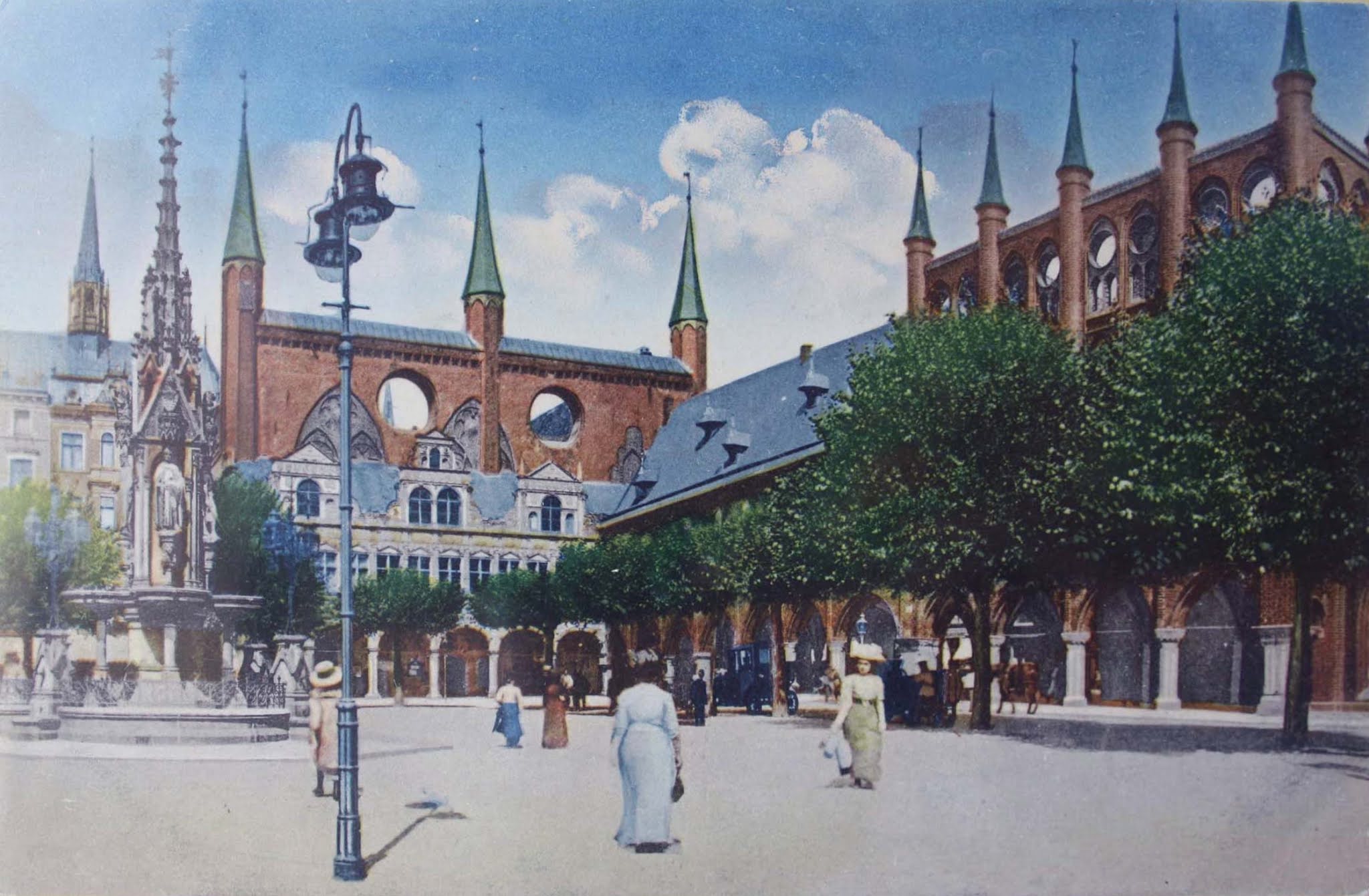
Lübeck: "Marienkirche, Markt" and "Rathaus" 


Lübeck before March 29th 1942 was one of the most beautiful well preserved medieval Hanseatic trading cities with a rich history and a wealth of historical buildings situated on the Trave river and estuary. It had Germany's most beautiful  and preserved "Rathaus" or city hall dating back to the 11th and 12th century. It lies east of Hamburg, and south of Kopenhagen. It was for centuries the gateway to the Baltic: to Stockholm, to Danzig and Saint Petersburg. 

400 tonnes of bombes dropped by RAF Bomber Command in a perfect frosty moonlit night turned it into rubble. 


A first (!) retaliation for the destructing of Coventry (and the Baedecker raids) two years earlier in what the Nazis named "Operation Mondschein Sonate"......(they had a euphemistic name for all their atrocities). An eye for an eye....    Historic Hamburg, Dresden, Berlin and dozens of other German cities were to follow, Lübeck was just target practising.....  Tooth for tooth...... Hammurabi's Law.  4000 years of civilisation, or was it marking the end of it ? Had there been another, a civilised way ?


Hildegard saw the still peaceful market presumably around 1930. She lived nearby and possibly was born here. People dressed in winter cloth but the one tree (in the centre) still in leaves: october, november ? Children looking eagerly to the balloons: no cell phones yet. 


Lübeck was rebuild, where and if possible, to its former glory, like Coventry, Berlin, Hamburg and Dresden were eventually rebuild. Mankind is great in repairing and rebuilding. We are the absolute champions in repairing and rebuilding. We have to be. The weakness and eventually "Untergang" of our destructive species is our greed and disability to prevent destruction. To prevent destruction while playing the Mondschein Sonata. All other species on the planet seem to have a build-in warning and survival strategy: not to completely destroy the environment from which it evolved and in which it lives, not destroying the environment of its neighbours. There seems to be something fatally, Pathetically wrong in our design.  


   Detail of "Das Lübeck Spiel", illustration by Hildegard Schwartz

All fresh information on Hildegard Schwartz is very much welcomed: gerbrandcaspers@icloud.com

-----------------

Hildegards short biography will be part of the upcoming (this winter) publication:

Das Haus de Frau (Vol. III)*

1914-1939: BUGRA Leipzig revisited 

An ABC, a Lexicon, a Who is Who containing 400 pages of short biographies of hundreds of German women printmakers born 1850-1900 pioneering and active with woodblock printmaking 1900-1935. Their Dutch, Scandinavian and Baltic sisters, the art galleries, academies, artist associations, many of their male colleagues, the roots to the Paris printmakers, their schools (not being allowed to study in the Academies), their teachers and inspiration etc....  

    * This volume accompanying my collection of prints presented in Volume I and II.

Many (most) of the best loved artists-printmakers of pur times before were still never properly researched. They are collected by their name and fame and at best dates of birth and death. 

"Collecting art without knowing about the artist is like collecting stamps without a catalogue"............

The identities, lives and careers of hundreds of forgotten artists revealed; disappeared and murdered Jewish artists retrieved, links to addresses, schools and colleges, exhibition and gallery records and work inventories etc...   

Sharing my archive of 20 years collecting biographic notes and the result of many years of research.   

The publication date will be announced in this Blog. 

The first edition will be available and printed by subscription only 

(Please wait:  no reservations before). 

------------------------

All pictures for this Blog article borrowed freely from the Internet for friendly, educational and non commercial use only. 

Friday, 14 September 2018

Helene Ady: big cats in Berlin

Helene Ady
(born 1875-1880 - died after 1930 probably in Berlin)
Graphic artist, arts & crafts artist, goldsmith and painter  

As this blog is composed following my stream of consciousness the cats in before posting brought me to this very obscured and hardly known Berlin artist. She is only known (to me) by these two wonderful (1913) hand pulled lithographic prints of tigers and leopards. She may have seen them in nearby Berlin  Zoo (Tiergarten). These prints managed to remain united for over a century.   


Very little is known about Helene Ady. My research into her biography learned she lived at various addresses (1900-1930) in Berlin-Schöneberg, stayed unmarried and was known as "Zeichnerin" and "Malerin" (drawer and painter) and was mentioned in the correspondence of Ludwig Detmann.  Detmann participated in the Berlin Secession and acted as teacher at the VdBK's drawing school teaching also Helene Mass, Margarethe Hoenerbach, Emmy Meyer and Martha Unverhau. Unless there existed 2 Helene Ady's, at the same time, she is also mentioned working as a goldsmith and arts & crafts artist.


Looking at the Ludwig Jungnickels 1905 tigers print I think Helene may have been inspired by him: is it the same pair of tigers ?   


Any help finding more facts about her life and family history and knowledge about other works by Helene Ady are very welcomed..... (as are any offers of her work) ......

PS: As there were very few Ady family members found in the old Berlin address books and Ady is a much more common family name in Hungary, Helene Ady might be (distantly) related to Hungary's most important 19th century poet Endre Ady (1877-1919). 

Saturday, 25 August 2018

Helene Isenbart:: Dantzig Oliwa Cathedral

Annex collecting "Holzschnitte" and continuously researching the biographies of German women printmakers born in the 19th century, on rare occasions opportunity knocks: finding and actually being able to acquire something special: an etching, lithographic drawing or a painting. Knowing my special feelings for this particular Berlin printmaker it was made personally known and shown to me by friendly Berlin gallerist and printdealer Thomas in Berlin recently.


This oil painting of an unknown church interior was painted by Berlin printmaker Helene Isenbart (b. 1864- d. in or after 1927). Almost without exception "our " women printmakers happened to be wel trained and accomplished painters)
Thanks to a very friendly and helpful reader of this Blog, who prefers to stay anonymous, we now do know the location. 


Helene Isenbart choose Danztig (then capital of West-Prussia, now Gdansk in Poland) Oliwa Cathedral for her interior. It is most famous for its splendid organ. 


Thanks to this very attentive and friendly and also Berlin helper we can stand where the artist draw and sketched her view. Knowing the title or location of a work of art adds greatly to its historic and artistic importance and "value" (not meaning money wise). 


It looks like the church has seen some restoration, on the pillars, and the rames of biblical paintings (stations) seem be renewed. But most of it, the floor tiles and church benches are still as they were 100 years ago when Helene Isenbart visited.

   ---------

All pictures borrowed freely from the Internet for friendly, educational and non commercial use only. 

Friday, 25 May 2018

Deja vu: Paris,Pissarro, Boulevard Montparnasse


An artist (I'm confident that with the help of readers we will be able to decipher the signature) travelled to Paris, took a room in Grand Hotel de Russie (photo below,  left) at the corner of Boulevard Montparnasse and Rue Drouot (Carrefour Drouot) and did what Camille Pissarro did 25-30 years before: enjoy the view from his balcony and make an image. 


Pissarro did not one but of some 15 of them, in 1897 when he was towards 70, acknowledging his mastership as "Father of Impressionism". They hang all over the world in treasured Impressionist collections. 


Although I think Pissarro obviously did enjoy the view and absorb the life and romance of this wonderful place, where 3 major Boulevards merge at Carrefour Drouot: Bd. Montparnasse, Bd. Italian and Bd. Hausmann. I also believe Pissaro "fiddled" with the point of vantage, recreating the perspective, in his paintings. He suggests to be positioned more or less in the centre of the road allowing him to see along the left row of trees. Something that would have been impossible from his balcony. 

Astonishingly: his has the same perspective as most of the postcard views. I could find no clues or discussions about this phenomenon in the public domain but I suppose these paintings will be analysed by the experts extensively.  Pissarro also exaggerated the width of the Boulevard considerably to emphasise its "grandeur" dramatising the importance of Paris' Grand Boulevards.


Speaking of postcards and photographs. Across the Hôtel de Russie is a large building with the name Reutlinger on it. Leopold Reutlinger continued the business his father had taken over from his brother Charles who started it in 1850. Their studios were located in this building. This classic (academic) nude  practising to be a Greek Godess or Maillol statue was taken (and composed)  by Leopold.    


The reversed letters upper right read Cadum ..von. They are no doubt from a soap advertisement that is known to be (and has been for a century) there although it should read Savon Cadum and not Cadum Savon. 


Reader Tom suggested the  etching artist saw a Neon light (iconic of Paris and in use since the end of WW-I) on the roofs opposite. Or the artist made a tiny mistake.   


About Grand Hotel de Russie in Paris (Rue Drouot 1) not much is to be found. In later photographs it also named Hotel de Brésil and by the time our artist checked in: La Maison du Cafe, which was also the name of a coffee brand.


At least until 1909 it was known as Grand Hôtel de Russie and was owned by Alfred Riguelle, the severe looking chairman of the French Cyclist Union.


See name of the Hotel upper right. 

All pictures embiggen by mouse click


   All help and suggestions on the etchers identity are welcomed !

(artist identity solved: august 10th 2018)
follow the label 

-------------

All pictures borrowed freely from the Internet for friendly, educational and non commercial use only.   

Monday, 19 February 2018

Anna Bähker, printmaker in "das Altes Land".


Anna Bähker 

Still unidentified etcher and printmaker.
 Living in Berlin 1921-30, member of the VdBK.
 Probably living for some time in the artist colony of Nidden.  


Anna Bähker is one of the artists who, in spite of all my efforts remains to this day a very unknown artist: I still have no idea who she actually was. Although I discovered the identity of so many obscured artists over the past years (all revealed in the book) Anna Bähker is still an enigma although her prints regularly show up in Ebay and other auctions. But gathering all small pieces one day will be successful and helpful in clearing her from obscurity. 


She is best known for the half a dozen prints showing (Baltic) fishing boats (more about these prints and their location in a later posting). She has been obviously working and/or staying in Nidden where printmaker Daniel Staschus and his wife lived. It is situated on the Curonian-Spit an ice age remnant, a long sandy stretch of dunes situated in Prussia's Baltic sea, now Kaliningrad/Königsberg-Lithuania)  


Recently and shortly after each other I found these two etchings (German :"Radierung") they are the first examples I ever saw other then her woodblock prints. Unlike many other printmakers I've never seen an oil painting by her. 


The first is said to be (possibly) showing "Worpswede" which is a picturesque village and artist "colony" near Bremen. The title is "Am Kanal" (at the canal). She possibly visited Worpswede artist colony because it is not far from her woodblock print titled "Altenländer Fleet" (canal Altes Land) 


"Das Altes Land" is however the region situated on the west bank of river Elbe, north-west of Hamburg. The old country, "laid dry" centuries before (since 12th century) by Dutch settlers and today Germanys fruits and vegetables garden.  


The other one (very small only 6 x 8 cm) is highly interesting because it is a mirrored version of her best known woodblock print "Stadttor" (town gate) which I would very much like to find and have one day. And of course finding out where this gate is located would be even better.


I can offer many fine works (in every international discipline) for swapping or trade if you happen to have or know a decent copy of this print that is on my wishlist for my collection of German Women Printmakers. 

--------------

All pictures borrowed freely from the Internet for friendly, educational and non commercial use only.  


Tuesday, 26 September 2017

Kornelie Gerland ?

Kornelie Gerland 
(b. probably Strassburg 1865) 
Painter in Dresden.
(Possible printmaker).  

My brilliant special Austrian correspondent ("korrespondierendes Mitglied") Hannelore, who to my great pleasure recently accepted this splendid and important position, did it again. But first she corrects me on using the right terminology: Kurrent is the proper name for old German script not Sütterlin. It developed and evolved from 500 years of cursive writing. Sütterlin was a more modern version developed in 1911 based on Kurrent. It was abolished by  the NSDAP in 1941.  


Hannelore found a suitable candidate for the unidentified Gerland/Garland print in before posting. An artist named Kornelie Gerland is not be found in any of the known Artists Lexicons (that I have at my disposal) nor in Dresslers Kunsthandbuch. Which makes Hannelore's research all the more special finding a needle in a haystack.    

  
Kornelie Gerland (said to be a painter in Dresden in just one to be trusted biographical mentioning /occasion) was the eldest daughter of Strassburg geology and physics professor, composer, language and ethnic researcher, author and pioneering earthquake expert Georg Gerland


This extraordinary man and his more than interesting career and his families biography will be part of my upcoming publication. I can reveal here Kornelie's younger, and only brother Heinrich Gerland (also a professor) was married to Eva Schott, eldest daughter of Jena glass expert, inventor and entrepreneur Otto Schott. 


Otto Schott was a successful and according to his recently restored Jena villa a  prosperous glass-industrialist fabricating special optical and astronomical products (lenses) which resulted in a spectacular increase in quality of microscopic and astronomical imaging. Today it is a multi billion dollar international company. He closely worked together with Carl Zeiss.   


Otto Schott acted as patron to London based and exiled from Britain beginning of WW-1 German painter-lithographer Georg Sauter (1866-1937). Schotts eldest daughter Eva and her husband had met Sauter visiting London becoming friends. Schotts portrait was made by his protegé Georg Sauter (l.) and by the great  Max Liebermann himself (r.).  


Georg Sauter had married British Lillian, sister of John, Galsworthy (above by Sauter) after meeting her in London National Gallery. George's  brother in law was the author of the famous "Forsyte Saga" and awarded the Nobel prize for literature in 1932. The book was made into one of the first European TV series and extremely popular in the late 1960's.


Sauter was a successful painter heavily influenced by James Abbot McNeill-Whistler (1834-1903), but also creating a scandal winning a second prize in  the prestigious 1909 Carnegie exhibition (read here) with this declared "erotic" painting ("the Bridal Morn" below) of a young women getting dressed by her mother and sister for her wedding day. Hard to understand what the fuzz was actually about a century later. The evolution of the human brain at full......     
  

Coincidence or clue ?
Eva Gerland-Schott died 1976 aged 89 in Hamburg-Wedel while I found the Strassburg Cathedral print, created most probably by her sister-in-law Kornelie Gerland, just 10 km. away in a Hamburg antiquarian shop last weekend. 


Thank you Hannelore. All information and suggestions welcomed


All pictures borrowed freely from the Internet for friendly, educational and non commercial use only.