Monday, 16 July 2012

I love Paris: 1950

Jan den Hengst
(1904-1983)
Jan Korthals
(1916-1972
Jan Rijlaarsdam
(1911-2008)

3 Dutch painters in Paris in the 1950's 


3 x Jan den Hengst, Montmartre, Paris
Three men, three painters, sharing their first name and who knew each other well, were friends even. They painted in Amsterdam. The canals, boats, bridges and busy street and city life. And all three went to Paris. They were great water color painters and great illustrators. Obscured and mostly forgotten now. Post impressionist painters would apply and fit on all three. 


4 x Jan Korthals, Paris 
Looking closely these men must have learned from each other. Stimulating, the  one professionally trained and the other self-taught like Jan den Hengst who ran a flower stall in his native Delft. They shared, choose and sat at the same pictoresque and famous spots in Montmartre under Sacre Coeur and along the river Seine. 
Vincent van Gogh,  view over Paris  from his room at Rue Lepic.
Were Vincent van Gogh had a boarding room in Rue Lepic (above and first picture). Most famous impressionist painters started their fame living in and painting Montmartre . 

3 x Jan Rijlaarsdam
I've just stumbled over some old water color (calender) reproductions and  discovered this wonderful bright, colorful and happy style shared by these three men. Very much the bright pictures and illustrations of my youth.
These men, friends, didn't meet one of my favorite painters and also addicted to Paris artist, but stood in the foot steps of American Impressionist, Frank Meyer Boggs (1855-1926) who decided  not  to leave France and Paris after studying with Jean Leon Gérome (1824-1905). He painted Montmartre and every quay along River Seine in the most Impressionistic way.


Frank Meyers Boggs and his son Frank Will (Boggs) (1900-1950), who like his father painted the Moulin Rouge (above) and their Paris Views will be continued in a future posting in the Linosaurus.
Jean Louis Gérome who initially opposed Impressionism, and needless to say lost, to me is best loved for his Roman Slave Market paintings and this great Pygmaleon and Galathea. And of course no less for the stunningly beautiful model embodying three thousand years of female aesthetics. Just Google: Gerome + Batsheba and you'll have a peek along with King David at his wife taking a bath. I can understand J.L. Gérome didn't need impressionism to say what he had to say.

Thursday, 12 July 2012

NOID Goldberg, Gastberg

?? Goldberg, Gastburg, Garburg ??


Again I ask readers helping with identifying an unknown German printmaker by his prints and by his signature. Very recently I was asked if I knew who could have done this Tigers etching. I didn't. But knew I'd seen the signature before.


Please send your (any) suggestions or solutions (see the email adress in the contact button)

Tuesday, 10 July 2012

John Hall Thorpe & Adam Bunsch

I JOHN HALL THORPE

Today a quick post on some recent emails by Blogreaders that might be of interest to readers. Fundamentaly I avoid any commercial activities and interests by third parties in the Linosaurus. Today for the first time breaking my house rules in the collecting interest of my readers.


Postings on John Hall Thorpe's flower prints* are by far the most and frequently visited in the Linosaurus. For those interested in finding and buying a JHT print: here's an adress that came to me today in the comments section of the original posting: http://www.barhammoneyfineart.co.uk/ 
There are this (above) rare "Fruits and Flowers" and 2 other JHT flower prints (search by artist) for sale, and the pricing ? Just see, consider and decide for your self.


II ADAM BUNSCH (link) 


Adam Bunsch, grandson of polish artist and printmaker Adam Bunsch (1896-1969) I revealed to you earlier, has informed me of his Website (under developpement and construction) on his grandfathers artistic legacy. Here's a great new print by Adam Bunsch borrowed from the site. It would be interesting to compare and analyze it with other prints by the various artists who dared at creating peacock prints and the Link to Adam Jr.'s website": www.adambunsch.pl 

Wednesday, 4 July 2012

Jan Visser and Fok Spies

Two days ago Folkert Matthijs (Fok) Spies passed away. This small posting in memory to his well spend life on earth.

A few weeks ago I discovered this 1916 woodblock by not very known Dutch artist and mainly remembered as a painter Jan Visser (Groningen, 1856-1936) It's numbered: No.3. I don't know if he created more woodblock prints. I certainly have never come across any but I've found some examples of other work that I will show you in due time. Any way, I like this print very much and I think it is, considering it is 1916 and Dutch, pretty unique and very original. I have been to the sea in a rumbling cart, my granddad and my parents have, my sons have and my grand daughters.  
Funny how things seem to happen simultaniously, going through old family photo's just today, writing an obituary. Or is it serendipity?

Fok Spies reached the blessed age of 85, of which forty as my father-in-law. Besides he was truly a friend. He lived life according to his motto: Live your life in soberness but let it be rich in feasts, celebrating each and every day and each and every opportunity. 
Here are his first (in the rumbling cart) and his last portrait. Amazing to see how the old man is already visible in the child. And how the child, after a life time, is still visible in the old man. In between these pictures he was a toddler, a schoolboy, a student, a husband, a schoolteacher, father of five, grandfather of ten and great grandfather of 6. He visited most of Europe's countries from the North Cape to Izmir, from Leningrad to Barcelona. In a tent and later in his old and battered campervan. A true roll model to the Art of Living. 
Shortly before he died he left me these two pencil drawings by an artist who was an amateur. S. Kraay is he all knew and it is all I know. The artist a friend and colleague of his elder brother who died before him. 

It is showing the old Church in the village of Soest. Along: the old Church road (Kerkepad), where just a few hunderd meters from the church he and his brother were born in the 1920's as the sons of the local police constable. Where as children they played. Where he will have walked every day of his childhood to school. Where he will be burried in the family grave. Beginning and ending. I found an older painting of the same spot, probably of the same  renovated and repaired over the years dwellings that have long since disappeared. 
The wind mill, I don't know, but I quess it's Soest or somewhere nearby too, although I couldn't match it with existing 2 wind mills in the village. Maybe a Dutch reader one day will recognize the artist S. Kraay and the location. I like them very much. To this day my thoroughly analog father-in- law had left no footprints in the Internet. Today I left these. 
-----------------------------------------------
Added information july 6th and proof of the tremendous powers of the Internet: Artist S. Kraaij was identified by an observing reader as Stephanus Kraaij born 1904 in Echteld. He was a trained artist who was living 1940-1950 in Soest. Echteld (only 35 km away) is also the genealogical homestead of the Spies family since 1650 when an immigrant from the Pfalz (a German province) was first recorded in the village.

Wednesday, 27 June 2012

Else Zinkeisen, II continued.


Else Zinkeisen
(Born 1871 Hamburg)
II
continued

As promised and completing here’s the rest of Else Zinkeisen's woodblock prints. In her native Hamburg she choose the old Hammer Kirche. Originally build in 1692 and distroyed in the bombing and firestorms raging over the city in 1943.

And the places she probably visited during holidays. They are picturesque and historic places like "Werratalblick", View on Werra vale , probaly seen from the same panoramic photografic point called Krayenberg.  
  
"Burg Hanstein" (Hanstein Castle)


"Burg Fürstenstein" (Fürstenstein castle) 

The caracteristic twin towers of the 15th century Frauenkirche Cathedral is visible dominating over “der Englischer Garten” in Munich. Creation of  the 1000 acre garden (larger then Central Park) started in 1789 by Sir Benjamin Thomson and has an interesting history you can read here* 

Monday, 25 June 2012

Else Zinkeisen (I) River Elbe


Else Zinkeisen
(born 1871 Hamburg)
German woodblock printmaker. 

(I): River Elbe 


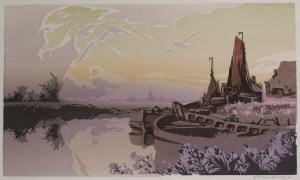
Today, again, an Ebay induced posting on a printmaker I’d never heard of before leading to some great discoveries and other fine artists. This above “Boote bei Sonnenuntergang” (Boats at sunset) undoubtedly are sailing in the Elbe estuary and came up for auction recently. 
"Fischer Boote auf der Elbe" and "Wolken über der Elbe". 

Other than the fact Else Zinkeisen was taught privately until 1899 and that she has been a member of the “Heikendorfer Künstlerkolonie” my research  turned   up absolutely nothing. But luckily a small but fine collection of her prints is kept in the “Künstlermuseum Heikendorf" at the Kieler Förde.  
Left: Else Zinkeisen, Right: Oscar Droege, (same?) dwellings along river Elbe.

The Kieler Förde, an inlet of the Baltic sea, North West of Hamburg in Germany's most Northern and beautiful province of Schleswick-Holstein. Sheltered and strategically situated along the busy trade route between North-Western Europe, Scandinavia, Denmark and the Baltic States. Not one of these prints I could locate outside this Museum: a well hidden treasure of prints of what has to be one of the earliest German Modern Printmakers.
 The Elbe River downstream North of Hamburg seen from the Ice-age,
glacier formed East bank ridge by Friedrich Kallmorgen (1856-1924)
Man made Elbe dikes by painter Friedrich Wilhelm Schwinge (1852-1913)

The artist colony sprang up in the 1920's around the house and studio of painter Heinrich Blunk (1891-1963) and it is one of the very few buildings remaining after WWII devastations. Kiel and its surroundings, like Hamburg in 1943, was almost completely destroyed by allied bombs because of its marine and submarine bases. The artists’ studios are gone but the House and Gardens survived, now housing the Museum.
Where we meet another great member of the colony: Oscar Droege (1898-1983) also born in Hamburg (but 25 years after Else Zinkeisen) and perhaps Germany’s most famous and certainly most prolific printmaker. Many of his (I count over a 100) prints featuring Hamburg and the river Elbe.

Painter Georg Burmester (1864-1936) was among them, very much influenced by Vincent van Gogh and  later to become a professor in Kassel art academie. He painted the surrounding  Schleswick land- and seascapes 


Along the North German coast, to the East the sister  "Niddener Künstkolonie" thrived. You can find similar prints of typical Baltic fishing and trading boats  by members Margarethe (L.E.M.) Gerhardt (1873-) and Daniel Stachsus (1872-1953). Max Pechstein and Lovis Corinth lived there.


This print by Else Zinkeisen is showing river fishing boats in the small tranquil  village and fishing  port of Altweder. Just opposite, on the other (West) side of river Elbe, of the mighty city of Hamburg. And situated in a wonderful ancient  and rural landscape. Below a photograph from about the time Else was there. 

A situation painted (below) by Friedrich Wilhelm Schwinge (1852-1913), my favorite  painter of the Frisian and Schleswick landscape (see also above).


And as it was recorded in one of the very last moments of it's existence (above) on photo. The fate that struck the village of Altweder has frightful similarities with the Dutch village of Blankenberg (50 years before) I wrote about in my earlier posting:  Blankenburg (link). It's the inevitabillity of progress: it can’t be stopped. It's all gone. Forever.

The Scottish sisters and artists Anna and Doris Zinkeisen are not (directly) related to Else. Anna Zinkeisen who designed several London Underground posters in the 1920-30’s and her Scottish family of timber traders have a 200 year Scottish history leading back to Silesian ancestry.

Next: some more prints and history by Else Zinkeisen.