Wednesday, 27 June 2018

Marie Wipperrmann in Paris II: A year later and first results !

Through this Blog I recently came in touch with Marie Wippermann relatives resulting in a very friendly correspondence, additional biography, family photographs and: two more woodblock prints by her created in Paris 1907-08. 

Marie Wippermann 
forgotten German painter and printmaker
(1877-1955)


The Karl Wippermann family.
As a daughter of prosperous Lüdenscheid distiller Karl August Wippermann she was allowed to study in Paris and according to family history also under Lovis Corinth in Berlin. Returned to Halver near Lüdenscheid in 1908 she married manufacturer Wilhelm Linden who died in 1922 after which it was said she never painted again and two of her three sons fell in WW-II in Russia.  
   
MW (right ) with her husband and probable sister 
As we saw at the time Marie was not alone in Paris (see before Wippermann article/posting) probably all attending lessons in the Academy Colarossi. 


I ask the help of readers to try and identify if possible the Paris locations Marie choose and depicted.


The street view (she possibly did it twice, so maybe from her rooms ?) possibly near where she had her quarters in the the Montparnasse district, not far from the Académie Colarossi and near Boulevard de Vaugirard (the "Jardin de Luxembourg" area) where Hamburg born Agnes Salomon lived who we will meet in next and closely related posting. 


A view on Eglise St-Joseph-des-Carmes in Rue (not the Boulevard) de Vaugirard (we think to see a cross on top, not a chimney) is a possible candidate. Seen from higher up the adjacent buildings ? Which happens to be "La Catho" or the Paris Catholic University founded 1875. It is not a 100% fit, possibly wrong, but just for starters. Better suggestions are welcomed.


What I thought to be earlier a "big cloud over Paris" on closer inspection and analysis is thick smoke from a chimney curling downwards into the street. Streetviews, winter and smoke were also topics used by Paris painter Albert Marquet, fauvist and close friend of Henri Matisse and in those years exhibiting with great success his Paris street views in Paris.

Albert Marquet 

Albert Marquet 
---

Seine river and quai with huge


Billboard - mural, Quai along River Seine with a barge (?)
  
This advertisement (obviously a huge mural) of "Le Petit Journal" a popular newspaper on a Paris wall somewhere along river Seine + remnants of other (red) advertisements + the silhouettes of the buildings I hope will be enough to eventually disclose the exact location of this Seine-quai print by Marie Wippermann.  

      
Marie Wippermann 

Albert Marquet 


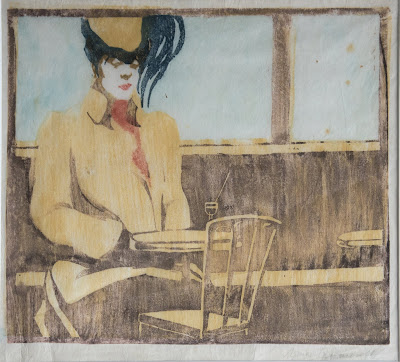
And then, in the end, creating a bridge to next posting, there was this surprising woodblock portrait, "Women in Café with coat and feathered hat", that once belonged in the private possession of Marie Wippermann that will be discussed in next posting. It will lead us possibly and unexpectedly to the birth of German Modern woodblock printmaking. In Paris ! This print was probably mentioned in a 1904 (!) graphics catalogue. 


More revelations & surprises in next posting.

All help and suggestions welcomed.

------------

All pictures borrowed freely from the Internet for friendly, educational and non commercial use only. And with courtesy of the Linden-Wippermann family.
     

Tuesday, 19 June 2018

Finding Helene Pferdmenges (news)

After posting and sending several emails to Pferdmenges family members with accessible email addresses I received notice of attention by a friendly family member who will look into this puzzle and forward my interest. 

And as many times before I received an addition, a piece of the puzzle, that I've obviously overlooked, by faithful reader Hannelore from Austria. Not identical but possibly related ?


Hilde Prelle-Pferdmenges 
(26-06-1907 – 1981 Hamburg)

Painter, graphic artist and sculptor. Studied painting “Wintersemester" 1928/29 at  Munich “Akademie der Bildenden Künste”. Married “Studienrat” (high school teacher) Walter Prelle(1906 - 1978). Since 1953 member HKüS and “Hamburger Berufsverbandes Bildender Künstler” and living and working in a nice villa in Hamburg Farmsen, Farmsener Höhe 17. Taught artist Anke Landenberger (b. 1948). The couple is buried at “Friedhof Hamburg –Tonndorf”. 

Hilde is mentioned in: "Der neue Rump, Lexicon der bildenden Künstler Hamburgs".


This is the only example I was able to find and I doubt the auction catalogue title: "Maxe Kirschberg". It is obviously a Jewish older man and dated 1940.


As always: all information welcomed !

Pictures borrowed freely from the Internet for friendly, educational and non commercial use only. 
  

Friday, 15 June 2018

Finding Helene Pferdmenges

Helene Pferdmenges

"Kleinbahn"  

Unknown and unidentified printmaker. 


In my ongoing research into the life's of forgotten German women printmakers it is not often that I encounter a completely new (to me) "girl on the block". This small and monochrome, titled "Kleinbahn" print surfacing recently in German Ebay was a surprise. Although investing many hours since (auto-diagnosed as a mild  disorder in the autistic spectrum) in trying to establish the identity of the maker Helene Pferdmenges it was without success so far. She is not to be found in any of the Artists Lexicions or Artist Address books, nor did I succeed in identifying an artist by this name after thorough Internet research. An artist by this name is nowhere mentioned.  


A "Kleinbahn" was a tertiary railway track or system, not a main or secondary line. Under less strict rules, laws and regulations they were constructed in the later part of the 19th century often using existing roads connecting rural areas or industrial sites (mines and factories). Most of them were soon to be closed at the beginning of the age of the automobile.   


Four of her prints are preserved in the Art Institute Chicago (Lois H. Culver Fund ?) in America, probably a bequest by a faithful visitor or supporter. I'm very curious to the American link of the donator with the Pferdmenges family. Maybe this would shed some light: a direct or indirect relative immigrating and in the possesion of these prints (?). One of them shows a street in Osterode in the Harz region (below left), the other ones could be also from here (Quedlinburg ?)     


---------------

This (auctioned) 1934 portrait of "Helene Hertmanni, geb. Pferdmenges"  by well known painter Adolf Münzer (1870-1952) who was also a professor in Düsseldorf Academy and an illustrator ("Jugend" magazine) shows a woman that cannot (I could not) be identified within the Internet free accessible genealogical sites. Her given dates are: born 1893- died 1962 (possibly taken from the frame?). I have not been able to find a Hertmanni-Pferdmenges partner by marriage (how many can there be with this combination ?) or a Helene Pferdmenges (1893-1962) other then:

Richard Hertmanni (1854-1948), merchant, married to Wilhelmina Emilia (Emilie) Pferdmenges (1856- 1939). She was the daughter of Johann Heinrich Pferdmenges (1836-1900) and Charlotte Wilhelmina (Minna) von der Heydt (1839-1870). Could the sitter (in her 30-40's ?)  possibly have been their daughter and a mistake introduced by the auction catalogue text ?


The Pferdmenges family originates from centuries past from the Mönchengladbach (Reydt) region and several prosperous members were in the 19th century wool, cotton and textile industrials. Large families with many children and as was the custom often intermarried over the centuries with other regional industrial families, loom- and mill owners, weavers etc....


Robert Pferdmenges and Konrad Adenauer 

Possibly the most known member was banker and member of parliament  (Bundestag) Robert Pferdmenges (1880-1962), a personal friend of Konrad Adenauer, first Chancelor of the Federal Republic of Germany (West Germany).  Robert Pferdmenges is considered to have personally saved the jewish Sal. Oppenheim Bank during the Nazi regime. (He was a son of Wilhelm Albert Pferdmenges (b. 1844) and Helene Croon (1851-1930) (see below)   


Thus my initial research ended up with several (too many !) persons with the name Helene Pferdmenges, either by birth or by marriage. Here is the result,  an ultimate attempt to identify one of the candidates as the artist by name and period: roughly born between 1850-1900 and living into or after the 1930's. And I think I possibly may have overlooked one or two. 


Finding Helene with the help of readers would be wonderful.   


Candidate artists named Helene Pferdmenges:

By marriage:

Helene Clara Wilhelmine Engels (1860-1956) married Friedrich Wilhelm Pferdmenges (1851-1930). She was a daughter of Hermann Engels (1822) x Emma Clara Pferdmenges-Croon (b. 1834)

Helene Clara Wilhelmina Croon (1851-1930) daughter  of Johann Theodor Croon (1793) textile baron married to Wilhelm Albert Pferdmenges (Mönchengladbach 1844) Kaufmann, textile baron. Mother of Robert Pferdmenges (above)

Helene Quack (1861-1936) married Johann Wilhelm Pferdmenges (Reydt 1853) a teacher. Their daughter Helene Pferdmenges (1891-1972)

By birth:

Helene Klara Auguste Pferdmenges (1875-1925)  daughter of Julius Pferdmenges (Viersen 1844) and Maria Elisabeth Panzer.

Helene Pferdmenges (1891-1972) daughter of Johann Wilhelm Pferdmenges (Reydt 1853), a teacher, and Helene Quack (1861-1936)

Helene Pferdmenges (1885-1909), daughter of Johann Heinrich Pferdmenges (Reydt 1847) x Eva Heymanns (Reydt 1854).

Helene Hildegard Pferdmenges (1903-1985), daughter of Johann Wilhelm Pferdmenges (Reydt 1875) x Adele Pott (b.1879)
            
Emma Christina Helene Pferdmenges (Hamburg 1878 – 1962) daughter of Johann Carl Pferdmenges (Viersen 1837-1921) and Christina Emma Elisabeth Dreyer (Bremen 1842-1911)

Helene Hertmanni- Pferdmenges (1893-1962). Unidentified person mentioned with the Adolf Münzer portrait.  
            ------------
            

This posting is a request to all who stumbles over it and who may have information about the printmaking artist Helene Pferdmenges and/or her family to share information. I plan to send an email to every Pferdmenges I can find the @ address of in a Google search. 


All pictures borrowed freely from the Internet for friendly, educational and non commercial use only.


Friday, 25 May 2018

Deja vu: Paris,Pissarro, Boulevard Montparnasse


An artist (I'm confident that with the help of readers we will be able to decipher the signature) travelled to Paris, took a room in Grand Hotel de Russie (photo below,  left) at the corner of Boulevard Montparnasse and Rue Drouot (Carrefour Drouot) and did what Camille Pissarro did 25-30 years before: enjoy the view from his balcony and make an image. 


Pissarro did not one but of some 15 of them, in 1897 when he was towards 70, acknowledging his mastership as "Father of Impressionism". They hang all over the world in treasured Impressionist collections. 


Although I think Pissarro obviously did enjoy the view and absorb the life and romance of this wonderful place, where 3 major Boulevards merge at Carrefour Drouot: Bd. Montparnasse, Bd. Italian and Bd. Hausmann. I also believe Pissaro "fiddled" with the point of vantage, recreating the perspective, in his paintings. He suggests to be positioned more or less in the centre of the road allowing him to see along the left row of trees. Something that would have been impossible from his balcony. 

Astonishingly: his has the same perspective as most of the postcard views. I could find no clues or discussions about this phenomenon in the public domain but I suppose these paintings will be analysed by the experts extensively.  Pissarro also exaggerated the width of the Boulevard considerably to emphasise its "grandeur" dramatising the importance of Paris' Grand Boulevards.


Speaking of postcards and photographs. Across the Hôtel de Russie is a large building with the name Reutlinger on it. Leopold Reutlinger continued the business his father had taken over from his brother Charles who started it in 1850. Their studios were located in this building. This classic (academic) nude  practising to be a Greek Godess or Maillol statue was taken (and composed)  by Leopold.    


The reversed letters upper right read Cadum ..von. They are no doubt from a soap advertisement that is known to be (and has been for a century) there although it should read Savon Cadum and not Cadum Savon. 


Reader Tom suggested the  etching artist saw a Neon light (iconic of Paris and in use since the end of WW-I) on the roofs opposite. Or the artist made a tiny mistake.   


About Grand Hotel de Russie in Paris (Rue Drouot 1) not much is to be found. In later photographs it also named Hotel de Brésil and by the time our artist checked in: La Maison du Cafe, which was also the name of a coffee brand.


At least until 1909 it was known as Grand Hôtel de Russie and was owned by Alfred Riguelle, the severe looking chairman of the French Cyclist Union.


See name of the Hotel upper right. 

All pictures embiggen by mouse click


   All help and suggestions on the etchers identity are welcomed !

(artist identity solved: august 10th 2018)
follow the label 

-------------

All pictures borrowed freely from the Internet for friendly, educational and non commercial use only.   

Thursday, 26 April 2018

Paul Leschorn: Sanguinary Islands (Corse Fr.)


Paul Leschorn (Metz 1876 - 1951 Allensbach), German painter and printmaker is mainly known by (and loved for) his "Alpine" winter landscape prints depicting the Vosges near his native Metz and later homestead Strasburg. They are mostly "Snowy trees" and "Tracks in a snow covered landscape". All very desirable !


In 1907 however Leschorn travelled to Dalmatia and, 1924-1931 several times to the isle of Corse (Corsica). Reader Tom in Boston (USA) would like to know the location of his newest find and acquisition an obviously "Mediterranean" coastal view (opening photo) with characteristic islands. 


Researching a bit I found the place last night: a string of small islands  (archipelago) near Ajaccio (Corse): the "Îles Sanguinaires" or bloody islands named after the many shipwrecks or, as others claim, because of the blood red sunsets.


I found one other example of a similar seascape, probably the same islands/rocks view, by Leschorn: "Rocks near Ajaccio" which seems to show a view to the smaller, most left of these islands.


---------------

All pictures borrowed freely from the Internet for friendly, educational and non commercial use only.