Tuesday, 23 April 2019

Linosaurus extinct

First and most of all I apologise for any inconvenience your visit to this humble Art Blog may recently have caused now it has been degraded by Google Law to the levels of visiting a porn site.


What has happened ?

Obviously some sad and frustrated individual has complained about the contents of this Blog. It happened shortly after showing a picture of an Arts & Crafts woodcarving that has since long been in my possession: mating storks that thanks to Google are now considered "pictures of a certain, inappropriate, objectional and explicit nature".
  

The mating storks symbolise the coming of spring and new life. 

(in many civilised and freed communities, liberated of stupid dogmas and blind puritanism)

In almost 10 years the Blog existed it saw over 900.000 page-views from all parts of the Planet. I was looking forward too greet the one Million'th visitor. Maintaining a blog about art, aesthetics and beauty I've never seen or heard any (not one) complaint. It received thousands of friendly and thankful comments and emails. And not to forget: through Blogging I made some dear and life time friends.   

So please allow me to correct and update the picture that probably was the cause of this situation. I think complaints based on puritan and backward standards like here, are even laughed at in the caliphate. Storks also mate and are welcomed as bringers of spring even deep in Syria and Irak.  


To be honest: I really do not understand Googles "policy": there has never been a complaint, no consultation, no message or notice of any kind. Whatso-ever. Nor does Google offer an opportunity to inquire, of hearing the other side, of explaining or ask for a revision. It simply stigmatizes with the click of  a button.   

Co-incidance ? This morning newspaper cartoon 
After some serious thoughts and considerations I decided the time has come to close the Blog and stop it. How can I be related to the "dirty pictures and obscene websites" Google has now associated me with. For my family, my granddaughters who now must ask permission and consent from their parents to see what "Opa" (granddad) may have shared and written. Besides, thanks to Googles' "Policy and Warning" visitor numbers seem to have almost come to a halt recently. So why bother to continue ? 

Those that count will know how to reach me. The research and the planned publications will continue of course. I plan to remove all (650) postings from the Internet in coming weeks beginning with the oldest. Allowing some time if there's anything you might want to look up or save.      

Thank you for all your support, all send information about forgotten and obscured painters and printmakers and all dear comments left on the postings. It has been a great journey and experience. 


So long, all the best !

Monday, 22 April 2019

Suiseki or the Japanese art of stone appreciation

Suiseki  水石

Sansui Keiseki

The meaning of appreciating a landscape shaped stone.

"It is not a silly thing at all to enjoy a stone in a tray. I see the whole world in a tiny stone. Some objects in this world are huge, and others are small, and they come in all shapes, but they are not that different when you look at their essence" (Hideo Marushima (b. 1934 -).


New Home for a million year old stone.
(with a natural image resembling a pine tree on a hill or mountain)


When I found this mysterious almost 3 Kg. green and orange stone (18 x 15 x 10 cm) with a flat bottom this morning in car boot who would have thought I would that same day be reading and learning about Japanese Empress Suiko who lived and reigned AD. 554-826 who received objects like this as precious gifts from Chinese visiting rulers: naturally formed stones resembling landscapes (or animals). 


And that i would read about Jade, because that is what the stone is made of: nephrite or jadeite: Ca2(Mg,Fe)52 and about Japanese culture and about Zen. The specifique colours and structure of the stone probably make it possible to pin point its origin. It can be seen the stone has been carefully preserved: small natural cracks or veins (impurities ?) have been filled with a perfectly matching orange substance only visible with a magnifying glass.   


Since Empress Suiko's times landscapes stones have been assimilated in Japanese culture: Bonzai stones, philosophers stones. Placed in a bowl of water, or in a pottery bowl filled with sand, or resting in an individually carved wooden "daiza" which is a special and honourable Japanese arts & crafts profession.


It would go too far and beyond the intention of this humble Blog to publish an essay on Suiseki history or on daiza carving. The interested reader or visitor can find all what there is to know in the Internet. All about this mysterious and simple world of

 enjoying what was already there. 


Which is of of course: the perfect synonym for:
Happines. 


How did this ancient stone travel from Japan (Korea or China) to the Netherlands? Where did stay and rest and with whom? Who appreciated it probably many generations before our times? Which river polished it for probably hundreds of thousands of years rolling it slowly towards the ocean? Who picked it up and where is its Daiza (companion pedestal)? Did I find the stone or did the stone find me 


Obviously the stone already woke the philosopher in me. 


If you think you may have an answer to one of the above questions: please email.

---------

All pictures borrowed freely from the Internet for friendly, educational and non commercial use only. 


Friday, 19 April 2019

Happy Easter

Happy Easter and Greetings 
from Friesland
2019 


"Different" woodblock by unknown Frisian artist with monogram 
S.J.H. 
(or possibly Sj.H.) 

Tuesday, 9 April 2019

Alice Munsell

Alice Munsell (Muntell)

 Note: December 2023 and 4 years after publication of this post part of the puzzle, the name of the artist (Munsell not Muntell) was solved with the help of a reader. 
Not her identity. She could be related to American painter, art educator and colour theorist 
Albert Henry Munsell (1858-1918).  She is not one of his 4 daughters.  

This small (12 x 15 cm.) lithographically printed red pencil or red chalk drawing of a reading women in Victorian dress, comfortably propped up by several pillows, was recently found as local car boot loot. No TV, no cell phone, no "social media" (I fail to understand the meaning of the word" social" in this context, creating obviously rather anti-social behaviour in recent generations). 

It was printed on older (19. century) paper (with a regular grid visible) and in the margin someone scribbled a name. A nice drawing, and a nice puzzle.   


All help to identify the (supposedly) artist (the name mentioned could of course also refer to the sitter), would be very welcomed. 
-----------------------

Post Script 

Dec. 2023: The drawing was published as an illustration in 1900 in "the Dome" which existed for only 3 years (1897-1900) with another drawing by Alice's hand. Who wrote her name on my lithographically printed copy is unknown. 


Gijsbertus Jan van Koppenhagen

Gijsbertus Jan van Koppenhagen 
(the Hague 1909 - 1977 the Hague)
Dutch graphic artist and academy teacher 


Although he taught for 40 years at the Hague Art Academy (Akademie voor Beeldende Kunsten), after studying there 1927-1931, my research into the biography of this hardly known Dutch printmaker delivered hardly any facts. No direct links (parents) to his family that seems to originate mainly from the Arnhem region. The use of first name Gijsbert in this family dates back for centuries. (He is also known as Gijs van K. or Bert van K.)  


This print titled "Hengelaartje" (fisherman) dated 1931 so in the year he graduated from his training and printed on thin Japan paper, is stylishly somewhat reminding of prints by better known printmaker Dirk Hidde Nijland. It popped up in a local sale recently. 


Van Koppenhagen later (from the 1960's ?) seems to have turned his interest and style to abstract geometric compositions executed in linocut print of which I found several in the internet.  


He married in 1935 Meintje (Hermine Wilhelmina) de Wolff who was born in Tegal (Java) in Indonesia in 1911. She had been also a student in the Hague Academy and is said to have worked in her native Tegal too. She is known as painter and sculptrice. As an artist she also remains very obscured: no genealogical or biographical data and hardly any examples (below, attributed to her) of her work. Both artists were member of the Hague artist association "Pulchri Studio".

Begonia's and tabacco plant 

 All pictures borrowed freely from the Internet for friendly, educational and non commercial use only.

All further information would be very welcomed.      

Sunday, 17 March 2019

Small treasures, gems shared.

Sorting and organising "other stuff" collected over the years selecting prints for the book and going over piles of paper waiting for identification, restoration and conservation, I selected these various prints for sharing and possible identification. 


I


Almost certain French print, possibly used as book illustration. Possible leading words: "Bergère, Chèvre, Bouc" (Shepherd, goat, buck). Very nice and clever composition and use of claire-obscure.  


II


Found in the Netherlands, although possibly of German origin; 1920's (?) Exceptional and intriguing choice of motiv. A century later "black men" (men of African genetic origin) depicted like this by our grandparents would cause raised eye brows and considered "inappropriate, not done and controversial". A cabaret, brothel or bar scene ?


Lower left the faded signature R (or K) Ta....... . Lower right: Epreuve Artiste (artist proof)

III  


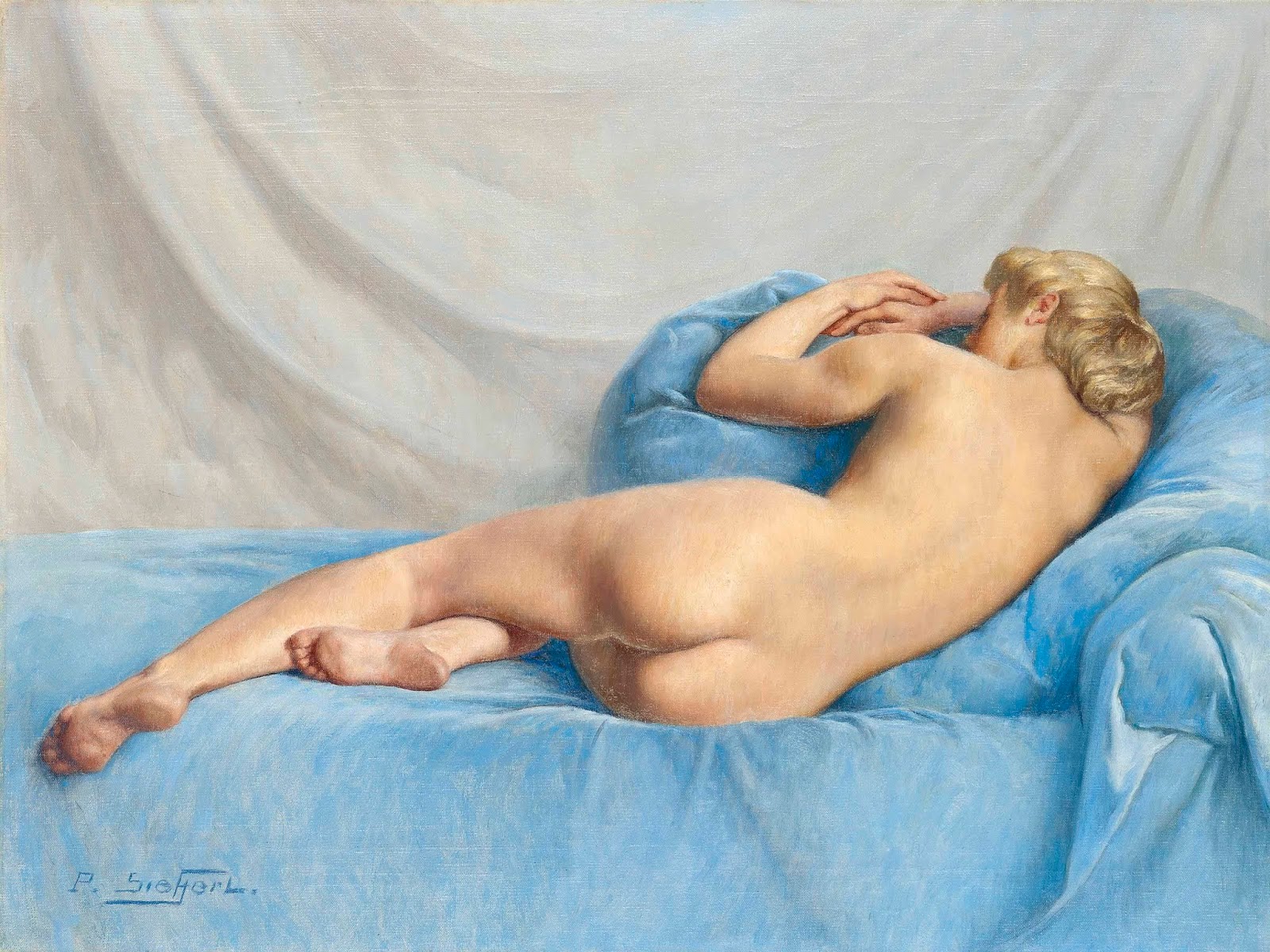
19th century chromolithographic print: (Victorian) reclining nude. Not a Paul Sieffert (1874-1957) painting but bought for a few bucks (€€) and almost just as nice. Sieffert was a French painter almost exclusively known from his numerous reclining nude paintings. And yes: he was pretty good at it. 


As always: all help identifying the artists involved is very much welcomed.  

Sunday, 10 March 2019

Susanna and the Elders: solved ! Albert Bechtold

Dorothea in Austria again solved a mystery. The print "Susanna" (and the elders, symbolised by two pair of spying eyes) was created in 1922 by Austrian sculptor and printmaker Albert Bechtold (1885-1965) who lived and worked in Bregenz.  
  

Thank you Dorothea !


After serving on the Italian front, marrying his Italian wife in 1917 Bechtold created this "Danae", daughter of Euridice, at the "Moment Suprème": the secret conception of Perseus by Zeus symbolised by a golden rain. Bechtold cleverly created a visual second layer to this myth: looking carefully Danae is reaching out to be kissed by bearded Zeus....  


The myth of Danae was depicted by numerous artist: from Rubens and Rembrandt to our modern times. Probably the best known and loved paintings of Danae is by an also Austrian artist: Gustav Klimt.