Showing posts with label Anders Zorn. Show all posts

Sunday, 24 November 2013

A stream of consciousness

Emile Gustaf Westman
(1894-1934)
Swedish printmaker

Stumbling over this Scandinavian etching of a blossoming tree and a visiting bee set a string of pictures and memories in motion that tells the story in what wondrous way the brain, my brain, is sometimes functioning. 

Because I'd never heard of this artist before I did my best to find out more about him but nothing much came up in the www. "Pupil of (Anders) Zorn"  the etcher-painterit said somewhere. But Emil Gustaf must have been locally known according to this big pile of prints I found offered in a Scandinavian auction site although he seems now largely forgotten. Many of the prints showing Malmö buildings and sites I discovered.
Only once his name popped up: in the entry to his son's biography: Gunnar Millet Westman (1915-1985) also an artist and remembered best for his sculptural work. And finding a picture of this granit statue called "Bro Bro Brille" immediately rang a bell. I've walked passed it many many times the last 10 years working in Groningen in the University Medical Centre. It's a very intimate statue of a family and the children encircling the parents in a game. You won't ever forget it, stroking the cold but smooth granite, and with a smile on your face, walking past, either to work or homeward. And I must have seen it in childhood.

It is hewn from a huge used granite press and it was placed in 1958, bought and donated to the city of Groningen (Netherlands) after a Danish sculpture exhibition in 1955 in the Municipal Park, to celebrate the opening of the big V&D warehouse. 


A decade after the destruction and rebuilding of what had been one of the best preserved and finest medieval market squares in Europe. 1955 was the year I (in my second year) returned with my parents from the tropics to the city of my forebears and living only a street length away to leave again a few years later the great and bustling and dynamic city of Groningen, capital of the North. 
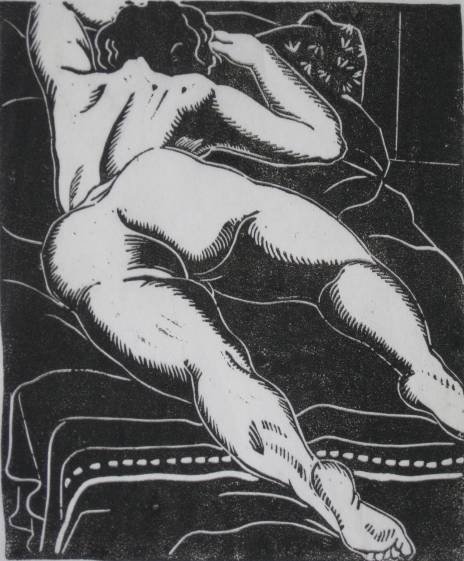
With Zorn and the foraging bee in my head the "connections" were made. Martin Erich Philipp: besides printmaking and painting and much like Zorn, was an etcher too. This sensitive "Rückenakt" (is it his wife Else Staps or a model standing at the window ?) imho his finest. It is probably far more affordable then a Zorn etching who I cannot help thinking, often has the air of a voyeur, camera in hand. Besides being a great painter and etcher of course. And now at the end of the stream it becomes obvious why the mind took such a detour after looking at a bee and blossoming tree. I don't know when Westman etched his but MEPH created his woodblock print in 1933. Both are lovely.

All pictures in this posting are borrowed freely from the Internet for friendly, educational and non commercial use only.    

Saturday, 24 March 2012

Emil Ganso: Bathers (Badende) (1/3)

Emil Ganso
(1895-1941)
American painter and woodcut printmaker,
 woodengraver, lithographer, etcher.   

Like Tor Otto Fredlin (1890-1950) in last posting, Emil Ganso wasn't predestined becoming an artist. He started his career as a baker in Germany, worked on board of the Germany-America Shipping Line and became, on the outbreak of WW1 an American citizen in 1914. Besides a self taught artist Ganso had to bake bread until 1924 when finally he could live of his art. Here's a good biography on the artist.  
A few weeks ago his print, "Bathers", was on offer at Ebay. It is a print uniquely made for "the Colophon", an American Art and Collectors Magazine in  februari 1933. It's executed in the wood engraving technigue and printed on mulberry paper. The Ebay offer went unnoticed and cheap. It however made me curious enough looking for more examples of Ganso's work and so  becoming aware of his fascination for bathing women. And ofcourse, he wasn't the only one.  
Besides famous for his still lifes, his interpretations of the female nude are highly praised. Besides in mine, I'm proud to say the Bathers print is also in the collection of the Metropolitan Museum of Art in New York. 
Left: "Hilda" by Emil Ganso and right a great unexpected etching by Martin Erich Philipp (1887-1978) who besides his fascination for the macaws in Dresden Zoo that made him famous even in America and being a good etcher evidently had a similar aesthetic eye for the female back.

For centuries bathing women have been an inspiration to artists from ancient Greece to Rembrandt, Rubens and Picasso. Lower left ofcourse the famous pastel by French impressionist Pierre August Renoir. This Blog more or less following my stream of consciousness (or "monologue interieur") I've discoverd so many closely related and often unknown works of art I've decided dedicating one or two more posting to this theme. A theme that magicaly seems to turn ordinary(?) women into mythologic creatures, graces and nymphs. 

But first here are some more of Emil Ganso's graces and nymphs. Bathing, reclining, resting women executed in different mediums (oil, pastel, etching and woodcuts) and when seen together they share the natural, relaxed and at leasure almost dreamlike atmosphere. Also completely unaware of any artist or observer in bathroom, boudoir or lakeside. Quite differently from, for example, the direct and far more confronting photographic style of Anders Zorn whom's nevertheless great and astonishing etchings of bathing women I discussed recently in the Blog (here). 
 
Ganso's women have much more in common with the women of Felix Valloton (1865-1925) (above) 
Next:  more bathing women, graces and nymphs.