Showing posts with label Ernst Rötteken. Show all posts

Tuesday, 6 March 2018

Unidentified artist: Lohe in Schleswig ?

Please read next posting for finding the location of the "Alte Kirche" print.

After recently finding another example by this printmaker in the Internet I decided to launch a renewed effort trying to solve this old problem and mystery. 

Years ago I found this Maya the Bee ("Biene Maja") print with "unleserliche" (illegible) signature. Maybe Martin Erich Philipp (1887-1978) gave him/her the inspiration for this print.   


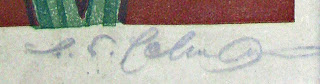
Since then, I saw a several others with the same signature which I to this day was never able to read properly or decipher. 


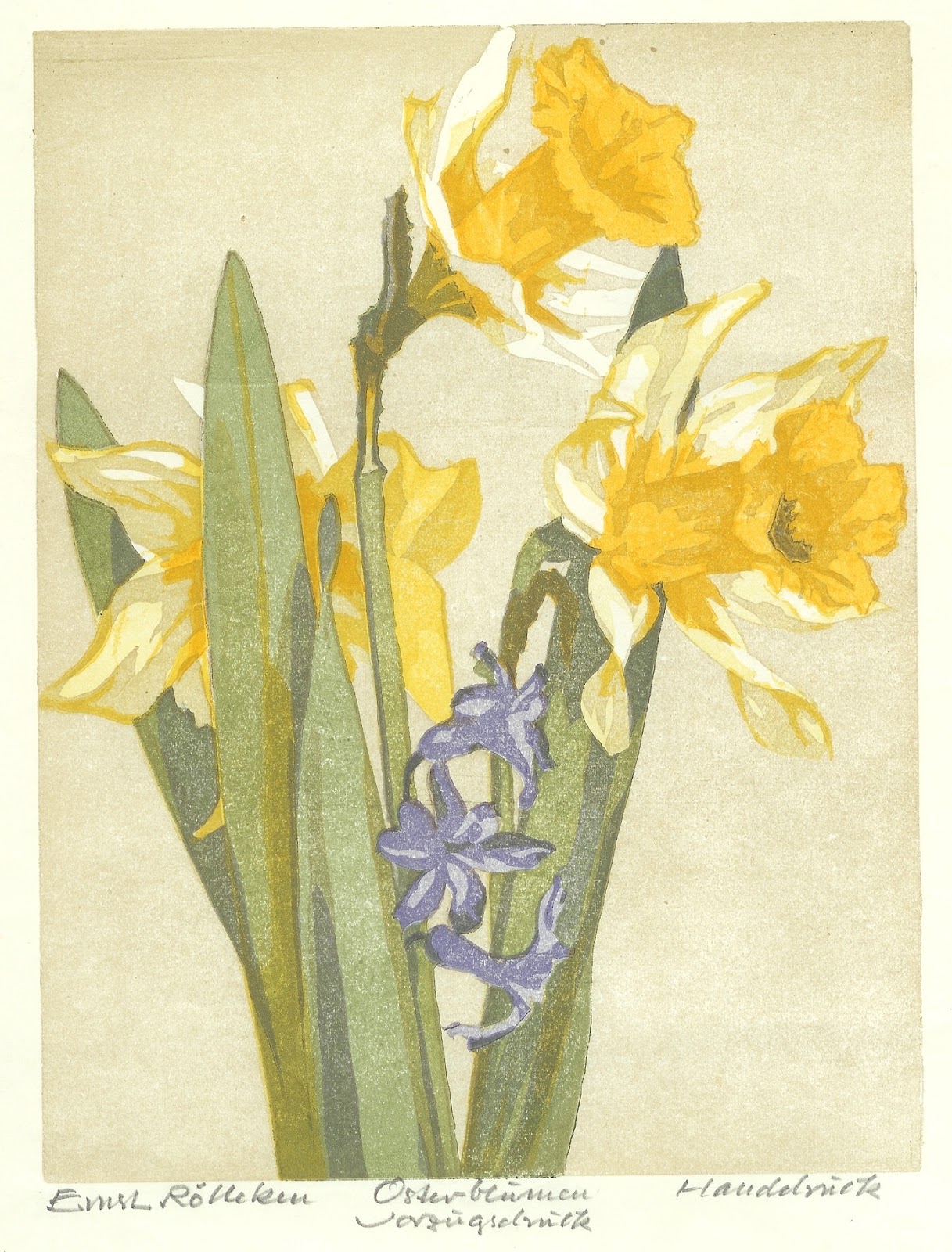
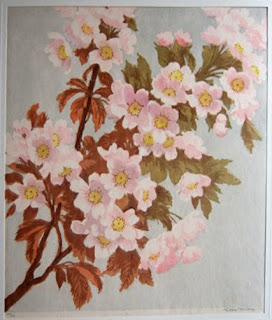
These prints are maybe not considered belonging to the highest regions of sophistication and artistic printmaking and probably are best described as "decorational". But they definitely have a certain charm and were never expensive. The flower prints are very reminding of Detmold printmaker Ernst Rötteken (1882-1945) (right) who's mission in life it was to provide Detmold households with "approved" yet affordable Art.   


But now this "Lohe, alte Kirche" surfaced. Assuming this print is not a phantasy composition it may hold a new clue to finally revealing the identity of this printmaker. Although the church, situated at the end (or beginning) of a small village street ("Dorfstrasse") is quite characteristic I have not been able, roaming the Internet for Schleswig church towers, to pin-point its location yet. 


Since the print surfaced in Cuxhaven, North of Hamburg and the bee print was found near Kiel (with 12 years in between) not far away but on the other side of river Elbe this could be a clue to a northern (possibly Schleswig-Holstein) artist. 
I have not been able to find a possible "candidate" (surname starting with a C. ?) in either "Lexicon Schleswig-Holstein Künstlerinnen" (Ulrike Wolff-Thomson) nor in "der Neue Rump" (Hamburg artists) (Maike Bruhns) both considered sources of importance and "weight".  


"Lohe" could point to a village in Schleswig-Holstein (near Kiel), but the church "does not fit". Maybe with the help of readers who are known locally it is now possible to finally identify this mystery printmaker.


Left: unidentified printmaker -Right: Ernst Rötteken (1882-1945)
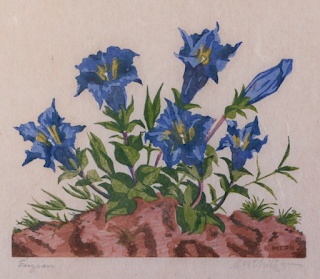


Gentian (Enzian): Martin Erich Philipp

(All pictures from my personal collection). 

Friday, 25 November 2011

Ernst Rötteken, rarest prints (II)


Ernst Rötteken 
1882-1945
German Painter and Printmaker

His rarest prints (II)


I think you’ve enjoyed the first series of Röttekens rare prints. So today I will share some more, before starting new postings on other interesting lowlands printmakers. This also allows keeping these 2 postings nicely together as a future reference. See for a reference to Röttekens more basic, widespread and popular prints here* (Link) or follow the Shop Button (above) to German Printmakers


3 studies of Geraniums
Ernst Rötteken was born in 1882 as the second son of Fritz Rötteken, veterinarian and equerry to the last King of Hannover George V (cousin to Queen Victoria). His father build a large family house within the walls of the old city of Detmold and Ernst, after finishing the Detmold Gymnasium, started his studies at first following courses in Botany. 
His knowledge of plants would later be of great help and value to his before mentioned endeavour allowing ordinary people to buy and own “real and good art” to decorate their houses instead of the kitsch and rubbish they were accustomed to and for whom his big landscape oil paintings were financially out of reach.

It was the same thought Vincent van Gogh wrote to his sister ”What I really would like to do is to paint for those who have no knowledge of artistic values”.


2 Studies of orchids

Rötteken originally was trained in traditional German landscape painting as a classical painter in Düsseldorf and later Karlsruhe Kunstakademie. And he was to become the leading and very successful painter of the Lippe landscape.
Village of Schwalenberg 1935
It was not before 1928 Rötteken, now in his mid 40’s, started his career as a woodblock (linoleumblock) printmaker after successfully trying and publishing a map of lithographic landscape prints in 1926. In his heydays his technically well made and well designed aesthetic flower compositions were ordered and sold in some 450 art shops in and beyond the province of Lippe all over Germany. The same method (flower prints, catalogue and selling points) of selling art to the "masses" was followed by contemporary Dutch printmaker Arie Zonneveld (1905-1941) whom I mentioned in this Blog many times before. Curiously both printmakers each created some 50 prints in their lifetime, but Zonneveld (although very short lived) created also some miniature landscapes which I've planned showing soon. 
Cactus and Geranium by Arie Zonneveld, also rare prints  

Both printmakers, to this day, are still very much appreciated and loved and are again collected by print enthousiasts not restricted to Lippe or Germany but because of Ebay and the computer all over the world.

Rötteken, early studies in composition; Irisses and Azalia's 

It takes a lot of time and research composing these articles. Leaving a comment, corrections or suggestions after reading therefore is always very much appreciated.

Some postings have been visited and consulted (borrowed and used !) over 900 times. Without leaving a single notice.

If I wasn't convinced you were probably very busy and forgot to, it could easily be interpreted as not very polite.

(Please consider that borrowing and using these unique pictures makes one very traceable.)

Saturday, 19 November 2011

Ernst Rötteken, rarest prints (I)


Ernst Rötteken (I)
(1882-1945)


German painter and printmaker


(< self portrait as a young man 1902)
The colors in this print below, "Echinopsis", make a nice bridge to continue after the colorful world of Matt Underwood's prints in last posting. Today I make a start sharing some very rare and probably never before shown or published flower prints by Ernst Rötteken (1882-1945).
I have so many nice things to share and show I'm afraid it will have to be in two separate postings. The above print, probably a proof, showing all (15 !) hues used, proving Rötteken, like Matt and Kandinsky, knew too. About the Japanese colors and hues.
Rötteken was a local printmaker in the Province of Lippe, living in Detmold the  provincial capital of the once souvereign Princedom of Lippe (Westphalen) in the hills and mountains of the Teutoburger Forest, were in AD 9, fierce Germanic tribes beat and stopped the advance of the Roman Legions. Rötteken produced his prints with the philosophy that by creating woodblock prints of his flower compositions the affordability put Good and Aesthetic Art into the reach and houses of the middle classe people of Lippe. 
Judging by their popularity and numbers of (unnumbered) prints many if not every middle class house in the province Lippe region was decorated with one or more of his prints. He was a well loved and respected artist, who experienced that prints of locally unknown and exotic plants like "Kamelie" didn't sell. 
It was "Goldregen, Roter Kaktus, Osterblumen, Sonnenblumen, Apfelblüten und Enzian" the Detmolders understood and wanted. So pernickety they were that prints like "Osterblumen" (Easterflowers) were not displayed in winter.  
See for these most and well known prints by Rötteken the Linosaurus Bazaar/Shop section following “German Printmakers” and you'll find a reference to these prints. Follow the button above or this use this link.
But these very unknown and rare prints however I enjoyed and photographed at my friend Hubert in Detmold when I visited him last spring. He is the greatest expert on painter & printmaker Ernst Rötteken and was one of the initiators of an exhibition of Röttekens work some years ago in Detmold. 
These are his early prints as well as experiments with form, design and color. Like in these three different prints of "Euphorbie".
Rötteken, relying for his bread and butter on his painting and printmaking had a small, 20 pages, cataloque made and installed at the regional better art and design shops and frame makers. It is sometimes on Ebay and holds 36 of his popular prints (to be ordered) and mentions 14 more prints in preparation (but some were never executed). In 1:4 miniature.  


.................To be continued ..............


It takes a lot of time and research composing these articles. Leaving a comment, corrections or suggestions after reading therefore is always very much appreciated.
Some postings have been visited and consulted (borrowed and used !) over 900 times. Without leaving a single notice.
If I wasn't convinced you were probably very busy and forgot to, it could easily be interpreted as not very polite.
(Please consider that borrowing and using these unique pictures makes one very traceable.)

Friday, 25 March 2011

NOID 11: first and fast results

NOID 11 (2)

The combined force of the Internet and (Bloggers) is not to be underestimated. Two fast results concerning last posting on unidentified prints and printers.
J. Prescher, has still no identity but two more examples were found both from American sources indicating maybe this artist is an American from German descent. We have 3 prints now, all flower compositions. I perticularly like this red poppies print


And, one more example emerged by the hand of the German artist but whoms signature is not yet identified. Also 3 prints by him are now known. This print has some similarities with Martin Erich Philipp's (1887-1978) 1933 print "Japanische Quitte". That is for the bumble bee. Foxgloves (lat. Digitalis Purpurea) stealing the show here.


Martin Erich Philipp

Ernst Rötteken (1882-1945) also choose this decorative red flowering plant of the apple and pear family: Quince (lat. Chaenomeles Japonica). With Art Deco vase but without the bee. Thank you observant readers and please share any other examples or identifications if you know of them.

Sunday, 23 January 2011

Viktor Pirkhoff (Part III) Cacti and Wildflowers


Viktor Pirkhoff
Part III
Cacti and wildflowers prints.
And some comparisons with contemporay artists.
Cactus prints
(the larger pictures by V. Pirkhoff)
Martin Erich Philipp (1887-1978)
Hugo Noske (1886-1960)

Sidonius von Schromm (1872-1948)

Wildflowers prints


Meryl Watts (1910-1992)


Ernst Rötteken (1882-1945)
Martin Erich Philipp(1887-1978)
Soon: Part IV: the Flower Bouquets by Viktor Pirkhoff.