Tuesday, 6 March 2018

Lehe ,"Alte Kirche" (not Lohe), near Bremerhaven

Within a few hours after my request for help both faithful readers Wolfgang in Frankfurt and Hannelore in Austria succeeded in finding the actual church to the print. 


Lehe, and not Lohe, now a part of Bremerhaven at the mouth of river Wezer,  century ago a rural village. 


* Lehe, now part of Bremerhaven, ** Cuxhaven, were the print was found. 

The church actually is not only an "old church" as the title suggests but it is locally known as "Alte Kirche" or "Dionysius-Kirche".


Thank you Wolfgang and Hannelore.

Lehe and its church, situated at the mouth of river Wezer in 1604.

What remains is the name of the printmaker, but I'm confident this will be solved in time too.    

Unidentified artist: Lohe in Schleswig ?

Please read next posting for finding the location of the "Alte Kirche" print.

After recently finding another example by this printmaker in the Internet I decided to launch a renewed effort trying to solve this old problem and mystery. 

Years ago I found this Maya the Bee ("Biene Maja") print with "unleserliche" (illegible) signature. Maybe Martin Erich Philipp (1887-1978) gave him/her the inspiration for this print.   


Since then, I saw a several others with the same signature which I to this day was never able to read properly or decipher. 


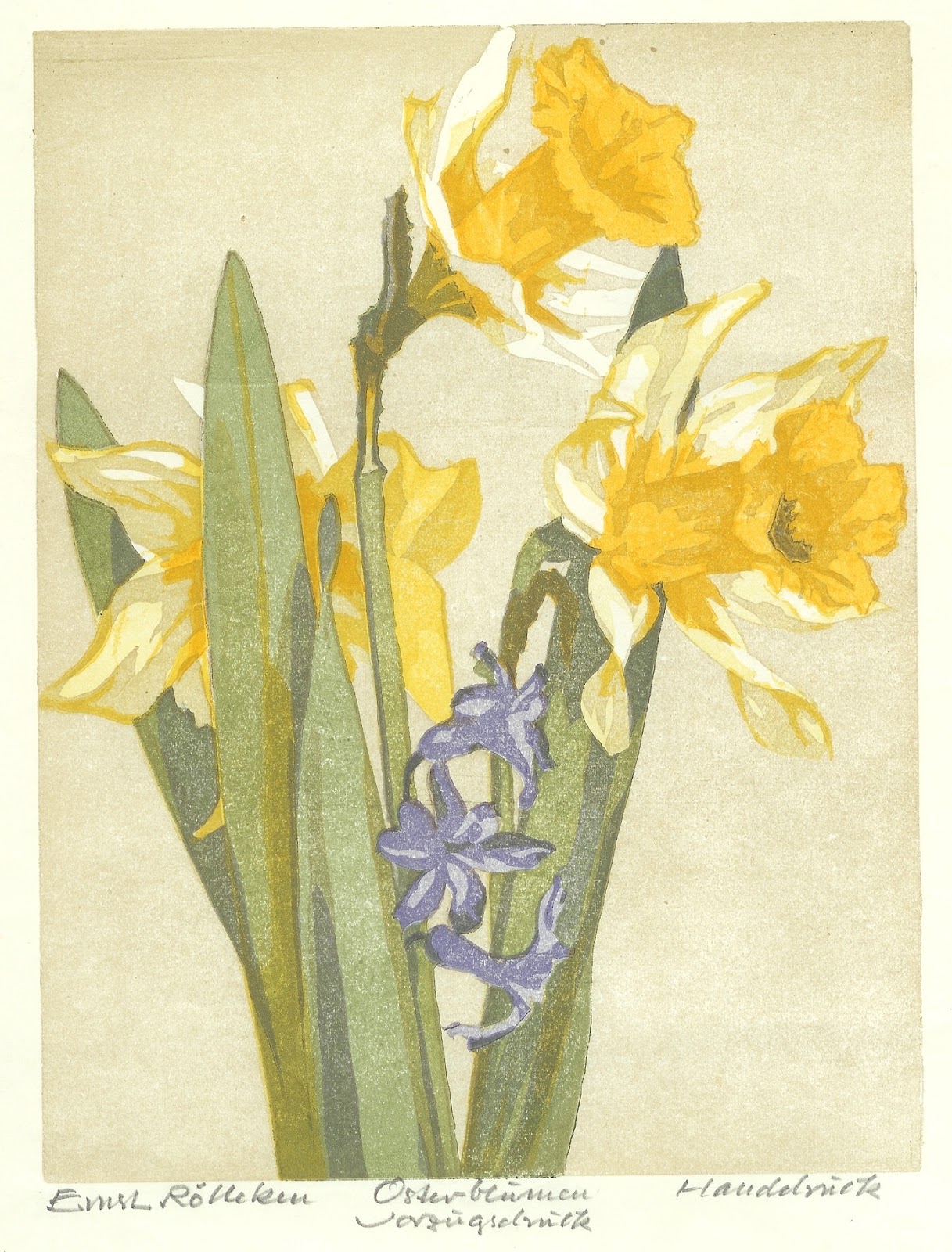
These prints are maybe not considered belonging to the highest regions of sophistication and artistic printmaking and probably are best described as "decorational". But they definitely have a certain charm and were never expensive. The flower prints are very reminding of Detmold printmaker Ernst Rötteken (1882-1945) (right) who's mission in life it was to provide Detmold households with "approved" yet affordable Art.   


But now this "Lohe, alte Kirche" surfaced. Assuming this print is not a phantasy composition it may hold a new clue to finally revealing the identity of this printmaker. Although the church, situated at the end (or beginning) of a small village street ("Dorfstrasse") is quite characteristic I have not been able, roaming the Internet for Schleswig church towers, to pin-point its location yet. 


Since the print surfaced in Cuxhaven, North of Hamburg and the bee print was found near Kiel (with 12 years in between) not far away but on the other side of river Elbe this could be a clue to a northern (possibly Schleswig-Holstein) artist. 
I have not been able to find a possible "candidate" (surname starting with a C. ?) in either "Lexicon Schleswig-Holstein Künstlerinnen" (Ulrike Wolff-Thomson) nor in "der Neue Rump" (Hamburg artists) (Maike Bruhns) both considered sources of importance and "weight".  


"Lohe" could point to a village in Schleswig-Holstein (near Kiel), but the church "does not fit". Maybe with the help of readers who are known locally it is now possible to finally identify this mystery printmaker.


Left: unidentified printmaker -Right: Ernst Rötteken (1882-1945)


Gentian (Enzian): Martin Erich Philipp

(All pictures from my personal collection). 

Sunday, 4 March 2018

Clara Telge (part I): visiting "das Alte Land".

Clara Telge 
German painter and illustrator. 
(Shanghai 19-03-1870 - 25-02-1947 Hamburg)  

Here follows what I came to know about the artist Clara Telge and I invite readers and passers-by to send all they know about this forgotten artist and her family. To my knowledge she not known as a printmaker.  


Less then a handful of paintings by her hand can be found in the Internet. I stumbled over Clara Tele because she came to paint in "das Alte Land" while researching another artist printmaker, Anna Bähker who, I discovered a few weeks ago,  also visited this picturesque region just West of Hamburg. 


What I do know is Clara was born in 1870 in Shanghai where her father Carl Bernard Hermann Telge had started an important trading house (import/export) on “the Bund”, the strip of land in Shanghai along Huangpu River. 


Bernard Telge came to Shanghai the moment it was allowed to foreign companies to settle and open business in China following the opening of the Chinese market after the 1842 Treaty of Nangking and when England finally ended  the Chinese Opium wars: in the early 1860’s steaming from Hamburg or Bremen.

Shanghai: The Bund 
Telge’s trading company was involved in the construction of China's infrastructure: steel bridges and railways and the selling of torpedos to China’s imperial navy as well as importing Prussian railway steam-engines and was also active in China’s (coal) mining, owning mines and recruiting German mining engineers. 


Paul Kayser: Teacher in and view from "Malschule Valeska Röver" in Hamburg.

Students in Valeska Rövers painting school. 
Going by the names of Clara’s no doubt private painting teachers her fathers business must have been as successful as she was talented: returned from China she studied in Hamburg at Valeska Rövers paintings school (above) while in Berlin she became a master student of Max Liebermann and Lovis Corinth and was allowed to study in Paris with Lucien Simon.


Please send all you may know about this Telge family. In Berlin at the time was active a Carl Franz Paul Telge a famous jeweller/goldsmith and jewellery designer admitted to the Rumanian court of King Carol-I and Queen Elisabeth. During his reign (1866-1881) King Carol encouraged and “imported” many artists and craftsmen from Germany/Prussia (many from Hamburg) to his Kingdom. More about this you can read in the book. Paul Telge's father was Julius Telge (1814-1887), also goldsmith in Berlin since the 1840's but originating from a Braunschweig mr. shoemaker. (A jeweler Bernard Telge is also mentioned in a Berlin chronicle but probably a mistake with Paul. This could be a clue to a family connection).  


I met Clara Telge visiting and painting around 1910. Like so many of her artistic sisters, not much about her life and career is delivered to us in the textbooks or artist lexicons. She was there to paint while staying, for many years as a guest in the house of Pastor (referent) August Meyer in Borstel a rural community in a picturesque district close to Hamburg. 


Clara is not known as a printmaker but she is known by an illustrated with watercolours booklet she created privately and exclusively for the children of the Meyer family. The once private booklet with these great illustrations was published in 2004 in a limited edition: "Ein Altenländer Bilderbuch" für große und kleine Pastorenkinder".   


I further learned the Meyer residence in the village of Borstel also received other Liebermann students: Alma del  Banco and her friend Gretchen Wohlwil but also Clara’s sister (?)  and nephews and nieces (?) from Berlin (as a biographer would I love to know their names....).

Clara Telge: Helgoland 


One of the very few paintings by Clara I was able to trace: View on Helgoland, a strategic rocky North Sea island and Ice age remnant just north of Bremen. Helene Mass was here obviously (above) and one of my favorite German impressionist painters Leonhard Sandrock (below)


Das Alte Land”, today Germanys largest fruit producing district consisting of former marshlands claimed from the sea by 12th century Dutch settlers was also the favourite subject of painter and printmaker (and Emil Orlik student)  Hans Förster (1885-1966) a native from Hamburg and awarded an exhibition in Hamburg Altona Museum that was extended until spring 2018.


More details about Clara Telge are mentioned in her short biography, one of the hundreds I’ve collected in my book that will finally be published later this month in a private and limited edition as a Liber Amicorum (book for friends) containing over 300 pages of short biographies of German, Scandinavian, Russian, Baltic and Dutch women printmakers active 1900-1935. 


Pictures embiggen by mouse-click
-------------

All pictures borrowed freely from the Internet for friendly, educational and non commercial use only.

Friday, 23 February 2018

Brussels construction works around 1915 by René Vandesande.


This etching, possibly of historic importance and in very good condition definitely is showing Brussels, its Town Hall ("Hôtel de Ville" at the Groote Markt) dominating in the centre clearly visible under a 45* angle and a large wood supported construction site the obvious subject of this great composition in the best French tradition.     


Although I searched I have not been able to find any photographs of a fitting similar construction site in Brussels around this date (1900-1915).


The artist shows construction work of a viaduct in a direction parallel with the front the Town Hall. It could very well show the building of Viaduct Rue Gray in the Rue Couronne (Kroonstraat), a double traverse of both the road and (in a second smaller and lower bridge) the railway from and towards central station. As seen by the artist from approximately the Zwemkunststraat (quartier Elsene). 


I invite readers and passers-by and all who know better to identify the signature, and monogram RV (Vande......) (Thank you reader Mich for solving the signature: R. Vandesande)


This etching, a great diagonal composition, is with many more fine graphic works available for swapping and trading to further my collection of German women printmakers in a friendly way.

Rene Vandesande (Doornik 1889 - 1946 Anderecht) was a Belgian painter and graphic artist).  

Monday, 19 February 2018

Anna Bähker, printmaker in "das Altes Land".


Anna Bähker 

Still unidentified etcher and printmaker.
 Living in Berlin 1921-30, member of the VdBK.
 Probably living for some time in the artist colony of Nidden.  


Anna Bähker is one of the artists who, in spite of all my efforts remains to this day a very unknown artist: I still have no idea who she actually was. Although I discovered the identity of so many obscured artists over the past years (all revealed in the book) Anna Bähker is still an enigma although her prints regularly show up in Ebay and other auctions. But gathering all small pieces one day will be successful and helpful in clearing her from obscurity. 


She is best known for the half a dozen prints showing (Baltic) fishing boats (more about these prints and their location in a later posting). She has been obviously working and/or staying in Nidden where printmaker Daniel Staschus and his wife lived. It is situated on the Curonian-Spit an ice age remnant, a long sandy stretch of dunes situated in Prussia's Baltic sea, now Kaliningrad/Königsberg-Lithuania)  


Recently and shortly after each other I found these two etchings (German :"Radierung") they are the first examples I ever saw other then her woodblock prints. Unlike many other printmakers I've never seen an oil painting by her. 


The first is said to be (possibly) showing "Worpswede" which is a picturesque village and artist "colony" near Bremen. The title is "Am Kanal" (at the canal). She possibly visited Worpswede artist colony because it is not far from her woodblock print titled "Altenländer Fleet" (canal Altes Land) 


"Das Altes Land" is however the region situated on the west bank of river Elbe, north-west of Hamburg. The old country, "laid dry" centuries before (since 12th century) by Dutch settlers and today Germanys fruits and vegetables garden.  


The other one (very small only 6 x 8 cm) is highly interesting because it is a mirrored version of her best known woodblock print "Stadttor" (town gate) which I would very much like to find and have one day. And of course finding out where this gate is located would be even better.


I can offer many fine works (in every international discipline) for swapping or trade if you happen to have or know a decent copy of this print that is on my wishlist for my collection of German Women Printmakers. 

--------------

All pictures borrowed freely from the Internet for friendly, educational and non commercial use only.