Kanae Yamamoto
(山本鼎 1882-1946)
painter, founder of modern Japanese printmaking
(Sosaka Hanga), socialist and idealist.
Theorist & Inventor of Craypas pastel crayons.
Self portrait Kanae Yamamoto, 1915 & Vincent van Gogh, 1888
In two of my last postings images by Kanae Yamamoto were used. I first read about this printmaker in Clives' Art end the Aesthete (here*). Then I stumbled over a picture used in Lillies Japonisme blog later finding, to my surprise, a "Brittany cow overlooking the sea" print for my Red Heads posting.
Kanae educated and trained in woodengraving both privately and in Tokyo Art School started the movement of Sosako Hanga, simply said doing all the work on the carving and printing himself and not aided by staff. All started with this first print (Fisherman) in 1904. Pioneering and introducing a new way of printmaking without a black (tying the composition together) keyblock.
So, scattered over the internet there is information and are examples of Yamamoto's prints and paintings but nowhere the two are combined. There's an actual Yamamoto Museum in Japan but its digital museum/website (in Japanese) is hard to understand and shows very few actual pictures. And there's the excellent biography by Dieter Wanczura (Artelino) you must read: (here*)
Compare Kanae Yamamoto's Brittany bathers with similar compositions by Paul Gauguin.
From 1912 to 1916 Kanae was in France, studying in Paris in the Academie Julian (like Carl Moser (below) did before him) and working mostly in Brittany, sending home his prints to finance his stay obroad. So surprisingly we find Urushibara (arriving 1907) wasn't the only Japanese printmaker staying in Europe at the time. This may also explain the rather odd publishing dates of some of his prints. Created in France, they were send back and published later, some of them probably even when he was already back in Japan.
Eugene Boudin (l) and Kanae Yamamoto (around 1914)
(It would be very rewarding finding which village Yamamoto is showing)
In Yamamoto's Brittany prints we'll find obvious influences by French impressionist artists. However most of them already history by the time he arrived. Vincent van Gogh (1853 died 1890), Paul Gauguin (1848 died 1903) Claude Monet and Eugène Boudin (1824 died 1884) the landscape, and famous for his cows, painter.
Paintings of haystacks by Claude Monet and Yamamoto
Bu surely many of their works will have echoed in the region and in Paris. But post impressionist painter Paul Serusier (1863-1927) I'm convinced he will have met. And possibly Maurice Denis (1870-1943). It is interesting comparing some of Yamamoto's Japanese prints with works of resemblance by his fellow artists and see how this earliest Modern Printmaker set the way the way for his colleagues
Kanae Yamamoto
Paul Serusier and Carl Moser
French (Paris) printmaker Henri Rivière (1864-1951) who stayed and worked in Brittany 1884 from 1916, so when Yamamoto was actually there, was probably the greatest artistic influence on the younger printmaker Yamamoto.
Kanae Yamamoto
Carl Moser and Henri Rivière
painting by Maurice Denis (1870-1943), the Cow Girl 1893
Kanae Yamamoto
Paul Gauguin and "the crashing wave"by Henri Rivière
Austrian printmaker Carl Moser (who took woodcarving lessons from Emil Orlik) also spend the summer months and stayed and travelled Brittany between 1900-1907, the year Yamamoto arrived. Even back in Austria Moser kept on making prints of Brittany girls, Britany bonnets and Brittany landscapes.
Breton girl: Kanae Yamamoto
Breton girls Paul Gauguin and Paul Serusier
And ofcourse French printmaker Amadée Joyau (1872-1913) worked in Brittany at the time Yamamoto stayed there. I've shown him in the Linosaurus before (here*)
And Czech printmaker Frantisek Simon (1877-1942 when living and working in Paris from 1907-1913 also visited "la Bretagne" and etched her rugged coast.
Two of his woodblocks probably published in Japan: left, in a combined cutting and engraving technique (click to see details !) a French provincial village (which ?) and right a maybe Russian panorama considering the shape of the church towers. Yamamoto made his way home avoyding war troubled Europe in 1916 through Scandinavia and Russia. Note in both prints his soft and consistent use of a pastel pallet.
Above two examples of Yamamoto's qualities as an oilpainter: a Brittany beach and a later Japanese beach scene showing he best fits the description being a Japoanese Post Impressionist painter.
Paul Gauguin and Kanae Yamamoto
"On the deck" a print probably made when he just had returned in Japan. It is dated 1917 and is showing a Japanese Fisherman working his nets. This last example, the group fishermen at a beach at sunset (or rise), proof of his superior cutting skills. I couldn't find a date, but the way he created the different expressions, shades of gray and structures of cloth of the robes with a simple cutting tool is almost incredible.
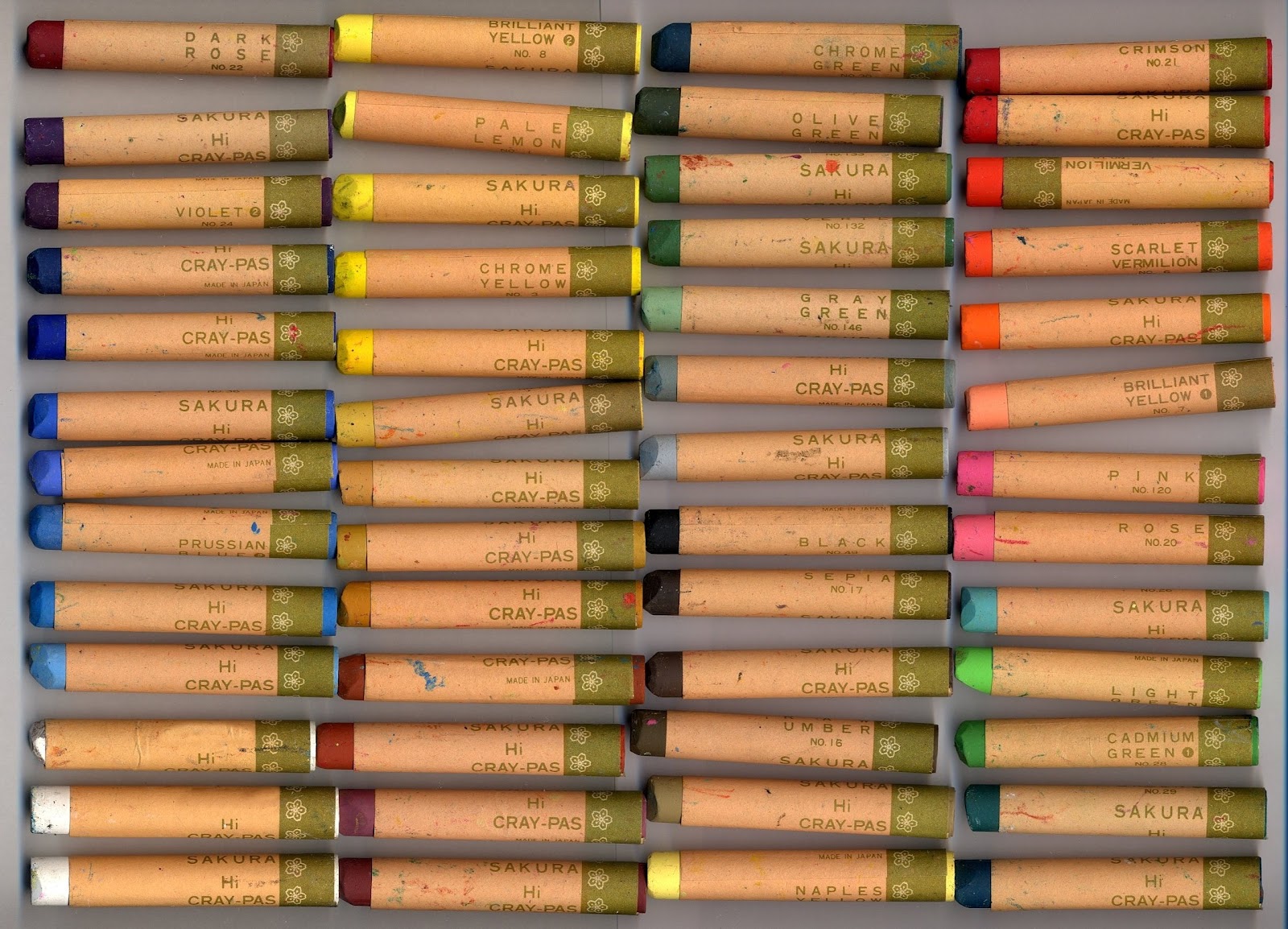
Being a theorist and idealist Yamamoto also invented and created the first use and production of color pastels in 1925. Together with a course in drawing for children according to the theory of Jiyu-ga (Drawing without a Master) Perfected, these artist materials are in use world wide both as original Sakura Craypas pastels (read more here*) as dozens of brands worldwide.
This posting has been one my most elaborate sofar, trying to create something that wasn't there before. It's by no means meant as definitive, at best a starting point for further interest for others.
Some pictures I borrowed and reblogged from "Japonism" and the "Blue Lantern".


%2B1.jpg)


%2B13.jpg)
%2B7.jpg)


++La+Couseuse.jpg)