Showing posts with label Max Slevogt. Show all posts

Saturday, 7 March 2015

Emmy Gotzmann: first result & great find !

Emmy Gotzmann
(1881 - ?)


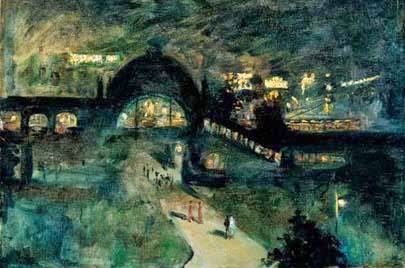
U-Bahnhof Bülowstrasse, Berlin 
(seen in the direction of Nollendorfplatz, next station)


U-Bahnhof Bülowstraße today.

The revealing of this painting is the result of using the immense possibilities of a friendly Internet. Combining knowledge, effort and research I'm really happy to show the world this wonderful painting that has not been seen, admired or enjoyed for so long. 
(Bülow station see in the direction of Nollendorfplatz, next station)

From Emmy's viewpoint side of the street looking towards the left: Luthers Kirche. Looking right would give the exact view on Bülow station and Potsdamerstraße crossing. This view before the line was raised, the station build and a passage was created through the wall of houses. 


And after raising the line and creating a passage. Around 1905   

This posting is also an announcement and a welcome to Emmy Gotzmann's biography that will appear later this year in honor of the obscured life and career of this wonderful and neglected painter. Who knows what other great paintings will be revealed. It's publication will be announced in this Blog. 

The newly build Bülow station, the front is situated along Potsdamersträße.   

This station is one of three rather famous stops in Berlins basic first "Hochbahn" line build in the late 1890's and opened in 1902. 

Between the Luthers Kirche and Berlin-Zoo/Kaiser Wilhelm Memorial Church  completed in 1906 on Auguste-Viktoriaplatz and Kurfürstendamm): Wittenbergplatz, Nollendorfplatz (with "Kaufhaus des Westens" founded in 1905) and Bülowstraße crossing Potsdamerstraße. The iconic station buildings were destroyed, like anything else, in the allied bombing in the last year of WW2. However, Bülow Bahnhof was rebuild.


Emmy must have taken the Godfather of Impressionists Camille Pissarro's (1830-1903) 1897 depictions of Boulevard Montmartre with high viewpoint and  diagonal compositions in mind. Pissarro was exhibited in Berlin with 40 paintings in Kunstsalon Cassirer in 1907 in nearby Victoriastraße 35 (along with 4 works by my research subject Fanny Remak by the way).


Lovis Corinth: Berlin, "Unter den Linden" and the Brandenburger Tor (were the Liebermanns owned a city palace).
 
Max Slevogt: "Unter den Linden". 

Berlin Seccesionist Lovis Corinth (1858-1925) and Max Slevogt (1868-1932), with Max Liebermann (1847-1935) the three leading Berlin impressionists, likewise choose the high viewpoint and diagonal composition in their "Unter den Linden". And maybe Slevogt had the greatest of impressionists in mind: Claude Monet's Rue de Montorgueil from 1878 (left) 


Lesser Leo Ury
(Nollendorf Station)


Emmy's painting is all the more important because there are so few examples of Berlin street views in painting. Let alone of the U-bahn, build after the example of New Yorks above-ground system. That is besides the paintings by a painter who was always to stand in the shadows of this trio: Leo Lesser Ury (1861-1931) owned a studio at Nollendorfplatz(1) and he just had to look outside to paint in the rainy atmosphere that is so characteristic for much of his work.

(1) The name of Ury's neighbor George Mosson (a Berlin seccessionist) keeps popping up in many artists biographies. Mosson, a painter of flowers, also taught and ran a painting school. 
   
Thank you Hartwig D.(2) and author Ferdinand Ruigrok van de Werve ! 


All pictures borrowed freely from the Internet for friendly, educational and non commercial use only. 
(2) to the protection of the owner of the painting. 

Sunday, 13 October 2013

Eduard David Einschlag

Eduard David Einschlag

German impressionist painter, etcher and printmaker 

(1879 - murdered 1943 in Treblinka)


Stumbling over a picture in the www. lead me to Neil's "Adventures in the print trade". As many times before Neil already investigated and covered this artist. 
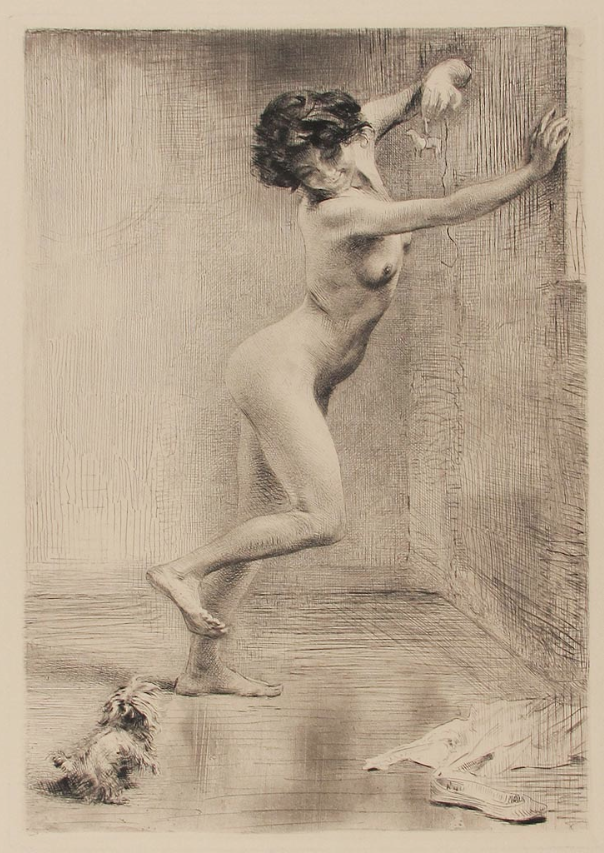
But since he discussed just a single example, the one etching in which the artist  supposedly depicts his wife, I considered it a good idea looking somewhat deeper into the life and works of this obscured artist. Because he was of Polish-Jewish descent he, along with most of his family, wife and sisters, was deported to the Warsaw ghetto in 1938 and was murdered in the hell of Treblinka probably around 1943.
Eduard was born in Leipzig to the merchant ("Kaufmann") Joseph Einschlag and his wife Dorothea Armhaus. He had an older brother Martin (*1877, the only member of the Einschlag family to survive the holocaust) and two younger sisters Wanda (*1883) and Hedwig (*1890) who were like Eduard deported to Warsaw, perished, and killed around 1943, but nobody knows for sure. 
His artistic talent was recognized at an early age and young Eduard went to study in Munich under Peter (von) Halm (1854-1923) one of the leading 19th century German etchers and where at that time Vasily Kandinsky created an artistic revolution. Later he continued his studies in Berlin where the 3 celebrated impressionist painters Max Slevogt, Max Liebermann and Lovis Corinth were at the height of their careers and taught at the Berlin Art Akademie.

In London Eduard painted not only the Houses of Parliament but also Charles Dickens "Old Curiosity Shop" at Portsmouth Street. Many of Einschlag's works I found are collected in the local Leipzig Museum (Stadtgeschichtliches Museum).  
In Berlin, from 1901 onward, his teacher at the etching press was Karl Köpping  (1848-1915) the leading Rembrandt copyist and celebrated etcher. In 1912 Einschlag returned to Leipzig to settle and to marry Louise Victoria Croner (*1883)
This Rembrandt self portrait, attributed not to Rembrandt but to a "follower of"  is in the Leipzig Museum collections and Wilhelm von Bode, to whom this print was dedicated, at that time in 1915 was "Geheimrat". I think the honorary title,  is best translated as curator.
Of this Rembrandt copy (above), although I tried hard,  I failed to find its original. 

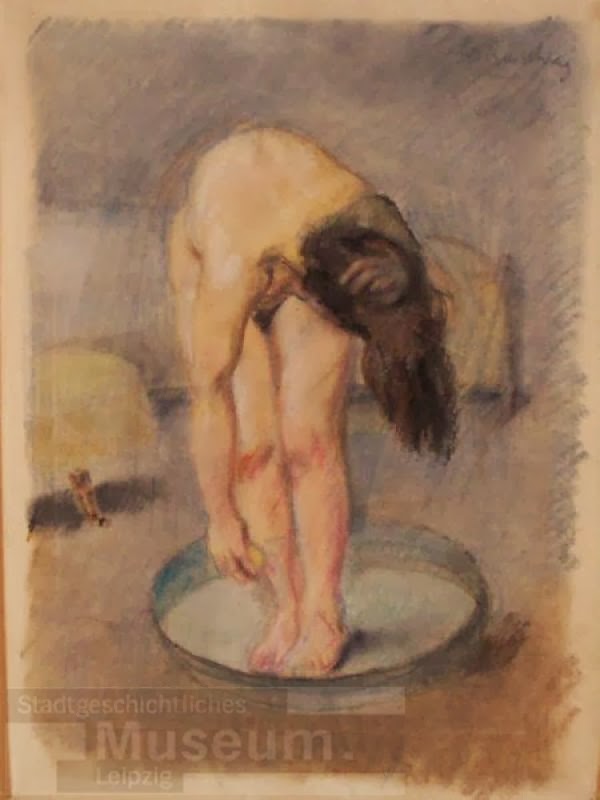
In 1910 he studied in Paris, where in the same year Pablo Picasso and George Braque revolutionized the Art World and from that time his admiration for Degas, the impressionist painter, also is eminent in this bathing girl. 
Einschlag was regarded the most celebrated artists of Leipzig in the 1920-30's and was intimately known and loved by the artistic and scolarly circles portraying many of its members in oil and etching.
He is regarded as an impressionist painter although he became mostly obscured and forgotten after the war, considered one of the best etchers of his time. 
And to my surprise he also tried at woodblock printmaking and recently I could not withstand buying this postings opening 1918 "woman at the window", an art-calender woodblock printed from the block, in the memory of this neglected artist. 

As a student of Karl Köpping his skills copying the old masters extended to the new masters also finding his etching of Degas' café scene that is now in the Musée Dorsay.
In Leipzig the Einschlags lived door to door in the same building to Rüdiger Berlit (1883-1939) a German expressionist painter and woodblock printmaker  and it was probably Berlit influencing and pursuading Einschlag to develop also in printmaking. And, can you believe it, I found this  photograph of the 1915  1915 Paper Fair in the Leipziger Peterstraße. Comparing it to the print he created you can see how good he'd become at it. Notice the banner of the The Lindstrom company.  

Much of Einschlags work was destroyed in and before the war when his art,  from 1933, was declared "entarted" or degenated. To be forbidden, publically ridiculed and destroyed by the same fanatics, insane and criminals that later killed 6 out of 7 (million !) Jews in occupied Europe.         
-----------------------------

Some examples of work by Eduard Einschlag's graphics teachers in Munich and Berlin 

Peter (von) Halm (1854-1923)


Karl Köpping  (1848-1915)


Rüdiger Berlit (1883-1939)  


All pictures are mouse-clickable to embiggen.  


All information was scratched from the www. and reassembled and reshaped to this posting to the best of my abilities without any economical or  commercial purpose. With that in mindte contents should be judged likewise (GC).