Showing posts with label German Impressionists. Show all posts

Thursday, 5 March 2020

Rahel Bodlaender, unforgotten.

Hail surviving Blog readers. 

After a sabbatical and Blog-"retraite" I salute new visitors & welcome back all revisiting old friends. 

This is the account, résumé or summing up of my recent investigations into the forgotten life of Berlin flower painter Rahel Bodlaender. I stumbled over her name in another of my research projects: that of Berlin Secessionist and flower painter, portraitist and leader of the VdBK drawing classes  George Mosson (1851-1933), in his life-time an artist of great fame, but today like Rahel almost completely obscured. Unlike his many famous Berlin fellow artists (Max Liebermann, Lovis Corinth) George Mosson has never been the subject of any serious research leading to a monograph or cataloque résumé. This posting is the introduction to the next composed around his person and his work. 

All help, corrections and additions are welcomed. 
All my genealogy and other findings shared on request.

Bodlaender, Rahel (Rachel)

 (Ortelsburg in Silesia 25-05-1863 – murdered 17-09-1942 Theresienstadt)


Painter of flower still-life. Not known as graphic artist. Daughter of Wolf Bodlaender and Berta N.N. Her mothers family name is still unknownHer father is probably the teacher (“Lehrer”) Bodlaender who is permitted to start a Jewish elementary school in Ortelsburg (Szczytno) in East Prussia in 1863 for a limited period of 3 years. Rahels sister Grete was born in Ortelsburg a year later. Another sister Lina (Eveline) however was born in Dirschau (Tczew) in 1869 near Gdansk in Pommern, some 100 km Westwards an indication Wolf Bodlaender and his family left Ortelsburg and moved from Ortelsburg to Dirschau ?


In the official death certificate in Theresienstadt of her younger sister Grete the names of the parents, Wolf and Berta are mentioned. On their deportation the three sister lived together in Berlin at Siegmunds Hof Nr. 6. in the Tiergarten district.


Rahel Bodlaender (she signed her work R. Bodlaender) today is known by 4 oil paintings (a kind of Biedermeier interior still-lives) and 4 postcards “after paintings by the artist” published by Wohlgemut & Lissner, the Berlin quality printing and publishing house of all well-known graphic artist in Berlin.
Nothing is known about where, under who or when she studied or which year she (and her sisters Grete and Lina) came to Berlin, nor how they might be related to the other Bodlaender families living in 19th century Berlin. Their specific family name indicates they must be all related to a pinpoint location somewhere around 1800. 


Bodlaender family name.

In the second half of the 19th century and first decades of the 20th, a dozen to two dozen Bodlaender family members lived in Berlin. Merchants,  doctors,  a vet and a urologist; a lawyer and a colonial ware shop owner, widows and single women school teachers. But  what ties the Bodlaenders together seems to be an area in East Prussia, also known as “Ober-Schlezien”. More specifiquely the area  around the small town of Rosenberg. The woodland district is locally also known as Bodland. In Rosenberg and its surrounding villages (dwellings) the first Jewish settlers are said to have arrived in the second half of the 18thcentury. The area since the 18th century is known for its thriving glass industry attracting many new settlers. Among them many were Jews from the eastern regions of Prussia known as Masuria.

The link to the Bodlaender family name can also be found in the name of the village: 

Bogacica (German: Bodland) is a village in the administrative district of Gmina Kluczbork, within Kluczbork County, Opole Voivodeship, in south-western Poland. It lies approximately 6 kilometres (4 mi) west of Kluczbork and 37 km (23 mi) north-east of the regional capital Opole.
Bogacka Szklarnia (German: Bodländer Glashütte). In the region several of these glass manufacturing industries started in the late 18th century 
Kluczbork (German: Kreuzburg O.S.)
Rosenberg O.S. (Polish: Olesno)

Following  the genealogical trails of several 19th century (Berlin, and Prussian) Bodlaender families they all seem to lead  to 1750-1800 Moses, Salomon, Samuel (Wolff and Louis) Bodlaender.  
I suppose the Jewish pioneers that settled here from other parts of Poland may have adopted the Bodlaender (meaning simply “from Bodland”) family name to their traditional Jewish patronymic names.  


Rahel Bodlaender perished (was left to die) a week after arriving in Theresienstadt  (North of Prag, halfway Dresden) with “Transort 1/60 ” which had departed from Berlin Sept. 7th 1942. She was 79 years old. She died in the most inhumane, horrifying and desolate conditions from “ENTERITIS/Darmkatarrh”, a routine “diagnosis” found in most official death certificates after her death in this hell on earth. The Nazis were as meticulous as they were criminal book keepers. Death by starvation, by fleas, lice and infectious diseases, dysentery, typhus and cholera. In all death certificates the doctors have Jewish names too. I suppose they literally eventually “shared the same faith”. Why spend Arian doctors on old, sick and dying Jewish people that weren’t even regarded as humans ? 


With the same cattle-wagon “Alter Transport 1/60” Rahels two sisters Grete, born 1864, and Lina (Eveline) born 1869, arrived in “Modellstadt” Theresienstadt. Lina died 4 days later with the same diagnosis (73 years old) as did Grete who held on until Jan. 12th 1943, 4 months later, 78 years old.  All together 33.430 people would die here, including 3 more  Bodlaender family members. Literature describes many of the Jewish people living in rural Eastern provincial communities left for Berlin in the second half of the 19th century. To find and build better lives. 

The sisters were known last living in Berlin Siegmunds Hof nr. 6 not far from the entrance of Berlin Zoo at Tiergarten park where “Lehrerin” Lina rented an apartment in a district housing many Jewish people and had its own synagogue. A few 100 meters from where the train conveniently left. 


Today Rachel Bodlaender, but for the postcards and a lonely auction record, is a completely forgotten and obscured artist and I suppose the 3 sisters, once living, loving and working human beings have long since vanished from memories and faded away into the mist of history. 


Rahel, Greye and Lina also have not yet been honoured with a “Stolperstein” Germanies sympathetic commemorating pavement brass plaques remembering the names and places were Jews once lived and from where they were torn away, expelled and deported. I intend to inform the Berlin Stolperstein project manager one of these days.  

As has happened so many times before I felt compelled to try and give this artist at least a small place within the world of her sister artists in my Artist Index or Lexikon. By trying to find and re-unite her with her family and place in history.  


In the Netherlands I found a Dutch Bodlaender family deriving from Dr. Moritz Leo Bodlaender (1899-1968). He was born in Breslau and gave the name Wolf (Berlin 1925-2013) to one of his two sons. Dr. Bodlaender settled in the Netherland in 1935 and naturalised in 1950. Maybe the solution of my quest lies more near home then I could have ever foreseen when I started it.

Rahel is not mentioned in any of the Artist Lexicons but I found her in Dresslers Adress book 1921 and 1930. Living at Straßburgerstrasse 9. In 1931 she is mentioned  “Blumenmalerin” living at the same address and a member of the RvbK (“Reichsverband bildende Künstler”) 

----------------

Please help me to find Rahel, Grete, Eveline, and their parents Wolf & Berta Bodlaender's connections and roots that must be within the Jewish community in the "Kreis Rosenberg" (Olesno) area  around 1800. 

Email: gerbrandcaspers@icloud.com


All pictures embiggen by mouse-click


All pictures borrowed freely from the internet for friendly, educational and non commercial use only. 


Saturday, 18 August 2018

Elsa von Durant: to the Manor born..

To my best knowledge: this condensed short biography is a first attempt.
The artist Eva Tischner-von Durant is not mentioned in any of the Artist Lexicons or adress books. 
All help and further information by readers is appreciated and welcomed. 


Elsa von Durant (1876-1958) was born in Breslau in 1876 as the oldest daughter of Baron Hans von Durant (1837-1907) and Baroness Eugenie von Hahn (1858-1900). To be more precise as: Freiin (Baroness) Elsa Emma Charlotte Henriette Kornelie Adelheid Christiane von Durant de Sénégas. Her 3 nobel brothers and her youngest sister were all born at her  fathers and ancestral Prussian estate and all given six or seven names, at palace Baranowitz in Upper Silesia (then Prussia now Poland). 


It had once been one of the great Prussian estates ("Gut"). Most of these estates today have fallen in ruin and neglect after the world had been on fire, maps were redrawn and populations were reshuffled in the aftermath: the Jews gone, the Germans out, communism in etc....   Although recent photo's show this palace at last has seen the beginnings of renovation.


Her ancestors had come from France, protestant nobility fleeing France after the Edict de Nantes (treaty guaranteeing some freedom of religion) was revoked in 1685. The male members in the generations before (I followed the Prussian von Durants to her great-grand-father) were all high ranking military, marrying happily members of other nobel families, sharing and securing fortunes, estates and palaces, while an aunt (sister of her grandfather) had been in the personal service and entourage of Empress/Tsarina Katharine the Great and in that of her son Emperor/Tsar Paul-I until he was assassinated in 1801, at the imperial court at Saint-Petersburg. 


But today she is a completely forgotten artist, and very undeservedly as this example proves. She is not mentioned in any of the Artist Lexicons nor in Dresslers Kunsthandbuch. She was born in great wealth (her sister Frieda (1883-1966) I found in Prussian millionaires listings, the Germans keen on meticulous book keeping) in a nobel family, gifted able and allowed to study painting in Munich and Paris around 1900 (no doubt in the "Damenakademie" and "Academie Colarossi"), meeting the impressionists, post-impressionist and modernists and fortunate enough to even collect their paintings (more later) and to pursue an artistic career. Elsa's name popped up unasked, in an Ebay queerie this week. And Googling I read about her in a newspaper article from a recent presentation by German art historian Ulrike Götze. Today sharing the first results of my investigation. 


She married ophthalmologist Dr.med Rudolph Tischner (1879-1961) in 1909 who besides his private "eye-care" praxis in Friesing (near Munich) was also to become the "Nestor of German Parapsychology" including, occultism, telekineses, homeopathy and several other disciplines we today describe as: quackery. She lovingly painted his portrait bent over his, no doubt one of his own many written books. When things were still OK.


She became the mother of their daughter, Elli in 1913 and enjoyed bringing her up sketching lovingly the embraceable and adorable young girl. They lived through WW-I. Somehow "change" set in: Mr. and Mrs Tischner divorced in 1919. 


Single mother and artist Elsa managed to survive the great Depression but not without being forced  to sell her beloved paintings in the 1920's (so much much for divorce settlements in the 1920's) and then saw the National Socialists rise to power. She survived WW-II, her house bombed and destroyed near the end in 1944 losing everything, then her daughter committed suicide (in 1944). She lived alone and forgotten in a wooden garden shed the last 10 of her 80 long years on the planet wondering: what the ..... has happened ?
-------------

These are the 3 paintings once in the personal collection of the Baroness Elsa von Durant.

Paul Gauguin: "l'Invocation" painted in 1903 the year of his death and today in the collections of the National Gallery in Washington (USA)


Paul Cezanne:"Vue de l'Estaque à travers les arbres" (1878), sold in 2002 to a private collector for $ 4.4 M.  


Vincent van Gogh: "l'Arlesienne" (or Madam Ginoux) Vincents neighbour painted in 1890 after a drawing by his friend Gauguin, bought in happier times 1908-1912 of van Gogh’s sister-in-law Johanna van Gogh-Bonger1862-1925 (wife of Theo van Gogh (1857-1891) was bought for less then 13.000 DM and was auctioned in New-York in 2006 for a staggering $ 40 M.

--------------

All examples of paintings (artwork) by Elsa von Durant and additional genealogical and family details are welcomed. 

All pictures borrowed freely from the Internet for friendly, educational and non commercial use only.

Thursday, 10 March 2016

Paul Kayser meets Albert Marquet : ferry to Blankenese

Ernst Odefey's steam tug and ferryboat woodblock prints created in (around) 1914 brought me to Hamburg harbor in before postings. 


It was around the time French impressionists Bonnard and Veuillard were invited (commissioned) by Alfred Lichtwark, the director of the Hamburg Kuntshalle, to paint (en plein air) in Hamburg. This Hamburg harbor view, below, by Veuillard is I think not owned by the Kunsthalle. 


Paul Kayser night view Hamburg harbor.
With his enthusiasm, foresight, knowledge and the money from his often wealthy and prosperous "Hamburg Kunstfreunden" he build a fine collection for the people of Hamburg commissioning contemporary paintings (graphics and photographs) of contemporary Hamburg by contemporary and local artists. Created outdoors. 


A steam ferry boat is seen here in Carlos Grethe's (1864-1913) painting. Grethe, marine and Hamburg harbor painter and teacher was born in Uruquay. He'll feature in following postings. 


Following my personal path (visiting Hamburg means traveling Elbe river by water taxi), getting acquainted with the world of a century ago, my interest and curiosity, the ferryboat leaving in Odefey's print led me to its possible point of destination through the paintings of (Jean) Paul Kayser (1869-1942) one of the "Künstlerclub" (see end of posting) members and protégé of Lichtwark.


Paul Kayser: Pier in Blankenese & Albert Marquet: Pier in Fécamp  

His painting of a landing pier in Blankenese and his many paintings of this picturesque former fishing village with it's iconic views over River Elbe and Hamburg harbor without me knowing this painter led me to the "believe" he could have lived here, finding out he actually did: since 1908. 


In 1909 he had met visiting Albert Marquet and they had painted together in the harbor. Reading the "Künstlerclub"  book I learned that it is not fully understood why Lichtwark did not commission or buy one of his 1909 paintings at the time. It lasted until the 1960's until a (1909) work of him was acquired for the Kunsthalle. It seems to have been related to Lichtwark's "problems" with Matisse students (.....) Several versions of this painting exist. 


Marquet created some 17 paintings during his stay in Hamburg. In 1933 Kayser payed his friend Marquet a visit in Paris.  


The red tugboat by Marquet is in the collections of the Hermitage but I have no idea where the original painting of the green steam ferry boat (it looks like Odefey's) is located. The only picture of the painting I found: on a postcard in German Ebay. Even before Marquet, another french (post) impressionist had visited Hamburg: August Herbin (1882-1960), in 1907.


August Herbin in Hamburg & Paul Kayser in Paris 

Besides being a successful free creating painter Paul Kayser worked also as a teacher in Hamburg. For over 30 years he taught at Glockengießerwall 25 in a building opposite Lichtwarks Kunsthalle, in the painting school, "Malschule Röver" (from 1904 "Malschule Gerda Koppel")


A school in which Lichtwark also was involved. Painter and printmaker Gretchen Wohlwill (1878-1962) studied here. (And also with Fritz Friedrichs (1882-1828) (below) who ran his own paintings school in Hamburg from 1910).
   

Gretchen Wohlwill & Fritz Friedrichs: Elbe pier.

From the window of his studio in the school Kayser painted the Glockengießerwall-Alsterdamm crossing and entrance to the Lombardbrücke connecting the shores of the Alster basin and dividing "Inner & Außer Alster" in 1910. With a perspective the Paris impressionists often choose painting the cities grand Rues. Opposite is the Kunsthalle and the construction of Hamburg "Zentral Bahnhof" (central station), started in 1899, had finished a few years earlier in 1906.


Paul Kayser: Hamburg Glockengießerwall, Hamburg.
Albert Marquet: St. Cloud, Paris    

His colleague and "Künstlerclub" friend Ernst Eitner (1867-1955) choose (I think) the opposite head of the Lombardsbrücke but from ground floor. 


Using the same high perspective from a floor window is seen in this painting of a quiet Hamburg lane by hardly known Hamburg painter Marie Schmersahl-Kyöbge (1875-1951). She was "promoted" by Alfred Lichtwark and Gustav Pauli (director of Bremen Kunsthalle and successor of Lichtwark in Hamburg after his death in 1914). 

----------------

All pictures borrowed freely from the Internet for friendly, educational and non commercial use only.


This small selection of possibly many hundreds great examples of Hamburg Impressionist paintings is of course extremely limited in the space of this Blog contribution, arbitrary and 
strictly personal.


Product Details


Carsten Meyer-Tönnismann's book: "der Hamburgische Kunstlerclub von 1897" reads like a novel and brings to life this artistic and prosperous period in Hamburg very vividly. Recommended ! 

Wednesday, 2 July 2014

Who was Erwin Frommbach ?

Erwin Frommbach

(born 6 september 1892 and active in Berlin around 1920)

Unknown German painter and printmaker 
Musician and director of a puppet theater in Berlin.


Who was this amateur printmaker, able to create this delightful little print of a "Havellandschaft" (Havel landscape) measuring only 8 x 10 cm.? It depicts the beautiful lake-district formed by the river Havel, surrounding the great city of Berlin and Potsdam on a sunny summers day in fresh and bright colors. It was where the great German impressionist Max Liebermann (1847-1935) lived on its borders and painted the scenery and mundane crowds on numerous occasions:

and an inspiration to many Berlin artists, like Walter Leistikow (1885-1948):


All I was able to find about Erwin Frommbach is that he was living and working in Berlin at the "Reichversicherung für Angestellte" (this national social-security system for middle-class personal was instituted in 1911). He also was a musician and worked as puppeteer, owning a puppet theater later carried on by his son Horst Frommbach. And I learned that Erwin had a sister (no name) that was the mother of Klaus Loose who was the founding father of the famous Bamberg Puppet Theater (Bamberger Marionetten Theater). In an interview that I've found in the Internet he remembered his relatives in Berlin very well and tells of the inspiration he found in the artistic environment of his uncle and nephew in Berlin before WW2.  


And researching I found these two paintings by Erwin Frommbach. But I like his print best. With this initial article/posting I'm confident with the help from readers and passers-by more information about this printmaker will surface in future. 

All pictures borrowed freely from the internet for friendly, educational and non commercial use only.

Sunday, 13 October 2013

Eduard David Einschlag

Eduard David Einschlag

German impressionist painter, etcher and printmaker 

(1879 - murdered 1943 in Treblinka)


Stumbling over a picture in the www. lead me to Neil's "Adventures in the print trade". As many times before Neil already investigated and covered this artist. 
But since he discussed just a single example, the one etching in which the artist  supposedly depicts his wife, I considered it a good idea looking somewhat deeper into the life and works of this obscured artist. Because he was of Polish-Jewish descent he, along with most of his family, wife and sisters, was deported to the Warsaw ghetto in 1938 and was murdered in the hell of Treblinka probably around 1943.
Eduard was born in Leipzig to the merchant ("Kaufmann") Joseph Einschlag and his wife Dorothea Armhaus. He had an older brother Martin (*1877, the only member of the Einschlag family to survive the holocaust) and two younger sisters Wanda (*1883) and Hedwig (*1890) who were like Eduard deported to Warsaw, perished, and killed around 1943, but nobody knows for sure. 
His artistic talent was recognized at an early age and young Eduard went to study in Munich under Peter (von) Halm (1854-1923) one of the leading 19th century German etchers and where at that time Vasily Kandinsky created an artistic revolution. Later he continued his studies in Berlin where the 3 celebrated impressionist painters Max Slevogt, Max Liebermann and Lovis Corinth were at the height of their careers and taught at the Berlin Art Akademie.

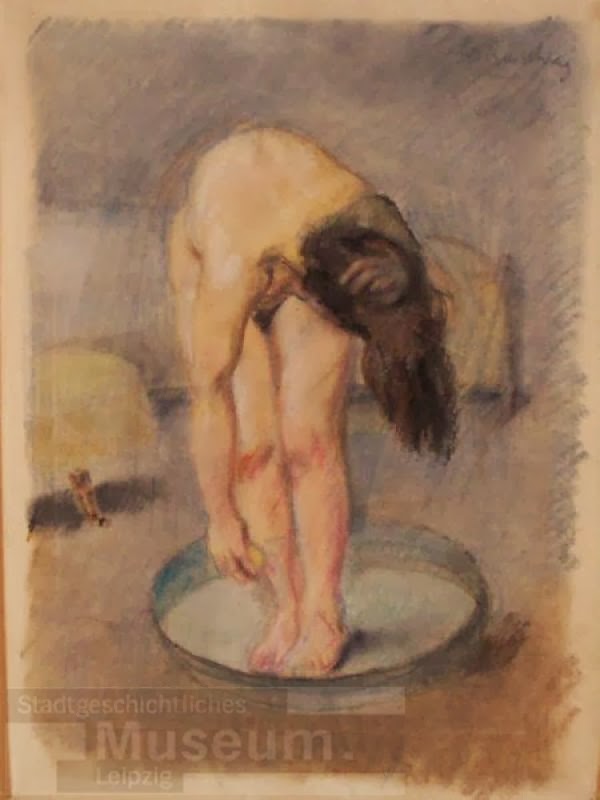
In London Eduard painted not only the Houses of Parliament but also Charles Dickens "Old Curiosity Shop" at Portsmouth Street. Many of Einschlag's works I found are collected in the local Leipzig Museum (Stadtgeschichtliches Museum).  
In Berlin, from 1901 onward, his teacher at the etching press was Karl Köpping  (1848-1915) the leading Rembrandt copyist and celebrated etcher. In 1912 Einschlag returned to Leipzig to settle and to marry Louise Victoria Croner (*1883)
This Rembrandt self portrait, attributed not to Rembrandt but to a "follower of"  is in the Leipzig Museum collections and Wilhelm von Bode, to whom this print was dedicated, at that time in 1915 was "Geheimrat". I think the honorary title,  is best translated as curator.
Of this Rembrandt copy (above), although I tried hard,  I failed to find its original. 

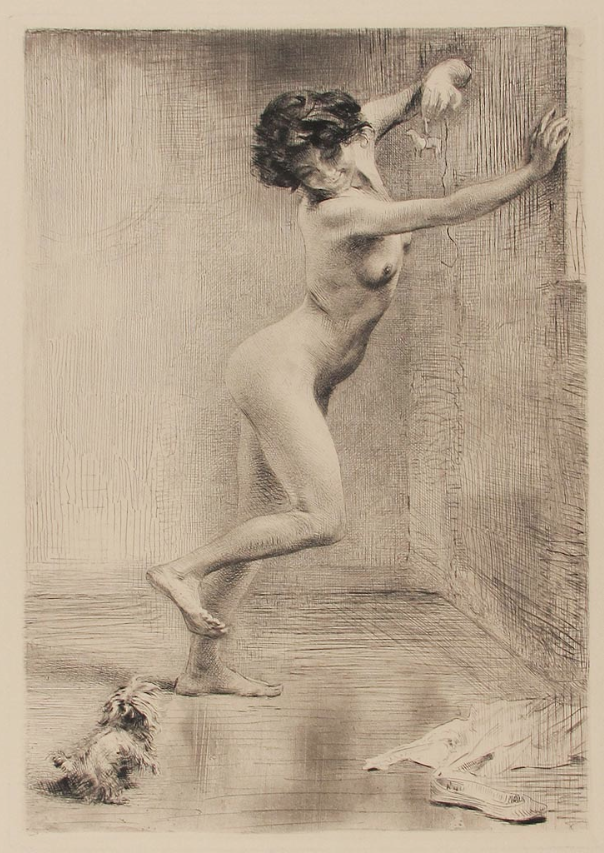
In 1910 he studied in Paris, where in the same year Pablo Picasso and George Braque revolutionized the Art World and from that time his admiration for Degas, the impressionist painter, also is eminent in this bathing girl. 
Einschlag was regarded the most celebrated artists of Leipzig in the 1920-30's and was intimately known and loved by the artistic and scolarly circles portraying many of its members in oil and etching.
He is regarded as an impressionist painter although he became mostly obscured and forgotten after the war, considered one of the best etchers of his time. 
And to my surprise he also tried at woodblock printmaking and recently I could not withstand buying this postings opening 1918 "woman at the window", an art-calender woodblock printed from the block, in the memory of this neglected artist. 

As a student of Karl Köpping his skills copying the old masters extended to the new masters also finding his etching of Degas' café scene that is now in the Musée Dorsay.
In Leipzig the Einschlags lived door to door in the same building to Rüdiger Berlit (1883-1939) a German expressionist painter and woodblock printmaker  and it was probably Berlit influencing and pursuading Einschlag to develop also in printmaking. And, can you believe it, I found this  photograph of the 1915  1915 Paper Fair in the Leipziger Peterstraße. Comparing it to the print he created you can see how good he'd become at it. Notice the banner of the The Lindstrom company.  

Much of Einschlags work was destroyed in and before the war when his art,  from 1933, was declared "entarted" or degenated. To be forbidden, publically ridiculed and destroyed by the same fanatics, insane and criminals that later killed 6 out of 7 (million !) Jews in occupied Europe.         
-----------------------------

Some examples of work by Eduard Einschlag's graphics teachers in Munich and Berlin 

Peter (von) Halm (1854-1923)


Karl Köpping  (1848-1915)


Rüdiger Berlit (1883-1939)  


All pictures are mouse-clickable to embiggen.  


All information was scratched from the www. and reassembled and reshaped to this posting to the best of my abilities without any economical or  commercial purpose. With that in mindte contents should be judged likewise (GC).